Essay 20: Olfactory avoidance

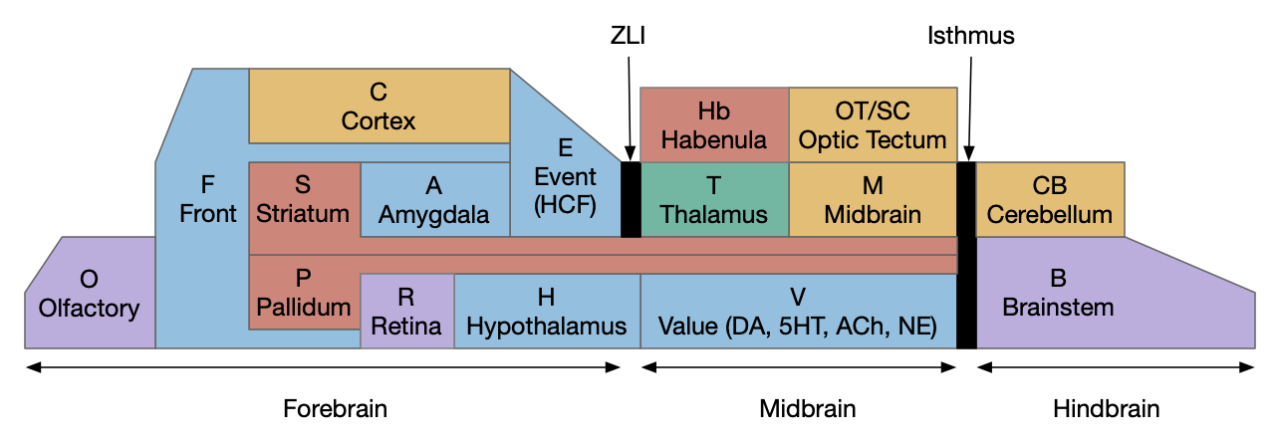
Although the essays have implemented obstacle avoidance, they haven’t yet explored olfactory avoidance. Olfactory avoidance is distinct from obstacles, not just because obstacles have higher priority, but because the olfactory system is from an entirely different nervous system than the sensorimotor system. In the chimaeral brain theory [Tosches and Arendt 2013], bilaterian brains are composed of an apical nervous system (ANS) focused on chemo senses (olfactory external and hypothalamic internal), and a blastoporal nervous system (BNS) focused on sensorimotor control like obstacle avoidance.

Olfactory path

The paths for olfactory motion compared with obstacle motion shows the value of the chimaeral theory in making sense of the brain. Working backward from the midbrain locomotive region (MLR), the acetylcholine (ACh) MLR nuclei specialize: the pedunculopontine nucleus (M.ppt) supports the sensorimotor BNS, and the laterodorsal tegmental nucleus (M.ldt) supports the chemosensory ANS.

Sensor-locomotion paths: olfactory on top and somatosensory on bottom. B.ll lateral line, B.rs reticulospinal motor command, B.ss somatosensory, Hb.m medial habenula, M.ldt laterodorsal tegmental nucleus, M.ppt pedunculopontine nucleus, Ob.m medial olfactory bulb, OT tectum, R.vis visual input, ,Vta ventral tegmental area.

In the above diagram, food odors and warning odors use distinct paths to the MLR. Food odors from the olfactory bulb (Ob) pass through the ventral tegmental area (Vta – posterior tuberculum in zebrafish) to the MLR [Derjean et al. 2010]. Aversive odors like cadaverine pass through the medial habenula (Hb.m) to the M.ldt portion of the MLR [Stephenson-Jones et al. 2012]. The food and avoidance paths are distinct because hunger and satiety from the hypothalamus modulate the food path, while the avoidance path can pass through unmodulated. These olfactory locomotion paths correspond to the ANS.

Lamprey medial habenula path

All vertebrates share this basic architecture, including the lamprey, one of the most evolutionary-distant vertebrates. [Stephenson-Jones et al. 2012] traced the Hb.m circuit, showing that Hb.m inputs are from the olfactory path, the parapineal (light attraction), and an electron-sensory alarm to the interpeduncular nucleus (M.ip).

Lamprey olfactory warning path through the habenula to the MLR. M.ip interpeduncular nucleus.

The above diagram fills out the olfactory warning path. The interpeduncular nucleus is a key node in the avoidance circuit, and also key to locomotor-induced theta, and one of the two serotonin nodes. Mip has a major output to the serotonin areas: dorsal raphe (V.dr) and medial raphe (V.mr) and to the central grey (M.pag) [Quina et al. 2017] and M.ldt as well as structures associated with hippocampal (E.hc) theta [Lima et al. 2017].

Medial habenula behavior

In larval zebrafish, Hb.m supports olfactory avoidance [Choi et al. 2017], [Jeong et al. 2021], and light seeking [Zhang et al. 2017]. At least one study indicates that it may also affect food seeking [Chen et al. 2019]. The non-Ob input to Hb.m — the posterior septum (P.ps) — produce locomotion when stimulated [Ostu et al. 2018], suggesting that later evolved functionality maintains the original basal function.

In zebrafish, M.ip only projects to serotonin areas (V.dr and V.mr), not to dopamine or MLR areas. The lamprey connectivity suggests that the M.ip to M.ldt connection was lost in fish.

The Hb.m to M.ip connection is affected by nicotine. An interesting property is that low stimulation and high stimulation have opposite effects. Low stimulation uses glutamate connections and is attractive while high stimulation adds ACh and is aversive [Krishnan et al. 2014].

Developmental genetic notes

As an interesting aside, both Hb.m and avoidant layers of OT shared a genetic marker Brn3a (aka pou4f1) [Quina et al. 2009], [Fedtsova et al. 2008]. That marker also appears in the cerebellum’s inferior olive, trigeminal sensory areas, and the amphioxus motor LPN3 neuron [Bozzo et al. 2023].

M.ldt and M.ppt are sibling areas, deriving from the r1 rhombic lip [Machold et al. 2011].

Glutamate and GABA neurons in M.ip, Vta, and M.ldt all derive from r1 basal neurons [Lahti et al. 2016].

Locomotion switchboard

The addition of olfactory avoidance further complicates the switchboard combining the various locomotor streams, especially if the olfactory path uses serotonin as a modulator as opposed to a straight glutamate connection. Although I’ll probably use a fixed priority for essay 20, and as [Cisek 2022] notes, avoidance can be combined additively, at some point the switchboard will need more control, especially when essays add vision and consummatory actions.

References

Bozzo M, Bellitto D, Amaroli A, Ferrando S, Schubert M, Candiani S. Retinoic Acid and POU Genes in Developing Amphioxus: A Focus on Neural Development. Cells. 2023 Feb 14

Chen W-Y, Peng X-L, Deng Q-S, Chen M-J, Du J-L, Zhang B-B. Role of Olfactorily Responsive Neurons in the Right Dorsal Habenula-Ventral Interpeduncular Nucleus Pathway in Food-Seeking Behaviors of Larval Zebrafish. Neuroscience. 2019

Choi JH, Duboue ER, Macurak M, Chanchu JM, Halpern ME. Specialized neurons in the right habenula mediate response to aversive olfactory cues. Elife. 2021 Dec 8

Cisek P. Evolution of behavioural control from chordates to primates. Philos Trans R Soc Lond B Biol Sci. 2022 Feb 14

Derjean D, Moussaddy A, Atallah E, St-Pierre M, Auclair F, Chang S, Ren X, Zielinski B, Dubuc R. A novel neural substrate for the transformation of olfactory inputs into motor output. PLoS Biol. 2010 Dec 21

Fedtsova N, Quina LA, Wang S, Turner EE. Regulation of the development of tectal neurons and their projections by transcription factors Brn3a and Pax7. Dev Biol. 2008 Apr 1

Jeong YM, Choi TI, Hwang KS, Lee JS, Gerlai R, Kim CH. Optogenetic Manipulation of Olfactory Responses in Transgenic Zebrafish: A Neurobiological and Behavioral Study. Int J Mol Sci. 2021 Jul 3

Krishnan S, Mathuru AS, Kibat C, Rahman M, Lupton CE, Stewart J, Claridge-Chang A, Yen SC, Jesuthasan S. The right dorsal habenula limits attraction to an odor in zebrafish. Current Biology. 2014

Lahti L, Haugas M, Tikker L, Airavaara M, Voutilainen MH, Anttila J, Kumar S, Inkinen C, Salminen M, Partanen J. Differentiation and molecular heterogeneity of inhibitory and excitatory neurons associated with midbrain dopaminergic nuclei. Development. 2016 Feb 1

Lima LB, Bueno D, Leite F, Souza S, Gonçalves L, Furigo IC, Donato J Jr, Metzger M. Afferent and efferent connections of the interpeduncular nucleus with special reference to circuits involving the habenula and raphe nuclei. J Comp Neurol. 2017 Jul 1

Machold R, Klein C, Fishell G. Genes expressed in Atoh1 neuronal lineages arising from the r1/isthmus rhombic lip. Gene Expr Patterns. 2011 Jun-Jul

Otsu Y, Lecca S, Pietrajtis K, Rousseau CV, Marcaggi P, Dugué GP, Mailhes-Hamon C, Mameli M, Diana MA. Functional Principles of Posterior Septal Inputs to the Medial Habenula. Cell Rep. 2018 Jan 16

Quina LA, Wang S, Ng L, Turner EE. Brn3a and Nurr1 mediate a gene regulatory pathway for habenula development. The Journal of Neuroscience: The Official Journal of the Society for Neuroscience. 2009

Stephenson-Jones M, Floros O, Robertson B, Grillner S. Evolutionary conservation of the habenular nuclei and their circuitry controlling the dopamine and 5-hydroxytryptophan (5-HT) systems. Proc Natl Acad Sci U S A. 2012 Jan 17

Tosches, Maria Antonietta, and Detlev Arendt. “The bilaterian forebrain: an evolutionary chimaera.” Current opinion in neurobiology 23.6 (2013): 1080-1089.

Zhang BB, Yao YY, Zhang HF, Kawakami K, Du JL. Left Habenula Mediates Light-Preference Behavior in Zebrafish via an Asymmetrical Visual Pathway. Neuron. 2017 Feb 22

18: Engineering issues with proto-striatum

The planned striatum model of essay 17 quickly runs into simulation problems because it’s missing priority selection between avoiding obstacles and seeking food. Obstacle avoidance needs a higher priority than seeking an odor plume, but a naive striatum doesn’t support that priority.

Broken striatum model where toward and away have no priority. Ob olfactory bulb, B.ss somatosensory touch, B.rs reticulospinal motor command.

This model fails because this striatum has no priority of away (avoid) actions from toward (approach) actions. An animal can’t simply follow an odor blindly, ignoring obstacles, but this model doesn’t support that priority.

Tectum

Adding the tectum seems like the right solution, although I was planning on putting it off until dealing with vision.

The tectum (optic tectum / superior colliculus) is better known for its vision support, but the deeper tectum layers are a general action-decision system. At its lower levels near periaqueductal gray (M.pag) it has a topographic direction-based map on its intermediate level and an action-based map in the deep level.

The tectum and M.pag are neighbors, almost layers of each other, and in animals like the frog, the M.pag is as a deeper layer of the tectum.

Relation between M.pag and OT in mammals (left) and frog (right), where the ventricle shape determines the anatomical label for homologous areas.

The tectum is an action organizer, not just a vision organizer. For the simulation, the action matters since the simulated animal doesn’t have vision.

Amphioxus, a non-vertebrate chordate that’s a model into pre-vertebrate evolution, has a few motor-related cells with the same genetic markers as the tectum [Pergner et al. 2020]. It’s conceivable that the amphioxus tectum is more action focused, since the amphioxus frontal eye is only a dozen photoreceptors with no lens.

Action categories

The tectum has split circuits for turning and for approach and avoid [Wheatcroft et al. 2022]. The simulation can use something like the following circuit.

Split tectum and striatum circuit. B.rs reticulospinal motor command, B.ss somatosensory input, M.lr midbrain locomotor region, M.pag periaqueductal gray, Ob olfactory bulb, S.d dorsal striatum, S.ot olfactory tubercle.

Approach (toward) senses like food odors excited toward actions, and avoidant (away) sense like touch excite away actions. Because the priority areas are split, each striatum can choose between non-priority options (left vs right). The priority resolves only later in the midbrain locomotor region, using context input to decide which major direction to use. In this split model, the simplified striatum circuit can work because all of striatum options are equal priority.

As a note on accuracy, the diagram misrepresents the actual olfactory path, specifically the real olfactory tubercle. In reality, olfaction has a distant, complicated path to the tectum.

Short-cut escape signal

The previous diagram is also misleading because it’s too organized, as if each function has a dedicated, planned circuit. Although the tectum itself is highly-organized, the downstream and modulating circuits are more ad hoc. For example, the zebrafish has an escape mechanism that short-cuts the tectum and drives the B.rs command motor directly [Zwaka et al. 2022].

fast escape shortcut of tectal locomotion circuit.
Fast escape shortcut of tectum-mediated locomotion.

In the above diagram, the escape circuit short-circuits any decisions of the tectum and striatum. Relatedly, the “switch” area in M.lr isn’t as tidy as the diagram suggests. It’s more like that M.lr contains multiple actions which laterally inhibit each other in a priority scheme, modulated by M.pag.

As an additional correct, many of the modulators like M.pag affect the tectum directly, instead of the diagram’s dedicated priority-resolution function.

References

Pergner J, Vavrova A, Kozmikova I, Kozmik Z. Molecular Fingerprint of Amphioxus Frontal Eye Illuminates the Evolution of Homologous Cell Types in the Chordate Retina. Front Cell Dev Biol. 2020 Aug 4

Wheatcroft T, Saleem AB, Solomon SG. Functional Organisation of the Mouse Superior Colliculus. Front Neural Circuits. 2022 Apr 29

Zwaka H, McGinnis OJ, Pflitsch P, Prabha S, Mansinghka V, Engert F, Bolton AD. Visual object detection biases escape trajectories following acoustic startle in larval zebrafish. Curr Biol. 2022 Dec 5

Essay 15: Odor Navigation

Since essay 15 is exploring the fruit fly mushroom body, which is olfactory-focused, the simulated animal needs odor-based behavior, following attractive odors toward food. The simulation assumes an odor gradient navigation system without implementing the details. Basically, it will cheat and assume a direction vector toward the odor, because the details don’t seem to matter for the mushroom body.

In reality, the animal should use a timed gradient calculation with a single sensor (klinotaxis) or a directional navigation with multiple lateral sensors (tropotaxis). Simple animals use either navigation technique, and even bacteria can use klinotaxis with a run-and-tumble strategy.

Odor plumes in water

The gradient itself is a big oversimplification for a marine slug as used in essay 15, because odors in water don’t have a simple gradient but clump instead. [Steele et al. 2023]. Since the odor plumes, clumps and filaments drive on the waters current, following the current upstream is a more effective than computing gradients.

To following a clumped odor plume in a water current, animals move upstream, against the flow toward the source. The navigation is based on the current flow mechanosensors, not an odor gradient. The odor sensing merely enables current following, which is an interesting circuit between chemosensory and mechanosensory circuits. Odor detection provides timing and go/no-go while the mechanosensory circuit navigates, somewhat like the “what” vs “where” split in the visual cortex.

In the diagram above, the odor control of the contra-flow navigation is inhibitory, a common pattern in vertebrate brain. For example, the striatum complex (basal ganglia) tonically inhibits its output, including midbrain locomotion or optic tectum. When an action is selected, the striatum disinhibits the midbrain command neurons. Despite the complication of disinhibition – double inhibition – the system improves signal noise.

When an inhibitory neuron disables a command, the added noise doesn’t matter because the behavior is disabled, and the extra control signal noise doesn’t harm the command. When the inhibitory control is taken away, the system has clean, undisturbed sensory data. As a contrast, in an excitatory system where the odor sensor positively excited the command, the odor control signal would add noise to the mechanical sensors, reducing precision. So, despite the extra complication of a double-negative inhibitory system, it’s behaviorally superior.

Essay 15 relevance

Although this odor navigation probably won’t be part of the essay 15 simulation, I think it’s important to describe what’s left out when simplifying a model. If the simulation becomes too simplified, it can lose the essence of the behavior. The simplification is necessary to keep the model uncluttered and focused, but the dividing line is a judgement call.

References

Steele TJ, Lanz AJ, Nagel KI. “Olfactory navigation in arthropods.” J Comp Physiol A Neuroethol Sens Neural Behav Physiol. 2023 Jul;209(4):467-488. doi: 10.1007/s00359-022-01611-9. Epub 2023 Jan 20. PMID: 36658447; PMCID: PMC10354148.

Essay 14: Obstacles and Food

Essay 14 simulates a dual-control slug that avoids obstacles and halts for food. The slug’s obstacle avoidance uses a Braitenberg vehicle circuit [Braitenberg 1986], and food halting uses primitive zooplankton behavior [Smith 2015]. The animal is called a slug because its base motion is a mucociliary sole, which moves without needing neural control. When the slug’s right sensor detects a wall, the left muscle contracts, turning it to the left. When the slug’s left sensor detects a wall, the right muscle contracts, turning it to the right. When the slug detects food, it halts briefly. The two control systems are entirely separate.

Food halting circuit

The animal pauses when it’s over food, similar to zooplankton behavior over algae or a Precambrian animal over a bacterial mat. Food-halting takes advantage of a refractory period to move slowly instead of halting entirely. A refractory period is a short time after a neuron of cell activates when it can’t fire or act until the period ends, a simple chemical timer.

The basic movement is motivated, meaning the animal moves without needing external motivation. It moves by default and only halts when it detects food. Note, the animal doesn’t move toward food; it only halts when it randomly is above food. The behavior is consuming not approaching.

Slug halting over food.

Because the food circuit leans on the refractory pause, its logic is trivial. Internal chemical timers of the cells provide a more sophisticated behavior than the circuit achieves on its own.

fn food_arrest_update(mut body: ResMut<Body>) {
    if body.is_sensor_food() {
        body.arrest(1.);
    }
}

Obstacle avoidance

The slug avoids obstacles by turning to the opposite side of the sensor. This navigation does not affect the basic locomotion from mucociliary sole. Instead it turns the entire body to modify locomotion without needing neural interaction.

Turning from an obstacle

Because both sensors activate when the slug hits an obstacle directly, the system needs to choose one direction. A simple choice prefers one direction for any conflict. In the vertebrates, some areas are asymmetric, such as the habenula. In the lamprey, the habenula is strongly asymmetrical, one side much larger and more sophisticated than the other. The habenula is associated with both motivation values and some navigation for escape, and it’s a primitive area in the midbrain that doesn’t rely on sophisticated cortical learning.

The essay’s code prefers the left sensor to the right one when there’s a conflict.

fn touch_muscle_update(mut body: ResMut<Body>) {
    if body.is_sensor_left() {
        body.set_muscle_right(1.);
    } else if body.is_sensor_right() {
        body.set_muscle_left(1.);
    }
}

Model meta discussion

With such a simple model, I think it’s important to ask what value the model provides. The code and logic itself is trivial. I think the model’s value is in focus, like a diagram for a model, showing what’s strictly necessary and exposing conflicts like the dual sensor when hitting a wall straight on.

The dual control system is a key concept. The [Arendt 2015] paper treats chemosensors and mechanosensors as fundamentally distinct cellular systems. The essay’s food halting system corresponds to the chemosensory cell types, and its obstacle avoidance system corresponds to the mechanosensory and muscle cells types of the skin.

References

Arendt D, Benito-Gutierrez E, Brunet T, Marlow H. Gastric pouches and the mucociliary sole: setting the stage for nervous system evolution. Philos Trans R Soc Lond B Biol Sci. 2015 Dec 19;370(1684):20150286. doi: 10.1098/rstb.2015.0286. PMID: 26554050; PMCID: PMC4650134.

Braitenberg, V. (1984). Vehicles: Experiments in synthetic psychology. Cambridge, MA: MIT Press. “Vehicles – the MIT Press”

Brooks, R.A. (1991), ‘Intelligence without Representation’, Artificial Intelligence 47, pp. 139-159.

Smith CL, Pivovarova N, Reese TS. Coordinated Feeding Behavior in Trichoplax, an Animal without Synapses. PLoS One. 2015 Sep 2;10(9):e0136098. doi: 10.1371/journal.pone.0136098. PMID: 26333190; PMCID: PMC4558020.

Braitenberg Slug

I’m considering exploring Braitenberg’s vehicles [Braitenberg 1984] for essay 14 in combination with the ideas from the archaoslug. The vehicles are a simple almost trivial design with surprisingly useful behavior. Each vehicle has a combination of sensor-motor pairs, taking advantage of the physical layout for the motor and sensor behavior.

Here, the sensors detect light and directly drive the motor wheels. Vehicles with crossed signals approach the light, while vehicles with uncrossed signals avoid the light. Braitenberg also explores negative signals where the signals inhibit the motors, and additional signal-motor pairs for different senses. The value of the Braitenberg vehicles is showing how simple control circuits can form the basics of behavior.

Optic tectum as an example

The optic tectum uses this dual-circuit architecture for approach and escape [Isa 2021]. The optic tectum is a midbrain optical and motor area responsible for much of vision in non-mammalian vertebrates and an understudied component of mammalian vision. In the OT, escape signals connect to ipsilateral (same side) motor neurons, and approach signals connect to a different set of motor neurons but crossing sides.

In the diagram, B.rs are reticulospinal motor neurons in the brainstem. OT.d.m is the medial optic tectum in the deep layers, and OT.d.l is the corresponding lateral. The OT shallow layers process optical information, and the deep layers drive motor actions. Stimulating the medial OT makes the animal escape and stimulating the lateral OT encourages approach. As a mnemonic, since approaching needs to aim at the target, its sensors need to be spread out (lateral), but escaping needs less precision and can rely on closer or merged (medial) sensors.

Because the Braitenberg architecture is so simple, I think it’s reasonable to imaging that primitive animals would quickly develop a similar pair of crossed and uncrossed systems as soon as neurons with specific connectivity were available, after the initial broadcast repeater nerved nets like in sea anemones (cnidaria). The dual systems mirrors the dual chemosensory and mechanosensory cell families in the archaoslug, which might have also encouraged split control.

Essay 14 pre-design

As a bilateral enhancement to the amoeboid archaoslug, I’m thinking of trying a ciliomotor slug with primitive obstacle avoidance but without any directed approach. Avoidance is a smaller evolutionary step because it can reuse the mechanosensory and nerve nets of the archaoslug, only adding a single crossed-pair of long-range neurons. After hitting an obstacle, muscle contractions turn the animal away from the obstacle.

The mucociliary sole remains the main locomotion and food detection. The slug still searches for food by grazing randomly on algae or bacterial mats, relying on browning motion to find food. There’s no tracking or approach system.

As mentioned above, the control systems for grazing locomotion and for obstacle avoidance are independent. Cilia locomotion is automatic with no neural control until the slug detects that it’s above food, when it stops. The locomotion direction is semi-random.

If the slug hits a wall, it contracts the side opposite the touch. This circuit is flipped from the Braitenberg vehicle, which has uncrossed signals for avoidance. The touch sensor activates the contralateral nerve net to contract the side muscle, and the slug turns toward the contracted side, away from the obstacle.

On motivation

Even in this trivial example, I think it’s useful to consider motivation in contrast with stimulus/response behavior. Since the basis of the word motivation is “to move,” it’s reasonable to use motivation as meaning moving force. So, motivation is a source of action without needing external stimulus. In the Braitenberg slug, the motivation is in the mucociliary sole itself, because it moves without external stimulus. If so, the motivation isn’t even neural; it’s just started by evolution.

The distinction of motivated vs non-motivated action is important in understanding the system. Knowing the sources of intrinsic motivation allows for tracing action from the source to its final result. As a design principle, adding self-motivation is more stable, because the animal is less likely to get stuck waiting for external stimuli to get started.

References

Braitenberg, V. (1984). Vehicles: Experiments in synthetic psychology. Cambridge, MA: MIT Press. “Vehicles – the MIT Press”

Isa, Tadashi, et al. “The tectum/superior colliculus as the vertebrate solution for spatial sensory integration and action.” Current Biology 31.11 (2021): R741-R762. https://doi.org/10.1016/j.cub.2021.04.001

Archaoslug

[Arendt 2015] examines the fundamental divisions of the nervous system by looking at ancestral cell divisions in some of the earliest animals, specifically a multicellular amoeboid bottom-feeder that glides on a mucus foot like a slug. The archaoslug moves like an amoeba instead of a true slug because it’s body isn’t symmetrical bilateral: there’s no front or side. The Adrent study is interesting for the essays because it fundamentally splits chemosensory control (hypothalamic and olfactory) split from mechanosensory / optosensory sense and muscle brain at the cell type and developmental level.

In this proto-slug, cells have specialized into three major classes:

  • External skin with mechanosensory and optosensory cells
  • Internal digestive gut
  • Mucociliary sole with chemosensory and locomotion cells

The mucociliary sole moves with cilia gliding over mucus. Chemical sensors that detect food choose when to stop. A similar locomotive strategy is described in [Smith 2015] and [Senatore 2017] for the existing algae-grazing, disc-shaped animal Trichoplax, which lacks any nerves at all and only has six cells in total [Smith 2014].

Locomotion and food searching for the archaoslug is simple: stop when the chemosensors detects food (algae), and move in a random brownian direction when no food is available. A simple chemical sensor and a peptide-based broadcast system would suffice, as in Trichoplax. Because the bacterial mats may have dominated the Precambrian environment, the brownian motion pausing for food could work.

The ventral skin specialized into mechanosensory cells, optosensory cells, and contractile cells which developed into the first neurons and muscles. The animal can avoid obstacles and threats using nerve nets that broadcast and repeat signals, like the repeating nerve nets in cnidaria (jellyfish, sea anemone, and corals) [Seipel 2005]. Note, though, the control circuits for between locomotion (mucociliary sole) and muscles (skin/body contractions) are distinct, and don’t even coordinate. A sea anemone or a slug will contract when touched, but the sea anemone has no locomotion and the slug’s contraction isn’t its primary locomotion. Similarly, an archeoslug with primitive muscles might only use the muscles to avoid obstacles, contracting when it runs into something, but its primary motion remains the ciliary, non-muscular sole. Meaning, the locomotive drive (arrest, approach, avoid) is controlled independently from navigation (spatial obstacle avoidance.)

This division into three types influences all later cell development, because the initial decisions shape the later evolved cell types. Genetic signaling to choose between the three might have created a path dependent split between three types.

Discussion

This split between chemosensory sole and mechano- and opto-sensory skin and muscle obviously mirrors the vertebrate split between the limbic system (olfactory and hypothalamic) and optic tectum system, but with a different spin. The limbic system is generally described as a motivational and emotional center. The root word for both motivation and emotion is the Latin movere, to move, which has less baggage than either word. The mucociliary sole area does move and control movement, but it’s hardly an emotional center. But the mucociliary sole area isn’t unique in its control of motion, because the unrelated skin/muscle area controls navigation.

Treating the mind as independent, conflicting centers resembles Dawkins’ descriptions of genes in The Selfish Gene, where each gene works independently and in competition with others, and coordination only occurs for mutual benefit. The general idea of competing mental centers is also in Minsky’s Society of mind, and the idea is older than either. So, the value of the archaeoslug isn’t the general idea of a divided mind, but the specific division that occurred in evolution.

References

Arendt D, Benito-Gutierrez E, Brunet T, Marlow H. Gastric pouches and the mucociliary sole: setting the stage for nervous system evolution. Philos Trans R Soc Lond B Biol Sci. 2015 Dec 19;370(1684):20150286. doi: 10.1098/rstb.2015.0286. PMID: 26554050; PMCID: PMC4650134.

Dawkins, Richard. The Selfish Gene. Oxford University Press, 2006.

Minsky, Marvin. Society of mind. Simon and Schuster, 1988.

Senatore A, Reese TS, Smith CL. Neuropeptidergic integration of behavior in Trichoplax adhaerens, an animal without synapses. J Exp Biol. 2017 Sep 15;220(Pt 18):3381-3390. doi: 10.1242/jeb.162396. PMID: 28931721; PMCID: PMC5612019

Smith CL, Pivovarova N, Reese TS. Coordinated Feeding Behavior in Trichoplax, an Animal without Synapses. PLoS One. 2015 Sep 2;10(9):e0136098. doi: 10.1371/journal.pone.0136098. PMID: 26333190; PMCID: PMC4558020.

Smith CL, Varoqueaux F, Kittelmann M, Azzam RN, Cooper B, Winters CA, Eitel M, Fasshauer D, Reese TS. Novel cell types, neurosecretory cells, and body plan of the early-diverging metazoan Trichoplax adhaerens. Curr Biol. 2014 Jul 21;24(14):1565-1572. doi: 10.1016/j.cub.2014.05.046. Epub 2014 Jun 19. PMID: 24954051; PMCID: PMC4128346.