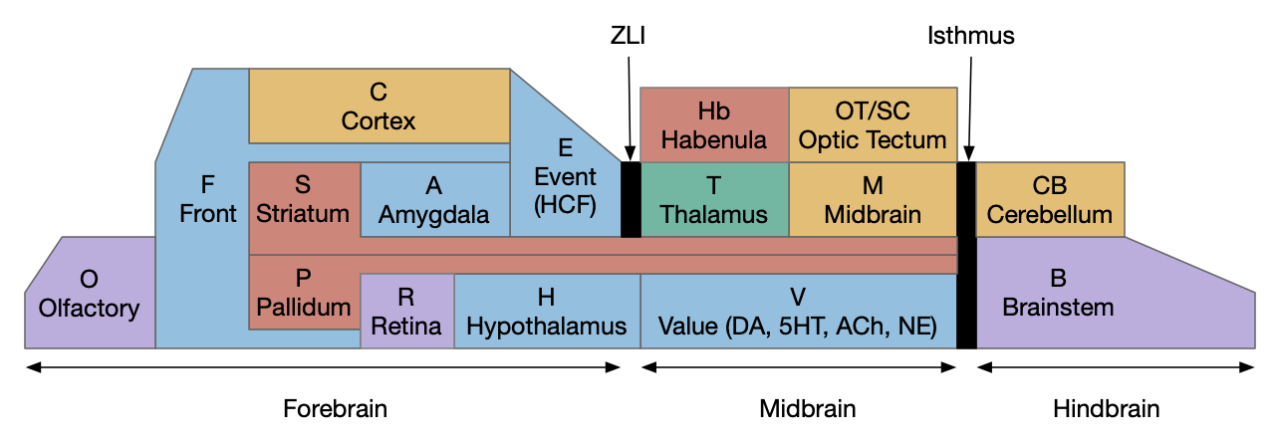
The mosaic of broken mirrors is an analogy for the striatum in the basal ganglia [Da Cunha et al 2009]. The striatum represents a vertebrate’s actions and environment in a broken and overlapping fashion. While actions have focal projections to the striatum, the contextual input is broad and diffuse [Fee MS 2012]. While the hippocampus represents the environment globally, the striatum depends on piecewise representation. This means striatal learning is unable to generalize, because mosaic fragments lack a global perspective [Da Cunha et al 2009].
In the essays I’ve used the striatum as a timeout for food seek from an odor plume. When a food odor doesn’t have any food, or the odor is behind a barrier, the animal needs some sort of timeout to give up seeking the odor, turn away from the false odor, and search else where. However, the current simulation only uses the seek action for the timeout; it lacks environment context.
Simulation screenshot showing the model animal trapped into perseverating seek in the center of a false odor plume. Circles represent odor plumes and the star represents food.
The above simulation screenshot shows the general problem. The circles represent food odor plumes and the star represents food. The animal has followed a false odor plume and will continue circling the center until the striatum timeout. However, there is a nearby valid odor plume with food in it. The animal should avoid the false odor plume and search the correct odor plume, but currently it can’t distinguish the two, because it’s only using its own seek action as a key. If the animal could detect environmental context differences between the two plumes, it could search more effectively.
As a context, odor neighborhoods [Jacobs 2022], [Marin et al 2021] can represent a primitive representation of place. If each place has a different set of odor molecules, the animal can use that odor scene to distinguish false odor plumes from true food odor sources.
Striatum as timeout
In the essays I’ve used the striatum as a timeout mechanism to prevent perseveration, specifically the S.d2 (striatum projection neurons with D2.i Gi inhibiting dopamine receptor), which use A2a.s (adenosine Gs stimulating receptor) to measure the buildup of Ado (adenosine). The striatum’s projection neurons are roughly evenly divided between S.d1 (D1.s Gs stimulating dopamine receptor) and S.d2. For long stimulations, S.d1 generally motivate the current action and S.d2 opposes the action and produces avoidance [Soares-Cunha et al 2020], but for short stimulations both are active for action initiation [Cui G et al 2013].
Ado signaling limits swimming in frog tadpoles [Dale 1998]. In the striatum A2a.s receptors in S.d2 projection neurons also detect Ado buildup from neuron activity and from astrocytes that monitor neuron activity [Kang S et al 2020]. The Ado buildup activates S.d2 neurons and increases its internal PKA (protein kinase A) [Ma L et al 2022]. PKG slowly builds up during activity with a buildup time constant on the order of 10-20s and a decay constant on the order of 70s [Ma L et al 2022], but the increase appears to be log or sigmoid-like, not linear, suggesting that longer timeouts would be possible with high thresholds or opposition from S.d1. In S.d2, the PKA buildup enables the release of the opioid enkephalin [Konradi et al 2003], [Hook et al 2008], which activates the DOR.i (δ-opioid inhibitory receptor), which is necessary for the inhibitory/avoidance behavior for S.d2 [Soares-Cunha et al 2020].
Because the essay simulation needs a timeout to limit food seek perseveration, and the Ado and S.d2 avoidance chain could plausibly implement that timeout, I’ve been using it as the basis for the simulation’s timeout. This function seems evolutionarily plausible, because avoiding perseveration is important to keep the animal from unproductive seeking, and the implementation is fairly straightforward, only requiring already existing Ado timeout sensing and S.d2, without needing the entire basal ganglia. However, up to this point, that timeout has only used the action as a key, and has not included any context. Essay 15 and 16 did cover odor seek timeout in the context of associative habituation, but on the context of the fruit fly mushroom body.
Action and context as striatum inputs
S.pn (striatum projection neurons: both S.d1 and S.d2) are often called medium spiny neurons because their extensive dendrites are covered with spines. Spines are small dendrite compartments that receive axon inputs. Spines can compartmentalize Ca2+ (calcium) transients [Fang LZ and Creed 2024], meaning S.pn activation is not necessarily global across the entire dendrite tree, but compartmentalized. In S.d (dorsal striatum), cortical axons attach to S.pn spines, while T.pf (parafascicular thalamus) connects to the dendrite shaft [Fee MS 2012]. T.pf signals include ongoing action feedback and efference copies from the hindbrain and midbrain, including OT (optic tectum), while the cortex provides environmental context.
Rough diagram of inputs to S.pn dendrites. Cortical input is to distal dendrites and spines, while T.pf is more proximal and to dendrite shaft. C (cortex), S.pn (striatum projection neuron), T.pf (parafascicular thalamus).
Songbirds have a portion of the basal ganglia devoted to singing called Area X [Kornfeld et al 2020]. Area X receives song action variability information from C.lman (lateral nucleus of anterior nidopallum) and timing context from C.hvc, which are areas of the songbird cortex. C.lman provides an action efference copy of the variation actions [Fee MS 2014]. The majority (85%) of C.hvc input is on S.pn spines, while 55% of the C.lman action information is on the dendrite shafts [Kornfeld et al 2020]. The action efferent copy input to S.pn are not plastic, while the contextual input on the shafts is plastic [Fee MS 2012]. The context drives S.pn activation to an Up state, gating the core action driver [Fee MS 2012]. Action input to the striatum is focuses, while contextual information is diffuse [Fee MS 2012].
S.pn inputs can differ in their attachment to spines or dendrite shafts, and they can also differ in triggering behavior and for Up states. S.pn are normally hyper polarized, meaning they are normally especially difficult to trigger. Some inputs can shift S.pn into an Up state, where they are more easily triggered. In S.v (ventral striatum), inputs from E.sub.v (ventral subiculum in the hippocampal complex) can shift S.pn into an Up state for hundreds of millisecond [O’Donnell and Grace 1995], [Sesack and Grace 2010]. When E.sub.v is disable, S.v spontaneous or bistable activity halts, and other inputs such as F.pfc (prefrontal cortex) can’t trigger action potentials [O’Donnell and Grace 1995]. Up state transitions can be facilitated by dopamine [Fang LZ and Creed 2024], [Lahiri and Bevan 2020] and astrocyte sensing of glutamate activity [D’Ascenzo et al 2007], [Yu X et al 2018].
For the purposes of the essay simulation, these differences in striatum input suggest it’s plausible to treat action input and contextual input as distinct types of input, following [Fee MS 2012]. Specifically, that the combination of an action input and a context is required to drive the striatum timeout. This means that a seek timeout can be specific to a context and not overflow to other contexts.
Innate and contextual odors
In vertebrates, O.sn (odor sensory neurons) axons project to O.gl (glomerules) in Ob (olfactory bulb), where they connect with O.pn (odor projection neuron: mitral and tufted cells in mammals) dendrites. Each O.gl is a large neuropil (axon and dendrite connection area) where multiple O.sn and O.pn combine. In mammals, each O.gn responds to a single O.sn odor feature. Each O.gl typically responds to several odor molecules, and each odor molecule drives multiple O.gl [Wilson and Mainen 2006], [Weiss 2020]. In other vertebrates, each O.gl can combine inputs from multiple O.sn. Insect odor processing also uses glomerules, but this shared structure is independent evolution not homology because even the underlying odor detection receptors are unrelated between insects and vertebrates [Weiss 2020]. The glomeruli structure is likely simply an effective way of connecting multiple O.sn to O.pn.
As an analogy that the simulation uses, consider phonemes in a syllable, where each syllable is like an odor molecule and each phoneme is like a glomeruli. The syllable “cat” consists of “c-“, “-a-“, and “-t”, corresponding to three glomerules, and “c-” is driven by many different syllables. So, O.gl doesn’t identify the whole odor, but only a feature of the odor, like “c-“, but the features can be recombined to identify the odor.
The odor glomerules in vertebrates are divided into a smaller innate group and a larger contextual group. Most mammals have distinct Ob and O.a (accessory olfactory bulb). The lamprey Ob.m (medial Ob) projects directly to the midbrain, including Hb.m (medial habenula) and V.pt (posterior tuberculum) [Derjean et al 2010], [Beauséjour et al 2022], while the Ob.l (lateral Ob) projects to Pa (pallium/cortex) and basal ganglia [Beauséjour et al 2022], [Beauséjour et al 2024], [Suryanarayana et al 2021].
Previous essays have only used the innate Ob.m projection and ignored the Ob.l projection. This essays adds the Ob.l context projection to S.o t(olfactory tubercle), which is a part of S.v (ventral striatum) with large, direct olfactory input, and output to H.l (lateral hypothalamus) and Pv (ventral pallidum). The Ob.l context may represent odor neighborhoods, introducing a notion of place.
Odor neighborhoods
Odors rarely occur in isolation, are dynamic in space and time [Marin et al 2021], and form spatial neighborhoods [Jacobs 2022]. Olfactory curs influence E.hc (hippocampus) place fields, and place cells in blind rats are similar to sighted rats [Marin et al 2021]. In O.pir.p (posterior piriform cortex/olfactory cortex), place can be decoded to 90% accuracy with 240 neurons [Poo C et al 2022]. The olfactory spatial hypothesis considers odor are more for navigation than for identification [Jacobs 2012], where an odor neighborhood is a local area of odor mixtures.
It seems plausible that an early proto-vertebrate could use a combination of odor features from O.gl in an early S.v to restrict a seek timeout to a local place. The circuit is a straightforward extension of existing Ado timeout circuitry.
Seek striatum
For the essay’s simulation, I’m using odor context from Ob.l as a neighborhood detector. The striatum has two inputs: an action that enables the striatum during a seek and a place context identified by odor to restrict the search.
Screenshot of the seek task blocked by a U-shaped barrier with odor neighborhoods represented by color and pattern. The local odor “rat” is represented by odor glomerules for “r-“, “-a-“, and “-t”.
The above screenshot shows the animal after its timeout from a failed odor seek when blocked by a barrier. The star represents food and the circle is an odor plume. Each pattern in the arena represents an odor neighborhood. The right side of the screenshot shows the active glomerules for the neighborhood, represented by “r-“, “-a-” and “-t”. I’m using syllables to represent odor molecules and phonemes to represent odor features detected by Ob glomerules.
Fruit fly mushroom body and Kenyon cells
Because the hypothetical proto-vertebrate would have a much simpler striatum than the mammal striatum, consider the comparison with the fruit fly MB (mushroom body) and its KC (Kenyon cells), which has a similar structure to the Sv projections to Pv, but has a much smaller scale. The mushroom body is highly conserved among insects and possibly predates all arthropods [Fiala and Kaun 2024], and serves as an odor pattern detector. In fruit flies, 52 O.pn project to ~2000 KC [Chan ICW et al 2024], which project to 24 MBON (mushroom body output neurons) [Seki et al 2017]. Each KC has three to seven claws [Zheng et al 2022], which are essentially single-connection dendrites.
Architecture of the Drosophila mushroom body, adapted from [Aso Y et al 2014]. For this essay, only the left side projections of PN to KC are important. KC (Kenyon cell), PN (olfactory projection neuron), OSN (olfactory sensory neuron)
The above diagram shows the fruit fly mushroom body, but only the KC on the left are relevant for this essay. The MBON on the right would correspond to Pv (ventral pallidum) in this analogy. Each of the 2000 KC receive essentially random olfactory input from the O.pn, where each KC receives 3-7 O.pn inputs.
This mushroom body structure roughly corresponds to vertebrate O.pn projections to S.ot (ventral striatum olfactory tubercle), which projects to Pv. Although the connectivity pattern is similar, the two structures are not homologous in any fashion. Insect O.sn and vertebrate O.sn use entirely separate olfactory receptor families, and KCs use ACh (acetylcholine) as a neurotransmitter, while S.pn use GABA and vertebrate-specific opioids. The point of the analogy here is only to compare the scale of the O.gl and S.ot for a possible proto-vertebrate because the mammal S.ot is vastly too large to be plausible for that ancestor.
The MB has been compared to vertebrate CB-like (cerebellum-like) structures in the hindbrain [Farris 2011], suggesting that both serve as adaptive sensory filters. CB-like structures have dual inputs: one is sensory-specific input and the other is multimodal contextual. The MB also serves as a brake on insect locomotion, because fruit flies with MB lesions are less likely to stop locomotion once begun moving. This locomotion stopping is similar to the seek perseveration timeout in this essay.
Analogy between the insect mushroom body and the vertebrate ventral basal ganglia. KC (Kenyon cells), MBON (mushroom body output neuron), O.pn (olfactory projection neuron), O.sn (olfactory sensory neuron), Pv (ventral pallidum), S.pn (striatum projection neuron)
For scale, consider using the lamprey Ob during the syllable analogy. The lamprey has approximately 40 olfactory receptor genes [Beauséjour et al 2020]. If we exclude about 10 innate from Ob.m, the 30 are contextual odors in Ob.l Consider splitting each odor as a syllable into three odor features as pheromones. If the 30 lamprey O.gl were organized like phonemes, then it might have 10 initial consonants, 10 vowels, and 10 final consonants. Suppose each S.pn receives three inputs from O.pn: one of 10 initial consonants, one of 10 vowels, and one of 10 final consonant. The 1000 S.pn would cover the possible syllables, expanding the dimensionality from 30 odor phonemes to 1000 odor syllables. Analogously, the Drosophila 52 O.pn phonemes expand to ~2000 KC syllables, roughly the same order of magnitude. Of course, the olfactory neighborhoods aren’t actually nicely ordered into convenient human-readable syllables, but it’s a convenience analogy, particularly for the simulation.
Returning to the original metaphor of the mosaic of broken mirrors [Da Cunha et al 2009], the O.pn breaks odor molecules (syllables and unbroken mirror) into a broken set of odor features (phonemes and mosaic tessera), and randomly reassembles the features in S.pn like tessera in a mosaic, partially recovering the original syllable structure, albeit lossy. Because the features are broken pieces stripped from their original odor molecule identity, the system could add other modalities, such as lateral line or whisker sensing, or temperature, or color fragments, before combining them, Although the fruit fly KCs primarily combine odor inputs, they also include a smaller number of non-odor inputs such as visual, gustatory, mechanosensory, and proprioceptive inputs [Farris 2011].
S.core seek and S.msh roam
So far I’ve used the striatum as a timeout to avoid seek perseveration, giving up on a failed food odor. Adding an odor neighborhood context improves the accuracy of seek perseveration control. Now that odor neighborhoods are available, the animal could also avoid neighborhoods that it’s already searched, essentially creating a memory breadcrumb, as explored in essay 44.
Rough topographic divisions of the striatum. The blue S.msh.d is used for roam, and the amber S.core and S.lsh are used for seek. S.core (Sv core), S.dl (dorsolateral striatum), S.dm (dorsomedial striatum), S.lot (lateral S.ot – olfactory tubercle of Sv), S.lsh (lateral shell of Sv), S.mot (medial S.ot), S.msh.d (medial shell of Sv, dorsal part), S.msh.v (medial shell of Sv, ventral part), Sv (ventral striatum aka nucleus accumbens)
Sv (ventral striatum) is divided into S.core (Sv core) and S.sh (S shell), where S.core surrounds the anterior commissure, which connects Ob and amygdala. The shell further divides into S.msh (medial shell) and S.lsh (lateral shell), with S.ot also dividing into S.mot (medial S.ot) and S.lot (lateral S.lot). S.msh itself divides into S.msh.d (dorsal S.msh) and S.msh.v (ventral S.msh). These regions have distinct genetic transcription factor types and connectivity, and S.msh may be even more complicated with further genetically defined subtypes [Chen R et al 2021].
Functionally, S.lsh and S.core are more similar, related to cues and seek [Floresco 2015], [Chen G et al 2023], [Ding YD et al 2022], [Dobrovitsky 2017], while S.msh is distinct and related to place [Al-Hasani et al 2015], [Humphries and Prescott 2010], but not cues [Domingues et al 2025]. S.sh is important for place habituation: avoiding places already visited [Floresco 2015]. S.core is more associated with seek actions, and S.msh associated with place preference and avoidance [Fisher et al 2025]. S.ot is less studied, but is strongly Ob and O.pir related. Assigning S.lot to the same group as S.lsh and S.mot with S.msh is not well supported functionally, but does have some transcriptional support [Chen R et al 2021]. S.msh.d generally supports RTPP (real-time place preference) and S.msh.v RTPA (real-time place avoidance) [Ding YD et al 2022], [D’Aquila 2024], [Faget et al 2024], but because other studies report S.msh.d as necessary for cued avoidance [Ramirez et al 2015], the S.msh function may not be as simple as a clear RTPA/RTPP difference. Sv has three-dimensional aspects as well, with S.msh.a (anterior S.msh) and S.msh.p (posterior S.msh) having opposing seek and avoid motivation [Castro et al 2015], [Berridge 2019], [Bond et al 2020], [Marinescu and Labouesse 2024], with differing projections to locomotion vs eating regions [Richard and Berridge 2011].
As a complication for reading the research, because the heterogeneity of Sv regions was relatively recently discovered, many papers report results for S.sh without distinguishing between S.lsh, S.msh.d, or S.msh.v, despite these regions having different or even opposing functions. Older papers often simply report results for Sv without even distinguishing S.core from S.sh. Another complication is that Sv is also important for eating, not simply dedicated to seek or avoidance. Stimulating S.sh.a immediately stops eating [Reed et al 2018]. However, eating and roaming/seeking are related because they’re mutually exclusive: the animal needs ot stop roaming or seeking to eat. In case cases eating circuits may actually be stop-moving circuits, since 70% of S.sh are inhibited while eating and 30% are short lived excite while eating [Marinescu and Labouesse 2024]. Note that although the divisions in S.v are broadly topographic, some sub-functions could be mixed salt-and-pepper style, particularly in the complicated S.msh region.
So, the essay can add S.msh place habituation to avoid places already visited [Floresco 2015]. This seems likely to be S.msh.d because S.msh.v is more associated with threat avoidance [Ding YD et al 2022].
Odor neighborhoods for roaming
The odor spatial hypothesis suggests that the vertebrate Ob (olfactory bulb) is used more for spatial navigation than odor identification [Jacobs 2012]. Odors form spatial neighborhoods [Jacobs 2022], and the mammalian E.hc (hippocampus) place fields are driven by odor [Jacobs 2022]. Odors are rarely in isolation, but are dynamic in space and time. Place cells in blind rats are similar to sighted rats [Marin et al 2021]. A very old model of E.hc called it the rhinencephalon (nose brain), which was displaced by the discovery of spatial place fields, but if place is grounded by an old odor neighborhood circuit, then rhinencephalon may be accurate [Jacobs 2022].
For the essay simulation I’ve created two parallel basal ganglia paths for seek and roam. The seek path is only activated when the animal is following a food odor plume. The roam path is more broadly activated when the animal is searching for food. For specific paths, S.core and S.lsh appear specific to seek [Dobrovitsky 2017], [Soares-Cunha et al 2020], [Walle et al 2024]. Sv research doesn’t investigate roam circuits per se, but RTPA (real-time place avoidance) and RTPP (real-time place preference) and conditioned place preference are centered on S.msh [Britt et al 2012], [Marinescu and Labouesse 2024].
The above diagram shows a hypothetical dual seek and roam circuit. S.core uses seek action feedback / efference copy to enable a seek timeout to avoid perseveration. S.msh.d uses H.l (lateral hypothalamus) roaming driver to enable place habituation to avoid searching places already visited.
Screenshot of the simulation with the animal leaving an area it’s already explored. The phonemes “d-“, “-o-“, and “-g” represent the current odor neighborhood.
The above screenshot shows the simulation for roaming odor neighborhood. Each pattern represents a different odor neighborhood. The phonemes on the right — “d-“, “-o-“, and “-g” — represent odor features of the neighborhood. The animal is avoiding the bottom neighborhood marked by blue horizontal lines because roaming has timed out for that neighborhood.
Monte Carlo simulation of the animal’s search. PvRoam represents roaming with timeout enabled. No PvRoam representing roaming without timeout.
As a test to verify that avoiding place repetition improves food search, I ran 300 Monte Carlo simulations for both the roam timeout enabled and disabled. In the simulation code, the timeout circuit is organized by its Pv projection, which owns the corresponding Sv. So enabling the roaming timeout means enabling PvRoam. The results suggest that avoiding place repetition improves performance by regarding the long-search tail of the distribution.
Discussion: multimodal feature inputs
The essay’s simulation only used odor features as striatum inputs for identifying neighborhoods, but the mosaic model can work with multimodal inputs. For example the lateral line sense can detect a barrier to the right of the animal, That signal can be added to the striatum mosaic to distinguish odor neighborhoods bordered by a reef from a neighborhood over sand. Temperature sensors can distinguish cold and warm neighborhoods. Similarly, even simple, non-imaging photoreceptors tuned to multiple colors could help distinguish sand from reef or deep blue ocean from shallow waters. Three or four bits of visual information could help distinguish neighborhoods without needing complicated visual processing.
Similarly, although the fruit fly mushroom body mainly has odor inputs, it also includes some visual, gustatory, and thermosensory input [Chan ICW et al 2024]. Like a striatum mosaic, the visual processing in the mushroom body isn’t complex, but it can distinguish environments.
Insect mushroom body as a cerebellum-like structure
An interesting comparison between the insect MB (mushroom body) and vertebrate CB-like (cerebellum-like) structures suggests that both act as adaptive sensory filters [Farris 2011]. Vertebrate CB-like structures, mainly in the hindbrain, use anti-Hebbian plasticity to predict and erase self-motion from sensor data [Bell et al 2008], [Montgomery et al 2012].
For example, the aquatic lateral-in sense uses water motion sensors to detect objects and prey. If the animal is swimming near an obstacle to the right, the relative water motion produces a curl around the animal, which a relatively simple circuit can decode to infer the barrier [Oteiza et al 2017]. Because the animal’s own swimming also produces water movement, a CB-like organ R.mon (medial octavo lateral nucleus) subtracts the self signal, enabling more accurate obstacle and prey detection.
Similar to the striatum context and action architecture explored in this essay, CB-like structures have a context formed by parallel fibers, which encodes multimodal combination of self-action and proprioceptive input, and a primary sensory input, which the context modulates. Also similar to this essay’s striatum model, repeated activation is anti-Hebbian: suppressing repeated activation.
There are major differences between the striatum and CB-like functionality, of course. CB-like structures form an adaptive filter to produce a more useful signal, while the striatum timeout in this essay avoid repeating search areas, and it’s hard to find any commonality in those two functions other than the very general avoidance of repetition.
Possible cortex enhancements
Because the simulation is a tow model, it hides the noise and signal problems. Odors in particular are difficult and messy sensor input because odors in water are clumpy, not the clean odor gradients and neighborhoods of the model. Real odor signals will appear and disappear, and neuron signals are generally short, between 3ms for fast AMPA receptors and 100ms NMDA receptors, but the odor needs much longer sustain, on the order of several seconds.
Cortical pyramidal neurons can activate a sustained ADP (afterdepolarization) model lasting on the order of 6-8 seconds when activated by ACh (acetylcholine) activating mACh.q (Gq coupled acetylcholine receptor). This sustained activity could stretch an odor neighborhood signal across the gaps in spotty odor receptor signal. A proto-vertebrate improvement could use a simple proton-cortical circuit as short term memory.
A more complicated improvement is associative pattern recognition. The mosaic striatum model can detect simple patterns, but it can’t generalize, and may be susceptible to noise and distractor signals. Typically, an odor scene will have multiple odor molecules, unlike the simulation’s simplified model. Cortex circuits could filter the noisy inputs and produce a more reliable input to the striatum, replacing direct Ob input with more conceptual O.pir (piriform cortex) engrams.
Odor and place
Although odors can form neighborhoods, they aren’t necessarily precise or reliable. One complicated improvement is dedicated cortical regions devoted to identifying place. O.pir ish the main olfactory cortex in mammals with homologous olfactory cortexes in other vertebrates. In mammals, O.pir.a (anterior O.pir) idenfieis odors, and O.pir.p (posterior O.pir) detects place [Poo C et al 2022]. The neuronal connectivity of O.pir.p resembles parts of E.hc, which is well-known to encode place.
Consider an evolutionary sequence of improvements that starts from a simple striatum mosaic that detects odor neighborhoods, then improves that primitive place detection with more sophisticated cortical place in O.pir.p. That single-mode odor place detection could then combine with other sensory modes using egocentric and allocentric inputs like head direction and landmarks into a more reliable place detection in E.hc.
References
Al-Hasani R, McCall JG, Shin G, Gomez AM, Schmitz GP, Bernardi JM, Pyo CO, Park SI, Marcinkiewcz CM, Crowley NA, Krashes MJ, Lowell BB, Kash TL, Rogers JA, Bruchas MR. Distinct Subpopulations of Nucleus Accumbens Dynorphin Neurons Drive Aversion and Reward. Neuron. 2015 Sep 2;87(5):1063-77.
Beauséjour PA, Auclair F, Daghfous G, Ngovandan C, Veilleux D, Zielinski B, Dubuc R. Dopaminergic modulation of olfactory-evoked motor output in sea lampreys (Petromyzon marinus L.). J Comp Neurol. 2020 Jan 1;528(1):114-134.
Beauséjour, P.A., Zielinski, B. and Dubuc, R., 2022. Olfactory-induced locomotion in lampreys. Cell and tissue research, pp.1-15.
Beauséjour PA, Veilleux JC, Condamine S, Zielinski BS, Dubuc R. Olfactory Projections to Locomotor Control Centers in the Sea Lamprey. Int J Mol Sci. 2024 Aug 29;25(17):9370.
Bell, Curtis C., Victor Han, and Nathaniel B. Sawtell. Cerebellum-like structures and their implications for cerebellar function. Annu. Rev. Neurosci. 31 (2008): 1-24.
Berridge KC. Affective valence in the brain: modules or modes? Nat Rev Neurosci. 2019 Apr;20(4):225-234.
Bond CW, Trinko R, Foscue E, Furman K, Groman SM, Taylor JR, DiLeone RJ. Medial Nucleus Accumbens Projections to the Ventral Tegmental Area Control Food Consumption. J Neurosci. 2020 Jun 10;40(24):4727-4738.
Britt JP, Benaliouad F, McDevitt RA, Stuber GD, Wise RA, Bonci A. Synaptic and behavioral profile of multiple glutamatergic inputs to the nucleus accumbens. Neuron. 2012 Nov 21;76(4):790-803.
Castro DC, Cole SL, Berridge KC. Lateral hypothalamus, nucleus accumbens, and ventral pallidum roles in eating and hunger: interactions between homeostatic and reward circuitry. Front Syst Neurosci. 2015 Jun 15;9:90.
Chan, I.C.W., Chen, N., Hernandez, J., Meltzer, H., Park, A. and Stahl, A., 2024. Future avenues in Drosophila mushroom body research. Learning & Memory, 31(5), p.a053863.
Chen, G., Lai, S., Bao, G., Ke, J., Meng, X., Lu, S., Wu, X., Xu, H., Wu, F., Xu, Y. and Xu, F., 2023. Distinct reward processing by subregions of the nucleus accumbens. Cell reports, 42(2).
Chen R, Blosser TR, Djekidel MN, Hao J, Bhattacherjee A, Chen W, Tuesta LM, Zhuang X, Zhang Y. Decoding molecular and cellular heterogeneity of mouse nucleus accumbens. Nat Neurosci. 2021 Dec;24(12):1757-1771.
Da Cunha C, Wietzikoski EC, Dombrowski P, Bortolanza M, Santos LM, Boschen SL, Miyoshi E. Learning processing in the basal ganglia: a mosaic of broken mirrors. Behav Brain Res. 2009 Apr 12;199(1):157-70.
Dale N. Delayed production of adenosine underlies temporal modulation of swimming in frog embryo. J Physiol. 1998 Aug 15;511 ( Pt 1)(Pt 1):265-72.
D’Ascenzo M, Fellin T, Terunuma M, Revilla-Sanchez R, Meaney DF, Auberson YP, Moss SJ, Haydon PG. mGluR5 stimulates gliotransmission in the nucleus accumbens. Proc Natl Acad Sci U S A. 2007 Feb 6;104(6):1995-2000.
D’Aquila, PS, 2024. Licking microstructure in response to novel rewards, reward devaluation and dopamine antagonists: possible role of D1 and D2 medium spiny neurons in the nucleus accumbens. Neuroscience & Biobehavioral Reviews, p.105861.
Derjean D, Moussaddy A, Atallah E, St-Pierre M, Auclair F, Chang S, Ren X, Zielinski B, Dubuc R. A novel neural substrate for the transformation of olfactory inputs into motor output. PLoS Biol. 2010 Dec 21;8(12):e1000567.
Ding YD, Chen X, Chen ZB, Li L, Li XY, Castellanos FX, Bai TJ, Bo QJ, Cao J, Chang ZK, Chen GM, Chen NX, Chen W, Cheng C, Cheng YQ, Cui XL, Duan J, Fang YR, Gong QY, Hou ZH, Hu L, Kuang L, Li F, Li HX, Li KM, Li T, Liu YS, Liu ZN, Long YC, Lu B, Luo QH, Meng HQ, Peng DH, Qiu HT, Qiu J, Shen YD, Shi YS, Si TM, Tang YQ, Wang CY, Wang F, Wang K, Wang L, Wang X, Wang Y, Wang YW, Wu XP, Wu XR, Xie CM, Xie GR, Xie HY, Xie P, Xu XF, Yang H, Yang J, Yao JS, Yao SQ, Yin YY, Yuan YG, Zang YF, Zhang AX, Zhang H, Zhang KR, Zhang L, Zhang ZJ, Zhao JP, Zhou RB, Zhou YT, Zhu JJ, Zhu ZC, Zou CJ, Zuo XN, Yan CG, Guo WB. Reduced nucleus accumbens functional connectivity in reward network and default mode network in patients with recurrent major depressive disorder. Transl Psychiatry. 2022 Jun 6;12(1):236.
Dobrovitsky V, West MO, Horvitz JC. The role of the nucleus accumbens in learned approach behavior diminishes with training. Eur J Neurosci. 2019 Nov;50(9):3403-3415.
Domingues, A.V., Carvalho, T.T., Martins, G.J., Correia, R., Coimbra, B., Bastos-Gonçalves, R., Wezik, M., Gaspar, R., Pinto, L., Sousa, N. and Costa, R.M., 2025. Dynamic representation of appetitive and aversive stimuli in nucleus accumbens shell D1-and D2-medium spiny neurons. Nature communications, 16(1), p.59.
Faget L, Oriol L, Lee WC, Zell V, Sargent C, Flores A, Hollon NG, Ramanathan D, Hnasko TS. Ventral pallidum GABA and glutamate neurons drive approach and avoidance through distinct modulation of VTA cell types. Nat Commun. 2024 May 18;15(1):4233.
Fang, L.Z. and Creed, M.C., 2024. Updating the striatal–pallidal wiring diagram. Nature neuroscience, 27(1), pp.15-27.
Fee MS. Oculomotor learning revisited: a model of reinforcement learning in the basal ganglia incorporating an efference copy of motor actions. Front Neural Circuits. 2012 Jun 27;6:38.
Fee MS. The role of efference copy in striatal learning. Curr Opin Neurobiol. 2014 Apr;25:194-200.
Fisher, A.A., Gonzalez, L.S., Cappel, Z.R., Grover, K.E., Waclaw, R.R. and Robinson, J.E., 2025. Dopaminergic encoding of future defensive actions in the mouse nucleus accumbens. PNAS nexus, 4(5), p.pgaf128.
Floresco SB. The nucleus accumbens: an interface between cognition, emotion, and action. Annu Rev Psychol. 2015 Jan 3;66:25-52.
Hook, V., Toneff, T., Baylon, S. and Sei, C., 2008. Differential activation of enkephalin, galanin, somatostatin, NPY, and VIP neuropeptide production by stimulators of protein kinases A and C in neuroendocrine chromaffin cells. Neuropeptides, 42(5-6), pp.503-511.
Humphries MD, Prescott TJ. The ventral basal ganglia, a selection mechanism at the crossroads of space, strategy, and reward. Prog Neurobiol. 2010 Apr;90(4):385-417.
Jacobs L. F. (2012). From chemotaxis to the cognitive map: the function of olfaction. Proc. Natl. Acad. Sci. U.S.A. 109(Suppl. 1) 10693–10700
Jacobs LF. How the evolution of air breathing shaped hippocampal function. Philos Trans R Soc Lond B Biol Sci. 2022 Feb 14;377(1844):20200532.
Kang S, Hong SI, Lee J, Peyton L, Baker M, Choi S, Kim H, Chang SY, Choi DS. Activation of Astrocytes in the Dorsomedial Striatum Facilitates Transition From Habitual to Goal-Directed Reward-Seeking Behavior. Biol Psychiatry. 2020 Nov 15;88(10):797-808.
Konradi, C., Macı́as, W., Dudman, J.T. and Carlson, R.R., 2003. Striatal proenkephalin gene induction: coordinated regulation by cyclic AMP and calcium pathways. Molecular brain research, 115(2), pp.157-161.
Kornfeld, J., Januszewski, M., Schubert, P., Jain, V., Denk, W. and Fee, M.S., 2020. An anatomical substrate of credit assignment in reinforcement learning. BioRxiv, pp.2020-02.
Ma L, Day-Cooney J, Benavides OJ, Muniak MA, Qin M, Ding JB, Mao T, Zhong H. Locomotion activates PKA through dopamine and adenosine in striatal neurons. Nature. 2022 Nov;611(7937):762-768.
Marin AC, Schaefer AT, Ackels T. Spatial information from the odour environment in mammalian olfaction. Cell Tissue Res. 2021 Jan;383(1):473-483.
Marinescu AM, Labouesse MA. The nucleus accumbens shell: a neural hub at the interface of homeostatic and hedonic feeding. Front Neurosci. 2024 Jul 30;18:1437210.
Montgomery, John C., David Bodznick, and Kara E. Yopak. The cerebellum and cerebellum-like structures of cartilaginous fishes. Brain Behavior and Evolution 80.2 (2012): 152-165.
O’Donnell P, Grace AA. Synaptic interactions among excitatory afferents to nucleus accumbens neurons: hippocampal gating of prefrontal cortical input. J Neurosci. 1995 May;15(5 Pt 1):3622-39.
Poo C, Agarwal G, Bonacchi N, Mainen ZF. Spatial maps in piriform cortex during olfactory navigation. Nature. 2022 Jan;601(7894):595-599.
Ramirez F, Moscarello JM, LeDoux JE, Sears RM. Active avoidance requires a serial basal amygdala to nucleus accumbens shell circuit. J Neurosci. 2015 Feb 25;35(8):3470-7.
Reed SJ, Lafferty CK, Mendoza JA, Yang AK, Davidson TJ, Grosenick L, Deisseroth K, Britt JP. Coordinated Reductions in Excitatory Input to the Nucleus Accumbens Underlie Food Consumption. Neuron. 2018 Sep 19;99(6):1260-1273.e4.
Soares-Cunha C, de Vasconcelos NAP, Coimbra B, Domingues AV, Silva JM, Loureiro-Campos E, Gaspar R, Sotiropoulos I, Sousa N, Rodrigues AJ. Nucleus accumbens medium spiny neurons subtypes signal both reward and aversion. Mol Psychiatry. 2020 Dec;25(12):3241-3255.
Suryanarayana, S. M., Perez-Fernandez, J., Robertson, B., & Grillner, S. (2021). Olfaction in lamprey pallium revisited—dual projections of mitral and tufted cells. Cell Reports, 34(1).
Walle R, Petitbon A, Fois GR, Varin C, Montalban E, Hardt L, Contini A, Angelo MF, Potier M, Ortole R, Oummadi A, De Smedt-Peyrusse V, Adan RA, Giros B, Chaouloff F, Ferreira G, de Kerchove d’Exaerde A, Ducrocq F, Georges F, Trifilieff P. Nucleus accumbens D1- and D2-expressing neurons control the balance between feeding and activity-mediated energy expenditure. Nat Commun. 2024 Mar 21;15(1):2543.
Weiss, L., 2020. Information processing in the olfactory system of different amphibian species (Doctoral dissertation, Dissertation, Göttingen, Georg-August Universität, 2020).
Wilson, R.I. and Mainen, Z.F., 2006. Early events in olfactory processing. Annu. Rev. Neurosci., 29(1), pp.163-201.
Yu X, Taylor AMW, Nagai J, Golshani P, Evans CJ, Coppola G, Khakh BS. Reducing Astrocyte Calcium Signaling In Vivo Alters Striatal Microcircuits and Causes Repetitive Behavior. Neuron. 2018 Sep 19;99(6):1170-1187.e9.
In the simulation, food search has two phases: a roaming phase, which is a correlated random walk, and a seek phase which climbs an odor gradient to food. Seek is very efficient, although it does require a timeout to handle false odor plumes, but roaming is essentially a random walk, leaving lots of opportunities for improvement. One possible improvement is reducing repeated search by avoiding already searched areas.
Evolutionary own-trail avoidance
Some of the earliest bilaterian fossil trails show the crawling animals avoiding crossing their own trail [Sims and Kiverstein 2022], suggesting this optimization existed in even the earliest bilaterians. The fossil trails also show wall-following (thigmotaxis). By combining own-trail avoidance, wall-following, and u-turns the bilaterians generated spiral-like paths that efficiently searched the local area.
The communal unicellular slime mold Physarum polycephalum leaves a trail of slime as it moves and the slime mold avoids its own trail [Reid et al 2012]. Physarum has been studied as solving complex search like the traveling salesman problem and maze escape. Even a simple animal can implement own-trail avoidance. Robot navigation and mapping has experimented with own-trail avoidance [Balch 1993]. Ants use pheromones to make trails to food [Jackson et al 2006], which is essentially an external memory for navigation.
The simulated animal represents a chordate proto-vertebrate, and the proto-vertebrates were freely swimming filter feeders, which essentially precludes leaving an odor trail because water currents would immediately disturb the odors. For the sake of this essay, I’m ignoring this practical implausibility, because I’m interested in how memory might use existing proto-vertebrate avoidance circuits. Using breadcrumbs as external memory can be a prelude to neural internal memory [Sims and Kiverstein 2022].
Odor avoidance
Odor trail avoidance could use at least two direct action paths in the proto-vertebrate brainstem. One path goes through Hb.mv (medial ventral habenula) to R1.a (anterior hindbrain motor area), and another path goes through V.pt (posterior tuberculum) to MLR (midbrain locomotor region) to R5.rs (hindbrain reticulospinal motor). Hb.mv, R1.a, MLR, and R5.rs are all highly conserved areas in vertebrates, while V.pt is likely conserved as the equivalent to mammalian midbrain dopamine Vta (ventral tegmental area) and Snc (substantia nigra pars compacta). Other action paths exist using the cortex, but to keep the animal simple, I’m still postponing all cortical circuits.
In lampreys, the Ob.m (medial olfactory bulb) projects direction to Hb.m (medial habenula) [Stephenson-Jones et al 2012], [Suryanarayana et al 2021]. Zebrafish Ob also projects to right Hb.d (Hb.mv in mammals) to R.ip.v (ventral interpeduncular nucleus, R.ip.m medial R.ip for mammals) [Miyasaka et al 2014], [Choi JH et al 2021], [Krishnan et al 2014], [Turner 2016] which can support chemotaxis to avoid odors [Choi JH et al 2021], [Krishnan et al 2014].
The R.ip.v (R.ip.m for mammals) is interconnected with R1.a for motor and can drive taxis avoidance, including chemotaxis [Chen WY et al 2019], phototaxis [Chen X and Engert 2014], and chemotaxis [Palieri et al 2024].
Possible negative chemotaxis for breadcrumb avoidance using the lamprey odor to habenula path. Hb.mv (medial ventral habenula), Ob.m (medial olfactory bulb), R1.a (anterior hindbrain motor area), R.ip.m (median interpeduncular nucleus), V.mr (median raphe).
Tetrapods do not have a direct Ob to Hb connection, in contrast to the lamprey and possibly fish. In a the fire-bellied toad, a basal amphibian, the Ob only projects to the habenular commissure but not to Hb itself [Freudenmacher et al 2020]. Similarly, mammals do not have a direct Ob projection to Hb.mv. Instead, Hb.mv is almost entirely driven by posterior P.se (septum) [Viswanath et al 2014], [Yamaguchi et al 2013], [Choi K et al 2016], which is mainly driven by E.hc (hippocampus). This mammalian upgrade from direct Ob sensory input to cognitive E.hc input is a major reason I’m using this Hb.mv to R.ip.m path for the essay.
V.mr (median raphe) will be important fr this essay to detect transition from roaming to avoidance, allowing U-turns or directional turns only at border crossings. When the animal first enters the avoidance odor plume, it should turn away, but it shouldn’t continue turning while it’s inside the plume.
Odor seek
I’m treating the section path through V.pt as a seek action path because of its resemblance to the Vta/Snc connectivity with MLR, and the Ob to V.pt can drive movement [Derjean et al 2014], but I haven’t seen a study showing seek functionality. In lampreys Ob.m projects to V.pt [Derjean et al 2014], which drives MLR, which drives R5.rs (hindbrain reticulospinal motor neurons) [Beauséjour et al 2022]. Zebrafish Ob.m projects to V.pt [Imamura et al 2020].
Possible odor-seek path in lampreys and fish. MLR (midbrain locomotor), Ob.m (medial olfactory bulb), OT (optic tectum), R.rs (mid-hindbrain reticulospinal motor), V.pt (posterior tuberculum).
For this essay, I’m interpreting this circuit as a seek system to approach food odors. Because MLR is highly interconnected with OT (optic tectum), I’m considering this system as “tectal” although I’m not actually using OT for this essay.
An alternative breadcrumb path
An alternative path for memory could use Hb.lm (medial Hb.l – lateral habenula), which projects to V.mr.glu (glutamate V.mr) and Vta.pm (posterior-medial Vta). Vta.pm drives RTPA (real time place avoidance through S.msh.v (ventral S.msh – medial shell of the ventral striatum). V.mr.glu drives E.hc (hippocampus) theta through P.msdb (median septum and diagonal band), which can also drive RTPA itself.
Memory for avoiding repetition is the underlying goal here, but this essay is focused on a fictional breadcrumb odor, in part because the path is simpler. Although Hb.lm produces avoidance like Hb.mv, it’s more complicated to explain where the Hb.lm signal comes from. In contrast the lamprey Hb.mv is directly driven by Ob.m.
Possible memory avoidance paths using the habenula, hippocampus and basal ganglia. E.hc (hippocampus), Hb.lm (medial lateral habenula), P.msdb (median septum and diagonal band), S.msh.v (ventral medial shell of the ventral striatum), V.mr.glu (median raphe glutamate projection), Vta.pm (posterior medial ventral tegmental area).
The above diagram shows a possible mammalian path for memory-based avoidance. Hb.lm is driven by S.msh (medial shell of the ventral striatum), which is associated with place preference and avoidance. Because the animal is avoiding already explored areas, this is a possible action path for mammals. However, that memory-based system requires far more neural machinery than the essay’s proto-vertebrate allows.
Medial habenula
For context (but not strictly needed for this essay), Hb.m has two areas with distinct circuits, although in mammals these two areas further subdivide into five subareas. In lampreys and fish Hb.d (mammal Hb.m) is asymmetrical. In fish, odor goes to the right Hb.m, and light input goes to the left Hb.m. The right odor input is used for chemotaxis [Chen R et al 2023], [Chen WY et al 2019], such as food seeking or avoiding predators. The light input is used as a landmark for body and head direction [Lavian et al 2024], such as using the sun as a compass.
Median habenula divisions dorsal and ventral with their respective inputs and outputs. The dorsal Hb.m is for landmarks and head direction and the ventral Hb.m is for taxis, including chemotaxis and thermotaxis. Hb.md (dorsal Hb.m – medial habenula), Hb.mv (ventral Hb.m), P.bac (bed nucleus of the anterior commissure), P.ldt (laterodorsal tegmental area), P.ts (triangular septum), R1.a (anterior hindbrain motor area), R.dta (dorsal tegmental area), R.dtg-vtg (dorsal tegmental area of Gudden, ventral tegmental area of Gudden), R.ip.l (lateral R.ip – interpeduncular nucleus), R.ip.m (median R.ip), R.nin (nucleus incertus), V.mr (median raphe).
Taxis and landmark information use different areas of R.ip. Taxis uses R.ip.m (median R.ip in mammals, ventral R.ip in fish) [Krishnan et al 2014], and direction uses R.ip.l (lateral R.ip in mammals, dorsal R.ip in fish) [Lavian et al 2024]. R.ip.l and R.ip.m correspondingly project differently. R.ip.l is interconnected with directional nuclei in R.dta (dorsal tegmental area) such as R.dtg (dorsal tegmental nucleus of Gudden) for head direction, R.vtg (ventral tegmental nucleus of Gudden), and R.nin (nucleus incertus) for eye direction. R.ip.m is connected with motivational areas such as V.mr, P.ldt (laterodorsal tegmentum) and the motor R1.a.
In mammals, Hb.m only receives input from the posterior septum, specifically P.bac (bed nucleus of the anterior commissure), P.ts (triangular septum), P.sf (septofimbrial nucleus), and P.ms (median septum) [Juárez-Leal et al 2022]. These septal areas are largely driven by E.hc. This indirect, cognitive hippocampal input for mammals contrasts with the direct sensory input for fish and lampreys.
Full habenula
For further context, Hb.l (lateral habenula) also divides into two major areas, which further subdivide into nine subnuclei. Hb.lm (medial Hb.l) will likely be important soon because it’s an avoidance path that projections directly to V.mr and Vta.pm motivational avoidance areas, but it’s not yet important for this essay. Hb.lm is important for avoidance and Hb.ll (lateral Hb.l) for failure. Hb.ll.ov (oval sub nucleus of Hb.ll) is highly studied for its role in dopamine motivation and learning, and its inputs are specific to Hb.ll.ov, which contrasts with other Hb.l inputs that are more diffuse.
Zebrafish Hb.v (Hb.l in mammals) only projects to the serotonin are V.mr, but not to dopamine areas [Agetsuma et al 2010]. Because lamprey Hb.l does project to dopamine as well as serotonin areas [Stephenson-Jones et al 2012], the zebrafish may be a secondary loss, but it does suggest that V.mr is more critical to Hb.l than the dopamine projection.
Functional connectivity of the habenula. H.l.glu (lateral habenula glutamate projection), Hb.ll (oval nucleus of the lateral Hb.l – lateral habenula), Hb.lm (medial Hb.l), Hb.md (dorsal Hb.m – medial habenula), Hb.mv (ventral Hb.m), P.bac (bed nucleus of the anterior commissure), P.epn (endopeduncular nucleus), P.ldt (laterodorsal tegmental area), P.ts (triangular septum), R1.a (anterior hindbrain motor area), R.dta (dorsal tegmental area), R.dtg-vtg (dorsal and ventral tegmental nuclei of Gudden), R.ip.l (lateral R.ip – interpeduncular nucleus), R.ip.m (medial R.ip), V.mr (median raphe), Vta.l (lateral Vta – ventral tegmental area), Vta.pm (posteromedial Vta).
The above diagram shows a functional diagram of Hb and some of its inputs and outputs. This essay uses Hb.mv avoidance taxis for avoid the breadcrumb odor. The next essay may use Hb.lm avoidance (non-taxis avoidance) for place avoidance memory. Hb.md landmark and Hb.ll failure are not currently used in the simulation, but may become important soon.
Simulation
The essay’s simulation has the animal searching for food using a correlated random walk as its base search strategy. Adding breadcrumbs for the animal’s own path could potentially improve the search by avoiding re-searching old areas. The simulation uses an Ob to Hb.m path, which then drives R1.a motor area. If the animal detects a breadcrumb, it turns away from its current path.
Simulation modules for the breadcrumb negative taxis. Hb.mv (ventral Hb-m – medial habenula), Ob.m (medial olfactory bulb), R1.a (anterior hindbrain motor area), R.ip (interpeduncular nucleus), V.mr (median raphe).
The above diagram shows the simulation modules in this breadcrumb avoidance action path. HbTaxis includes both Hb.m and R.ip. The Raphe module represents V.mr and stores the current for a short time on the order of a second. The animal should only make a U-turn if it newly encounter its trail. If it’s already avoiding the trail, it should move ballistically. The Raphe module maintains the current avoidance action to enable boundary-only turns.
Screenshot of the animal seeking food in an open field. The teal star represents food, the teal circle represents its odor plume, and the purple circles represent the breadcrumb trail.
Simulation roam
Roaming is driven by circadian wake and by a FoodZone detection, as used in essay 43. Parts of H.l respond to the animal entering a food zone [Jennings et al 2015]. For this essay, H.l HypMove drives roam when outside a food zone and pauses inside a food zone for filter feeding. HypMove represents the SLR (subthalamic / hypothalamic locomotor region), which is part of H.l [Ji C et al 2024].
Simulation modules for roaming. Wake and hunger drives roaming, which stops when the animal reaches a food zone. H.l (lateral hypothalamus), H.scn (suprachiasmatic nucleus – circadian), N.sp (spinal cord), P.bst (bed nucleus of the stria terminalis), SLR (subthalamic motor region), S.ls (lateral septum), R1.a (anterior hindbrain motor area).
Importantly, the roaming signal needs to disable breadcrumb avoid. If the animal is in a food zone, any roaming optimization needs to stop when roaming stops. In the essay’s stimulation, I’m using R1.a HindMove as an integration point for roaming motivation with the chemotaxis.
Simulation seek
The breadcrumb avoidance needs to coordinate with the Seek module. Seek follows a target odor toward food, essentially chemotaxis. The Seek module implements a bilateral, directional seek. In lamprey the V.pt receives direct input from Ob and projects to MLR [Derjean et al 2010], [Beauséjour et al 2022], [Beauséjour et al 2024], which drives locomotion through R5.rs.chx10 (mid-hindbrain reticulospinal) [Cregg et al 2020]. The Seek module is enabled by HypMove, which represents H.l, in particular its roaming signal.
Simulation modules for the seek action path, directly driven by olfactory input. H.l (lateral habenula), MLR (midbrain locomotor region), N.sp (spinal cord), Ob.m (medial olfactory bulb), S.lsh (lateral shell of the ventral striatum), R5.chx10 (mid-hindbrain locomotor region), V.pt (posterior tuberculum).
The Seek module uses an entirely different locomotion action path than the breadcrumb’s avoid action path. Seek drives MidMove, representing MLR, which projects to R5.rs.chx10 (mid-hindbrain reticulospinal motor area), which is distinct form the R1.a motor area. In contrast the breadcrumb taxis used HbTaxis to the HindMove R1.a module. These two action paths only directly interact at the spinal cord motoneurons. Because there’s not central node that manages these two action paths, they need to inhibit each other as a distributed system.
Importantly, the Seek module needs a timeout to avoid perseveration. I’m using the striatum as a timeout system, as I’ve done in that last few essays. The striatum region would likely correspond to the mammalian S.lsh (lateral shell of S.v – ventral striatum) or S.core (core of S.v) because those are involved with seeking, as opposed S.msh (medial shell of S.v), which is more involved with place.
Screenshot of the U-trap scenario as the animal times out its seek. The teal star represents the food zone and the teal disk represents its odor plume.
The above screenshot shows the animal just after the striatum timeout expire. The circular teal area is an odor plume, the teal star is the food zone, and the beige walls are barriers. While Seek is active, the animal struggles against the barrier to try to follow the odor plume. When the striatum expires, the animal returns to its roaming.
Monte Carlo results
I updated the simulation framework to enable Monte Carlo experiments without using the graphical view. Each scenario timed the animal searching, finding, and eating food with success defined as nutrients in the animal’s gut. The scenarios executed 200 times. The two scenarios maps were an open field and a U-shaped trap. Each map had a scenarios with a large seek odor plume and a scenario without an odor plume.
Monte Carlo results comparing roaming without breadcrumb avoidance against trail avoidance.
Although the breadcrumb trail shows a small improvement in the open field, it’s a minor difference. For this simple implementation there isn’t a huge gain with the breadcrumbs. It’s possible that a better implementation would improve the results, but this essay was looking for large gains from a simple change.
The breadcrumb strategy did avoid crossing the animal’s trail more than the roaming-only strategy, but often the breadcrumbs pushed the animal away from the goal. If the animal made a mistaken turn away from the goal, the trail-avoidance would exacerbate that mistake by driving the animal to search further away from the goal. In contrast the default roam would often reverse its mistake.
The seek trap scenario found that striatum timeout with avoid was better than timeout that just disabled seek. If that result generalizes, it might help explain why the S.v (ventral striatum) output region P.v (ventral pallidum) produces avoidance when triggered by S.d2 (striatum projection neurons with D2.i inhibitory dopamine receptors) indirect path.
The seek trap also showed the need for progressively increasing timeout. Because the timeout recovery time is currently fixed, the animal could restart seeking before exiting the trap, producing a cycle of seek and timeout. The current striatum timeout matches the adenosine building on the timeframe of 120s to 180s, but it doesn’t include longer term plasticity. Plasticity would progressively increase the timeout on the order of 20 minutes to an hour.
Issues raised by the simulation
The simulation raised several issues because it integrated multiple action paths that I’d previously implemented independently.
The breadcrumb avoid in Hb-R.ip should respect the roam and food zone calculated in H.l.
The breadcrumb avoid is distinct from chemotaxis avoid such as avoiding predator odor, which is also in the Hb-R.ip circuit.
How does the breadcrumb avoid interact with ARTR (anterior hindbrain turning region)?
How does the R.pb (parabrachial) toxic-environment avoid interact with the Hb-R.ip taxis avoid?
How does V.rn (serotonin raphe nuclei) interact with Hb-R.ip and R1.a? These regions are highly interconnected.
Avoid itself should have a timeout. S.msh.v and Vta.pm are activated for avoidance and could serve as an avoidance timeout.
Seek (V.pt) uses a different MLR action path and mid-hindbrain R5.rs than the anterior hindbrain R1.a motor output used by SLR roam and Hb-R.ip avoidance. How is this conflict managed? In the lamprey, inhibiting SLR does not affect the Ob to MLR to R5.rs action path [Derjean et al 2010].
Seek needs to stop when roaming stops for a food zone.
Seek timeout needs to progressively increase when the initial timeout is insufficient to escape the U-trap.
Roam vs seek action paths
I’m treating the roam action path as distinct from the seek path. Roam uses Hb.m → R.ip → R1.a using SLR, but seek uses V.pt → MLR → R5.rs.chx10. These two paths use similar input from innate-odor Ob.m and final output N.sp (spinal motoneurons), but everything else is independent. I’m associating the roaming path with limbic areas and seek path with tectal-associated areas, but OT (optic tectum) is not part of the essay’s simulation. The important issue here is how the two paths interact.
For the seek path I’m using the lamprey V.pt as a proto-vertebrate seek precursor to the mammalian Vta.l and S.lsh seek system.
Subcircuit showing the distinct action paths for roaming and seeking. Roaming is associated with SLR and limbic areas, and seeking is associated with MLR and tectal-associated areas. Hb.mv (ventral medial habenula), MLR (midbrain locomotor region), N.sp (spinal motoneurons), Ob.m (medial olfactory bulb), P.ldt (laterodorsal tegmental area), R1.a (anterior hindbrain motor region), R5.chx10 (mid-hindbrain motor region), V.pt (posterior tuberculum).
Studies involving nicotine addiction have identified an inhibitory path in mammals from R.ip avoidance via P.ldt (laterodorsal tegmentum) and the Vta to S.lsh circuit [Wolfman et al 2018], [Kim K and Picciotto 2023]. R.ip ⊣ P.ldt → Vta.l → S.lsh. R.ip inhibits P.ldt, which inhibits Vta.l phasic dopamine, which inhibits seek.
For the simulation, I’m using P.ldt as an inhibitory path from HbTaxis to inhibit Seek. In mammals P.ldt and Ppt (pedunculo-pontine tegmentum) are distinct but related areas, but non-mammal studies do not show distinct areas, at least for the studies I’ve read. I’m assuming a proto-vertebrate would have a single Ppt/P.ldt complex. Ppt is either part of the MLR or at least highly associated with it, and Ppt is highly interconnected with OT.
Simulation model
The Hb.m roam and V.pt seek action paths described above need to interact with the hunger and food-zone driving input from H.l HypMove. In this system, H.l HypMove drives both R1.a and V.pt. In mammals H.l as SLR drives R1.a for roaming [Ji C et al 2024]. Mammalian H.l is also strongly interconnected with Vta.
The R.pb.l tactile toxic avoidance needs to interact with the R1.a roaming circuit. The simulation’s R.pb.l RpbAvoid drives avoiding in R1.a HindMove, which is almost certainly incorrect. R.pb drives avoidance for place-specific irritations like itch. This R.pb itch-avoidance projection is to hypothalamic nuclei such as H.pv and H.l, and is distinct from R.pb projections for S.a (central amygdala), and P.bst (bed nucleus of the stria terminalis), which functionally handles food-related issues like sickness. In the diagram, the dotted line from RpbAvoid to HypMove does not currently exist in the simulation, but I will need to change that connectivity in a later essay.
Discussion
The experiment explored if a simple breadcrumb odor could improve searching for food. The breadcrumb odor drives an avoidance circuit in R1.a using the same avoidance action path as for predator odors with Hb.m to R.ip. The essay’s implementation did not show a significant improvement from roaming random walk.
One possibility is that this result is accurate and a simple breadcrumb trail is not an improvement over random walk for this scenario. The breadcrumb avoids crossing the animal’s own path. When the animal makes a wrong choice away from the food, this avoidance can exacerbate the error by forcing the animal to continue searching further away instead of crossing the trail to correct the mistake.
Another possibility is that the essay’s implementation is too simplistic or is broken. While possible or even likely, I’d have expected that if breadcrumbs provide an immediate large improvement, that even a flawed implementation would show significant gains.
The most significant improvement for seeking was the timeout and subsequent avoidance when the animal gave up seeking the odor. This timeout avoidance was more effective than the breadcrumb avoidance of the seek, and both were more effective with giving up and resuming roam without an avoidance phase. The striatum as a timeout and memory device is both simpler than a complicated mental breadcrumb system and potentially more effective.
References
Agetsuma M., Aizawa H., Aoki T., Nakayama R., M. Takahoko, M. Goto, T. Sassa, R. Amo, T. Shiraki, K. Kawakami, et al. The habenula is crucial for experience-dependent modification of fear responses in zebrafish Nat. Neurosci., 13 (2010), pp. 1354-1356
Beauséjour, P.A., Zielinski, B. and Dubuc, R., 2022. Olfactory-induced locomotion in lampreys. Cell and tissue research, pp.1-15.
Beauséjour PA, Veilleux JC, Condamine S, Zielinski BS, Dubuc R. Olfactory Projections to Locomotor Control Centers in the Sea Lamprey. Int J Mol Sci. 2024 Aug 29;25(17):9370.
Chen R, Xu X, Wang XY, Jia WB, Zhao DS, Liu N, Pang Z, Liu XQ, Zhang Y. The lateral habenula nucleus regulates pruritic sensation and emotion. Mol Brain. 2023 Jun 27;16(1):54.
Chen WY, Peng XL, Deng QS, Chen MJ, Du JL, Zhang BB. Role of Olfactorily Responsive Neurons in the Right Dorsal Habenula-Ventral Interpeduncular Nucleus Pathway in Food-Seeking Behaviors of Larval Zebrafish. Neuroscience. 2019 Apr 15;404:259-267.
Chen X, Engert F. Navigational strategies underlying phototaxis in larval zebrafish. Front Syst Neurosci. 2014 Mar 25;8:39.
Choi JH, Duboue ER, Macurak M, Chanchu JM, Halpern ME. Specialized neurons in the right habenula mediate response to aversive olfactory cues. Elife. 2021 Dec 8;10:e72345.
Choi K, Lee Y, Lee C, Hong S, Lee S, Kang SJ, Shin KS. Optogenetic activation of septal GABAergic afferents entrains neuronal firing in the medial habenula. Sci Rep. 2016 Oct 5;6:34800.
Cregg JM, Leiras R, Montalant A, Wanken P, Wickersham IR, Kiehn O. Brainstem neurons that command mammalian locomotor asymmetries. Nat Neurosci. 2020 Jun;23(6):730-740.
Derjean D, Moussaddy A, Atallah E, St-Pierre M, Auclair F, Chang S, Ren X, Zielinski B, Dubuc R. A novel neural substrate for the transformation of olfactory inputs into motor output. PLoS Biol. 2010 Dec 21;8(12):e1000567.
Freudenmacher, L., Schauer, M., Walkowiak, W., & von Twickel, A. (2020). Refinement of the dopaminergic system of anuran amphibians based on connectivity with habenula, basal ganglia, limbic system, pallium, and spinal cord. Journal of Comparative Neurology, 528(6), 972-988.
Imamura F, Ito A, LaFever BJ. Subpopulations of Projection Neurons in the Olfactory Bulb. Front Neural Circuits. 2020 Aug 28;14:561822.
Jennings JH, Ung RL, Resendez SL, Stamatakis AM, Taylor JG, Huang J, Veleta K, Kantak PA, Aita M, Shilling-Scrivo K, Ramakrishnan C, Deisseroth K, Otte S, Stuber GD. Visualizing hypothalamic network dynamics for appetitive and consummatory behaviors. Cell. 2015 Jan 29;160(3):516-27.
Ji, C., Zhang, Y., Lin, Z., Zhao, Z., Jiao, Z., Zheng, Z., Shi, X., Wang, X., Li, Z., Yu, S. and Qu, Y., 2024. Activation of hypothalamic-pontine-spinal pathway promotes locomotor initiation and functional recovery after spinal cord injury in mice. bioRxiv, pp.2024-11.
Juárez-Leal I, Carretero-Rodríguez E, Almagro-García F, Martínez S, Echevarría D, Puelles E. Stria medullaris innervation follows the transcriptomic division of the habenula. Sci Rep. 2022 Jun 16;12(1):10118.
Kim, K. and Picciotto, M.R., 2023. Nicotine addiction: More than just dopamine. Current opinion in neurobiology, 83, p.102797.
Krishnan S, Mathuru AS, Kibat C, Rahman M, Lupton CE, Stewart J, Claridge-Chang A, Yen SC, Jesuthasan S. The right dorsal habenula limits attraction to an odor in zebrafish. Curr Biol. 2014 Jun 2;24(11):1167-75.
Lavian, H., Prat, O., Petrucco, L., Stih, V. and Portugues, R., 2024. The representation of visual motion and landmark position aligns with heading direction in the zebrafish interpeduncular nucleus. BioRxiv, pp.2024-09.
Miyasaka N, Arganda-Carreras I, Wakisaka N, Masuda M, Sümbül U, Seung HS, Yoshihara Y. Olfactory projectome in the zebrafish forebrain revealed by genetic single-neuron labelling. Nat Commun. 2014 Apr 9;5:3639.
Palieri V, Paoli E, Wu YK, Haesemeyer M, Grunwald Kadow IC, Portugues R. The preoptic area and dorsal habenula jointly support homeostatic navigation in larval zebrafish. Curr Biol. 2024 Feb 5;34(3):489-504.e7.
Stephenson-Jones M, Floros O, Robertson B, Grillner S. Evolutionary conservation of the habenular nuclei and their circuitry controlling the dopamine and 5-hydroxytryptophan (5-HT) systems. Proc Natl Acad Sci U S A. 2012 Jan 17;109(3):E164-73.
Suryanarayana, S. M., Perez-Fernandez, J., Robertson, B., & Grillner, S. (2021). Olfaction in lamprey pallium revisited—dual projections of mitral and tufted cells. Cell Reports, 34(1).
Turner KJ, Hawkins TA, Yáñez J, Anadón R, Wilson SW, Folgueira M. Afferent Connectivity of the Zebrafish Habenulae. Front Neural Circuits. 2016 Apr 26;10:30.
Viswanath H, Carter AQ, Baldwin PR, Molfese DL, Salas R. The medial habenula: still neglected. Front Hum Neurosci. 2014 Jan 17;7:931.
Wolfman SL, Gill DF, Bogdanic F, Long K, Al-Hasani R, McCall JG, Bruchas MR, McGehee DS. Nicotine aversion is mediated by GABAergic interpeduncular nucleus inputs to laterodorsal tegmentum. Nat Commun. 2018 Jul 13;9(1):2710.
Yamaguchi T, Danjo T, Pastan I, Hikida T, Nakanishi S. Distinct roles of segregated transmission of the septo-habenular pathway in anxiety and fear. Neuron. 2013 May 8;78(3):537-44.
The key element of decision making is the commitment to an action: all-or-none, both sustaining a decision and locking out competing action. In contrast, the choice part of decision-making is less important. Even a simple random choice or first choice is an effective decision mechanism, but losing out the all-or-none means the decision isn’t a decision. The key is ensuring that once a choice is made, the animal sticks to that choice. The losing action should not interfere with the winner. Specifically a decision suppresses dithering: switching between competition actions [Redgrave et al 1999].
This essay uses wall-following from essay 41 as the decision. If the animal detects a wall to the right, it will follow that wall for a time, improving search over random walk by reducing the search to a single dimension. In this case, the choice is left or right, which particularly matters because the choice requires communication between the two sides, which requires specific circuits because commissures are relatively rare.
Decision: two-phase commit
Decision-making has two main components: the choice (preparation) and commitment. A decision that doesn’t sustain or that doesn’t lock out competing stimuli isn’t a decision. Decision-making can split into a preparation / selection phase, which compare options — taking time if necessary, followed by a commit winner-take-all phase where the winning action goes forward and any losing action is locked out.
Decision as a two-phase process
Most decision research is focused on the preparation phase because people are interested in choosing A vs B, and much less research on the commitment implementation, the timeout and lock-out. For the essay simulation, the commitment is more important and needs to be implemented first. Without the commitment, a losing option can continually interrupt the animal, distracting it from its goals. The requirements for commitment are something like:
Sustain
Timeout: prevent the sustain from becoming perseveration
Lockout: prevent competing actions
Orientation and wall-following
For a decision, this essay uses wall-following (thigmotaxis), continuing from essay 41. Wall-following needs to be treated as a decision beyond a single swimming cycle. Consider the alternative where a lateral-line sense is a simple sensory-action reflex for each swimming cycle. Without a longer conception of the decision, the animal can’t avoid perseveration: it would circle a pillar or a convex arena endlessly. Any timeout needs to curtail wall-following, not right turns. Similarly, without persistence the animal might alternate left and right wall-following in a crowded environment, where both the left and right lateral-line indicates obstacles. Of the two, the timeout issue is more critical, but the ability to continue an action, is necessary to enable a “win-stay” strategy.
Because the research hasn’t located the circuit for wall following, these essays need to choose a brain location for it. The previous essay proposed R1.a (anterior hindbrain) as the driver of thingmotaxis, but an alternative uses OT (optic tectum) as an orientation center for thigmotaxis. Because OT receives lateral-line input via M.ts (torus semicircularis / inferior colliculus) [Zeymer et al 2018], it has the sensory information needed to turn toward a wall. OT is known as an orientation center. When a surprising or salient sensation appears, the animal turns toward it. If we imagine the proto-vertebrate as non-cortical, then that orient is likely OT. Even in mammals with a strongly developed cortex that can provide orientation functionality, OT is perhaps the strongest [Schall 2019].
Two architectures for orientation decisions. On the left, the orientation sustains its own decisions and is directly modulated by timeout. On the right, a separate module is responsible for sustaining the decision, possibly incorporating motor efference copies as part of the sustain system.
One immediate question is if the orientation also implements sustain. Compare the left and right model. In the left model, the orientation system implements sustain itself, driving and sustaining a turn action. The right model has a distinct sustain system, which may be driven by motor efference copies. The known connectivity of OT could support either model.
OT has independent sustaining capabilities, in part due to sodium channel modulation [Ghitani et al 2016], [Thompson AC and Aizenman 2023]. OT also has a loop with T.pf (parafascicular thalamus) and S.d (dorsal striatum), which can implement the timeout using A2a.s (adenosine G-s coupled stimulatory receptor) and adenosine accumulation. Although the left model is possible, several studies report OT burst neurons activate at the decision point [Lintz et al 2019], [Stine et al 2023], with ramping neurons before the decision and action [Munoz and Wurtz 1995], [Lintz et al 2019], not after the decision, suggesting the model on the right. Ppt (pedunculopontine tegmental nucleus) is well-suited as a central node of the sustain role. Ppt maintains activity from one decision to another in tasks that repeat decisions [Thompson JA et al 2016]. It also receives widespread input from hindbrain motor areas, including R1.a and R5.my.gi (medulla giganocellular chx10 turning neurons) [Huerta-Ocampo et al 2021].
If wall-following uses the midbrain orientation circuitry, then a combination of OT and Ppt is plausible following the model on the right. Note, though, that the sustain may not be only Ppt, but could also include other anterior hindbrain systems like R1.a, V.rn (serotonin Raphé nuclei), and possibly R.ip (interpeduncular nucleus), because all of these are associated with brainstem sustained attention network [Alves et al 2022].
S.nr tri-value logic
S.nr (substantia nigra pars reticulata) is a key player in commitment. S.nr provides tonic suppression over essentially every voluntary action. For this essay, consider S.nr as a tri-value logic. The tonic, middle level of S.nr allows ongoing actions to continue, but inhibits starting a new action. A low S.nr value, the classic disinhibition model, allows new actions to start. A high S.nr value stops ongoing actions. The tonic level itself might be adjustable. For decision-making, this tri-value S.nr can support the commitment requirements of sustain, timeout (Stop), and lockout (passive inhibition with overriding Go).
S.nr as a tri-value system. The tonic activation allows sustain of an ongoing action. A Go signal disinhibits an action, allowing it to start. A Stop signal inhibits an ongoing action.
In the diagram above, the tonic S.nr inhibits new actions, but ongoing actions would continue, or a sufficiently strong sense input could start an action. An explicit Go signal would allow a weak sensory input to start an action. An explicit Stop signal would stop all action, regardless of the sense strength. The adjustable tonic level can be influenced by sleep and wake pressure, since S.nr.m is associated with sleep [Liu D et al 2020]. As the animal grows tired, a higher tonic S.nr would discourage new actions and encourage stopping of sustained actions, but the sleep pressure would not outright prevent action.
In the context of decision commitment, disabling S.nr eliminates orientation selectivity: mice are unable to resist orienting to any object in the whisker field [Redgrave et al 1999]. In PD (Parkinson’s disease) an overly-active S.nr produces bradykinesia (slow movements) and akinesia (lack of voluntary movement), and inhibiting S.nr can reduce akinesia and bradykinesia [Hu Y et al 2023], [Lin C et al 2024]. However, an underactive S.nr can produce dyskinesia (twisted postures) where opposing actions activate at the same time, and stimulating S.nr can reduce dyskinesia [Hu Y et al 2023].
Action sustain and timeout
An immediate consequence of commitment is timeout. Without a timeout, an unending commitment can lock an animal into a decision forever. A previous essay already covered a possible timeout circuit using adenosine as a timing neurotransmitter. The S.d2 (striatum with D2 dopamine-receptor) projection neuron have A2a.s (adenosine G-s coupled stimulatory) receptors, and some studies use A2a.s receptors to identify the S.d2 neurons as S.a2a as opposed to the S.d2 convention in the essays. Adenosine builds up around active neurons, partially produced by astrocytes that monitor glutamate activity [Ma et al 2022]. This adenosine progressively activates S.d2 neurons, which stops action using the indirect path.
Basal ganglia timeout circuit. Ongoing left wall-following provides an efference copy to S.d2. As time continues, adenosine enables S.d2, and eventually activates the indirect path to stop the left action. H.stn (subthalamic nucleus), P.ge (globus pallidus, external), S.d2 (striatum D2-receptor projection neuron), S.nr (substantia nigra pars reticulata), T.pf (parafascicular thalamus).
The above diagram shows a possible timeout circuit for thigmotaxis following a left wall. During the left wall-following, an efference copy via T.pf (parafascicular thalamus) drives glutamate to S.d2 in the striatum. Sustained glutamate in S.d2 produces adenosine, which progressively activates S.d2, which then inhibits the current action using the indirect path of P.ge (external globus pallidus) to H.stn (subthalamic nucleus) to S.nr to stop the left action.
Note that the P.ge / H.stn circuit is complex and oscillatory. This path isn’t necessarily a straight chain as the above diagram would suggest. For example, S.d2 to H.stn / P.ge can switch the mode from irregular, unsynchronized firing to a regular oscillation [Terman et al 2002], or switch from a gamma (~80Hz) to a beta (~20Hz) frequency [Wang Y et al 2024].
Interrupting sustained action
Sometimes sustained actions need to be interrupted, either for dramatic reasons like a predator attack or more mundane situations like stubbing a toe. These interrupts need to be fully general, halting the current action, no matter which action path happens to be active. Note the similarity to sleep, where sleep needs to halt any action.
Two ways of halting action are either a direct halt signal or a deadman’s switch. In a deadman’s switch, a tonic signal maintains normal behavior, and the absence of the signal stops the action. The brain uses this pattern with several instances of high-affinity Gi (G-protein coupled inhibitory) receptors that saturate in normal, tonic activity, but disengage when the neurotransmitter drops. In particular the D2.i (dopamine G-i inhibitory) receptor is high affinity, quickly saturating, that is fully active at normal tonic levels of dopamine and only shuts off when dopamine levels drop.
Adding a dopamine deadman’s switch to the timeout circuit. An interruption drops DA, which immediately activates the timeout circuit from S.d2. H.stn (subthalamic nucleus), P.ge (external globus pallidus), S.d2 (striatum D2 projection neuron), S.nr (substantia nigra pars reticulata), T.pf (parafasciculus thalamus), V.da (midbrain dopamine), V.rmtg (rostral medial tegmentum).
The diagram above adds a dopamine deadman’s switch to the timeout circuit. Tonic dopamine from V.da (midbrain dopamine) normally inhibits S.d2, allowing for a normal timeout. Because D2.i is a high affinity receptor, a low tonic level of dopamine activates it and quickly saturates the receptor. When dopamine drops below a threshold, the D2.i receptor will deactivate and disinhibit the S.d2 neuron, which rapidly fires the timeout using the indirect path, stopping the action. Dopamine will drop if V.rmtg (rostromedial tegmental) activates. V.rmtg is activated by pain or itch sensations and by many more general failure or disappointment systems.
Lockout and the Sprague effect
The commitment phase needs to lockout alternative distractors. I haven’t found any research on this specific scenario. Decision research generally studies artificial forced-choice scenarios, where each choice is separated by several seconds from another choice, and is forced by a single decision point, like a T-maze or Y-maze, or turning left or right from a central cue port. The design of the typical experiment removes the scenario of sequential, continuous choices. Because of the lack of direct studies, the following discussion is more speculative. Attention is a related, but distinct research area to decision-making. Sustained attention is similar to this commitment issue.
The Sprague effect is related to OT attention. In mammals OT receives excitatory input from C.vis (visual cortex). If the left C.vis is lesioned, the animal will ignore items in contralateral, right visual field. Paradoxically, a following lesion to contralateral, right OT will restore attention to the left visual field [Gambrill et al 2018], [Gebhardt et al 2019], [Jiang et al 2003], [Krauzlis et al 2013]. Further studies have shown this effect with the second lesion to the tectal commissure [Gambrill et al 2018] or to the specific area of contralateral S.nr [Krauzlis et al 2013] or to the entire contralateral Ppt [Valero-Cabré et al 2020].
In frogs there is a direct OT to contralateral OT connection. Unilateral OT legion impairs bilateral visual behavior regardless of looming direction [Gambrill et al 2018]. In contrast unilateral OT lesion deficit in behavior only in lesioned hemifield [Gambrill et al 2018].
Possible Sprague effect circuit, showing lockout of contralateral wall-following. OT.d (deep layers of optic tectum), Ppt.a (anterior pedunculopontine tegmental nucleus), Ppt.p (posterior Ppt), S.nr (substantia nigra pars reticulata).
This above diagram shows a potential circuit for the Sprague effect. (For simplicity, straightening out crossed output to the motor.) Once a decision to follow a right wall has been made, the ongoing motor action sends an efferent copy to Ppt [Caggiano et al 2018], which projects to S.nr [Durmer and Rosenquist 2001], which inhibits the contralateral OT.d [Durmer and Rosenquist 2001]. Similarly, a motor efferent copy to Ppt also projects to the ipsilateral OT.d [Valero-Cabré et al 2020], which enhances attention to continue following the right wall.
This Ppt sustained attention circuit is similar to the R.is (nucleus isthmus / parabigeminal) circuit in fish [Henriques et al 2019] and birds [Marín et al 2007], covered in essay 19. Like Ppt, R.is has both ACh and GABA components, although in Ppt the components are mixed salt-and-pepper, while R.is has distinct nuclei. Ppt and R.is are sibling areas, both generated from the same progenitors in R1 (hindbrain rhombomere 1), but one is generated before the other [Morello et al 2020]. R.is is better understood because it has simpler connectivity than Ppt. When zebrafish hunt paramecia, R.is sustains attention to a target prey and inhibits attention to other visual areas [Henriques et al 2019]. R.is provides a similar effect in birds [Knudsen 2011], [Marín et al 2007], [Mysore and Knudsen 2011], [Reynaert et al 2023].
Although Ppt has much more complicated connectivity and function, like R.is, it has reciprocal connectivity with OT. Ppt is also active during actions, and it highly heterogenous, and connected with much of the hindbrain motor, both R.pn (pons, anterior hindbrain) and R.my (medulla, central and posterior hindbrain). Like R.is, Ppt proves ACh attention to OT [Isa et al 2021], [Mena-Segovia et al 2008], [Mena-Segovia et al 2017], [Krauzlis et al 2013], [Wolf et al 2015] and as the Sprague studies show, it inhibits the contralateral OT via S.nr.
At the time of choice, many Ppt reflect previous action and outcome. Ppt lesions reduce influence of recent experience on action selection. The Ppt ACh input to OT is possible as a Bayesian prior [Thompson et al 2016].
Passive lockout
An alternative to an active of alternative actions is a passive lockout, which inhibits actions without needing input from a sustain system. Once an action commits, the passive lockout prevents new action. A possible passive lockout involves the H.stn / P.ge pair, which is hyperactive in PD. Akinesia like PD is exactly what’s needed for passive lockout.
H.stn / P.ge as a passive lockout system. H.stn (subthalamic nucleus), P.ge (external globus pallidus), S.nr (substantia nigra pars reticulata).
In the above circuit, H.stn and P.ge form a spontaneously oscillating circuit at beta frequencies. In PD, this circuit is hyperactive, oscillating at beta frequencies, providing broad movement inhibition [Fischer et al 2017]. This circuit drives S.nr, which inhibits the action.
This description vastly oversimplifies the P.ge / H.stn circuit. The P.ge / H.stn circuit can operate in at least two modes: inhibitory at beta frequencies (H.stn exciting S.nr), and excitatory at gamma (P.ge inhibiting S.nr) [Fisher et al 2017], [Terman et al 2002]. H.stn also has distinct subregions, with H.stn.vm (venture-medial) as almost an extension of H.l [Haynes and Haber 2013], while H.stn.l as distinct functionality [Baunez and Lardeux 2011], [Pasquereau and Turner 2017].
Studies seem to divide on whether H.stn is suitable for a commitment function. H.stn activity terminates at onset of movement [Espinosa-Parrilla et al 2013], which would argue against passive lockout. H.stn gamma increases during movement for humans [Fischer et al 2017], but others point out that H.stn beta are brief bursts, not sustained [Feingold et al 2015], and H.stn beta in humans is active for acute stopping [Wessel et al 2016].
A second passive lockout is in the striatum itself, discouraging new actions by default. S.pn (striatum projection neurons), both S.d1 (D1 receptor S.pn) and S.d2, are hyper polarized, making them harder to drive than most neurons. Secondarily, new actions are inhibited by the feedforward, fast-spiking S.pv (parvalbumin) neurons, which inhibit S.d1 and S.d2 before they can be activated. S.pv activates before S.d1 and S.d2 [Gage et al 2010], [Lee C et al 2019], [O’Hare et al 2017], [Yim et al 2011].
Striatum passive lockout using the inhibitory S.pv neurons. Once an action starts, an endocannibinoid sub circuit disinhibits the action, allowing sustained activity. eCB (endocannibinoid neurotransmitter), S.d1 (striatum D1-receptor neurons), S.d2 (striatum D2-receptor neurons), S.pv (striatum parvalbumin inhibitory neuron), T.pf (parafascicular thalamus).
A passive lockout system needs to be paired with an active initialization. If new actions are passively inhibited by default, a new action needs extra effort to cross the barrier. Possible active initialization nodes include OT, Ppt, as well as the S.d1 direct path.
The following diagram shows a possible active initialization. The passive lockout subcircuit is the same as before. The active initialization would logically use the S.d1 path. Phasic dopamine activates the Go path, both by enabling the S.d1 input and their output, because D1.s receptors are on inputs to S.d1 and on the axons in S.nr, which enables the direct path to disinhibit the S.nr.
Explicit active Go circuit to override the passive lockout circuit. H.stn (subthalamic nucleus), LL (lateral-line), OT (optic tectum), P.ge (external globus pallidus), Ppt (pedunculopontine tegmentum), S.d1 (D1-receptor striatum), S.nr (substantia nigra pars reticulata), T.pf (parafascicular thalamus), V.da (midbrain dopamine).
This Go circuit is for wall-following, which uses the lateral-line as a wall distance sensor. The lateral line sense is input to the OT orientation circuit, which excites both the S.d1 path via T.pf and the V.da path, which will add a phasic DA burst to enhance the S.d1 circuit, giving it an extra boost to overcome the barriers.
Note that OT / Ppt also inhibits contralateral OT as described in the Sprague effect system, and the OT to V.da excitation is ipsilateral, but OT also inhibits the contralateral V.da via V.rmtg [Pradel et al 2021]. So this circuit is also part of the active lockout system.
Consider the striatum passive lockout circuit again, which discouraged new actions but enabled sustained actions. That passive lockout implies the necessity of an extra push for new actions. Phasic dopamine bursts could provide that extra push. A burst of dopamine activates the low-affinity D1.s receptors in S.d1, allowing S.d1 to override its intrinsic hyperpolarization and the feedforward S.pv inhibition and initiate a new action.
Striatum passive lockout circuit with sustain from eCB disinhibition and new actions enabled by DA burst. DA (dopamine), eCB (endocannabinoid), S.d1 (D1-receptor striatum projection neuron), S.d2 (D1-receptor striatum projection neuron), S.pv (striatum parvalbumin inhibiting interneuron), T.pf (parafascicular thalamus).
Pretectum suppression of OT
This essay uses the aquatic-only lateral-line for thigmotaxis. Thigmotaxis is an interesting system because the animal must be weakly attracted to the wall but simultaneously repelled by the wall to avoid collision. M.pt (pretectum) is an obstacle avoidance system in the midbrain and OT is an orienting system. In non-mammalian vertebrates (reptiles, birds, frogs), the striatum projects directly to M.pt, which inhibits OT [Krauzlis et al 2018]. If the animal gets too close to the wall, M.pt should inhibit the OT orientation and avoid the wall, but if the animal is far enough from the wall, it should approach the wall with thigmotaxis, suppressing the avoidance circuit.
Thigmotaxis balancing attraction from OT orientation and avoidance from M.pt obstacle avoidance. LL (lateral line), M.pt (pretectum), OT (optic tectum), S (striatum), T.pf (parafascicular thalamus).
The above circuit shows this potential thigmotaxis circuit. Normally, M.pt avoids the wall and suppresses OT to keep any OT orientation from running into the wall. But during thigmotaxis, the S circuit will suppress M.pt to allow the animal to get closer to the wall.
Simulation
The simulation divides thigmotaxis into several systems. An obstacle system roughly corresponds to M.pt and keeps the animal from running into a wall. An orientation system provides an attractive drive toward the wall. These two systems are now designed as independent and general, where sensory input is external. For example, the lateral line drives both the obstacle and orient systems, but the code for obstacle and orient systems are ignorant of the lateral line itself.
Outline of simulation modules for lateral-line thigmotaxis.
The decision commitment uses a loop with a sustain module and a striatum module. The sustain roughly corresponds to Ppt with possible associated areas like V.dr and R1.a, because the simulation is more abstract than directly implementing each neural ganglia. The striatum module provides with timeout function with an adenosine-lie timeout. The sustain also provides an active inhibitory lockout function, following the Sprague effect studies.
Thigmotaxis is wall-following locomotion, as opposed to random-walk exploring open areas. Thigmotaxis is almost entirely studied as an indicator of anxiety, under the model that anxiety is driven by distant, learned fear. Under this model, wall-following is driven by trying to avoid threat. However, for this essay I’m treating thigmotaxis as a navigational strategy, an addition to the random walk, area-restricted search, and targeted seek that previous essays have simulated. Because thigmotaxis is essentially never studied in itself (or at least I haven’t found any studies yet), even the regions that implement thigmotaxis is not studied.
Simulated thigmotaxis
Because I haven’t found research into the underlying mechanisms of thigmotaxis, the following motivation and implementation is speculative, but may be useful in exploring the non-defensive value of thigmotaxis.
When navigating a maze, wall-following using the right hand rule is a highly effective technique. Although this simple rule doesn’t work on all mazes, it works on a large number. Importantly, even a simple nervous system could implement this rule, since this technique doesn’t require any memory. The following screenshot shows some of the searching value of thigmotaxis.
Screenshot of thigmotaxis where the animal follows the wall to the right to explore an island in the maze.
In the screenshot above, the animal is turning using thigmotaxis to explore the isolate island. A random walk about bound off the island and spend more time in open areas. Similar, wall-following naturally moves from section to second in the rest of the maze, such as following the corridor between the main areas to the left and right. In contrast, while random motion can also cross the passage if the trajectory happens to match, the probability is lower. Wall-following will always read the new section, but random search will only probabilistically have the proper trajectory to enter.
State and stateless thigmotaxis
For thigmotaxis, using the lateral-line sense seems to be the most direct with fewest requirements. Lateral-line is a new sense in vertebrates not present in tunicates, the closest non-vertebrates. The lateral line sense is a series of hair cells that measure water flow around the animal. This sense detects nearby objects and obstacles like a passive sonar at a distance approximately the animal’s own length. The lateral line sense has disjoint head and trunk systems and is lateralized into distinct left and right. The essay simulation approximates the lateral line by combining sense data points into these four combined areas with no finer details to approximate the information available to a simple proto-vertebrate.
A simple, stateless thigmotaxis tries to keep the head lateral-line in a middle range. If the head is too far from the wall, the animals turns toward the wall. If the head is too near the wall, the animal turns away from the wall. Because the lateral-line sense is lost beyond the animal’s own length, if the head loses the signal but the trunk still senses a wall, the animal can turn toward the trunk side to regain a head sense.
Stateless thigmotaxis is likely to lose the wall if the animal doesn’t turn quickly enough or the wall changes are too sharp, as in the post-like wall in the above screenshot. In the simulation, stateless thigmotaxis very quickly loses the wall and almost never follows sharp turns. In the animal loses the wall, thigmotaxis turns off and the animal reverts to random walk. Adding state to the system remembers the wall’s side. Even a short memory like a second or two can improve thigmotaxis performance. If the animal is following a wall to the right as above and the lateral line sense is lost, but the animal remembers that the wall is on the right, it can turn right, most likely restoring contact with the wall.
Based on running the simulation, short term memory is likely important to thigmotaxis, almost as important as the distance sense itself. In trying to understand which brain area might implement thigmotaxis, having access to simple short term memory is likely important.
Improving ascidian cement-gland search
As several essays have covered, the ascidian tunicate larva searches for a permanent adult filter-feeding settling place with a combination of phototaxis and geotaxis. When the ascidian larva finds a landing spot, it will attach with a cement gland. Geotaxis drives the ascidian larva up and phototaxis drives it away from light [Anselmi et al 2024]. This combination prefers overhanging ledges, which are both dark and upward, but the animal will settle on flat ground if it can’t find a ledge. This cement gland and phototaxis combination still exists in some fish and amphibian tadpoles. Consider a proto-vertebrate that adds thigmotaxis to this cement-gland strategy. Because the thigmotaxis animal spends more time near walls than random search would, it’s more likely to find an overhand.
As a search strategy, thigmotaxis could improve over random walk if the search target is near walls. In a reef-like ecosystem, better food sources might be near the reef and more marginal feeding in open sand. Along with potential improved defense of sticking near walls, thigmotaxis may improve search, both by preferring richer areas near walls or reefs, and improving maze-like navigation, where the maze here is the reef itself.
Arguments against thigmotaxis
There is an argument against thigmotaxis as a specific locomotor strategy, increase arguing that thigmotaxis is an epiphenomenon [Horstick et al 2016]. Circular arenas are common in scientific experiments. In a circular arena, the animal will appear to stick to the wall if the animal simply moves forward ballistically while avoiding barriers. The diagram on the left below shows this illusionary thigmotaxis. In contrast, the diagram on the right shows genuine thigmotaxis, where wall-following is needed to produce the trajectory.
Illusionary thigmotaxis on the left, where wall-following appears from a combination of ballistic motion and obstacle avoidance. In contrast, the right shows actual thigmotaxis where wall-following is necessary to produce the trajectory.
In a mouse experiment (that I can’t find the reference to), driving MLR (midbrain locomotor region), a low-level locomotor area, drives the animal forward, but obstacle avoidance keeps the animal from running into the walls. The resulting path is circular, running around and around the experimental area following the walls, which appears exactly as thigmotaxis, but in this case there is not thigmotaxis system at all. The apparent thigmotaxis is an epiphenomena from the combination of the shape of the arena, forward motion, and wall avoidance.
Note that the epiphenomenon depends on the arena shape [Horstick et al 2017]. If part of the arena is convex instead of concave, the ballistic motion will avoid the wall, bound off it, and the apparent thigmotaxis will disappear. The screenshot above shows that situation, where a distance thigmotaxis system is required to follow the wall.
Motor-driven taxis
Since I can’t find any direct thigmotaxis study, using related studies seems like the best approach. Thermotaxis is the avoidance of too-hot or too-cold areas. In fish the Hb.d (dorsal habenula; Hb.m in mammals) to R.ip (interpeduncular nucleus in the anterior hindbrain) circuit is central to thermotaxis [Paoli et al 2025]. This thermotaxis is movement-driven, as opposed to sensory-driven. Movement organizes the circuit. When the fish turns to the right, the circuit remembers the movement direction, and if heat increases, the circuit determines that heat is toward the right. The circuit needs two pieces of state. First is needs to remember that it turned to the right for a second or two. If the temperature increases, the circuit now knows the hotter area is toward the right. The second memory saves the “right is too hot” for a few seconds so the animal can avoid the right side. The important thing here is that a motor efference copy drives the hold system. The system is motor-driven with a coincidence detection of the motor turn with a sensory change.
The specific brain area for this thermotaxis circuit is the anterior hindbrain. The motor detection is in R1.a (anterior hindbrain, rhombomere 1) in the R1.dta (dorsal tegmental area). The thermal gradient signal is from the right Hb.d. The habenula is asymmetric in most vertebrates with the right and left having different functions. Taxis is primarily right Hb.d. The motor direction and sensory gradient are compared in R.ip.i (interpeduncular nucleus, intermediate part), which is in the basal R1. R.ip.i is primarily neuropil [Dragomir 2019] with axons and dendrites from R1.a and R.ip itself only has a relatively few neurons, a structure similar to Ob (olfactory bulb) glomeruli.
An interesting effect of this system is that only the signal valence matters, not the identity. A too-hot signal, or too-cold, or too-dark, or predator odor signal doesn’t need to be distinguished in the circuit. All of these result in avoiding the right if they increase after the animal turns right. This means that all kinds of threat signals can use the same circuit. In frogs the right Hb.d is organized around a single neuropil [Concha and Wilson 2001], suggesting that multiple senses lose their identity in the right Hb.d. Similarly, attraction can use the same system by switching left and right. The fish R.ip.v appears to have a gradient where more dorsal areas are attractive and more ventral areas are avoidant [Chen WY et al 2019].
Thigmotaxis and anxiety
Although thigmotaxis is not studied in itself, it is heavily studied as a marker for anxiety. Although anxiety research is aimed at understanding human anxiety, animal studies typically use “anxiety-like” to make clear that animal results may not match human anxiety. The main anxiety-like measures in mice are OFT (open field test), which directly measures thigmotaxis and EPM (elevated plus maze), which measures mice avoiding corridors above the ground.
Much of the anxiety study focuses on the forebrain, particularly sub-areas of P.bst (bed nucleus of the stria terminalis) and E.hc.v (ventral hippocampus), but there is significant anxiety research in the hindbrain, particularly research into nicotine addition and anxiety from nicotine withdrawal. The hindbrain areas most associated with anxiety-like behavior are Hb.m, R.ip and V.mr (median raphe).
Motor-driven taxis
The simulated thigmotaxis outlined earlier was sensor-driven: the animal’s movement was purely an output. But zebrafish studies about thermotaxis (avoiding too hot or too cold areas) suggest that the animal’s self movement drives the data collection and decision [Paoli et al 2025]. The thermotaxis circuit is movement-driven. The animal first moves to the right or the left, and only after the movement does the circuit measure change in temperature. If the fish turns to the right and heat increases, the circuit stores state about heat to the right. If the heat is too hot, the fish can turn to the left to avoid the heat.
This thermotaxis circuit needs to pieces of state. First it needs to remember that it turn to the right for a second or two, allowing a later temperature increase to show that the right side is hotter. Secondly once it has determined that the right side is hotter, it needs to store that information so it can avoid the right for a time. These two state variables are on the order of a second to a few seconds. The important thing here is that a motor efference copy drives the system. It’s a coincidence detection of the motor turn with changes in a sense like temperature.
The implementation area is in the anterior hindbrain. The motor direction state is in R1.a (anterior hindbrain) in R1.dta (dorsal tegmental area). The thermal gradient signal arrives from the right Hb.d (dorsal habenula in fish, medial habenula in mammals). The two data are combined in R.ip.i (interpeduncular nucleus, intermediate part), which is in the basal R1. R.ip.i is primarily neuropil [Dragomir 2019], [Wu et al 2024] with axons and dendrites from R1.a and Hb.d and only a relatively few neurons, similar to the structure of olfactory bulb glomeruli.
A second interesting effect of motor-driven behavior is that only the signal valence matters, not the identity. A too-hot signal, or too-cold, or too-dark, or a predator odor signal doesn’t need to be distinguished in the circuit, because all of these result in avoiding the dangerous right side. This means that all kinds of threat signals can use the same circuit. In frogs the right Hb.d is organized around a single neuropil [Concha and Wilson 2001], suggesting multiple senses lose their identity in the right Hb.d. Similarly attraction is a simple change in direction, so the bulk of the circuit can be the same. The first R.ip.v appears to have a gradient where more dorsal areas are attractive and more ventral areas are avoidant [Chen WY et al 2019].
Habenula and thigmotaxis
Research into anxiety and nicotine addition have consistently shown correlations with right Hb.d (Hb.mv in mammals), R.ip.d and anxiety-like behaviors, prominently including thigmotaxis. In studies anxiogenic (anxiety producing) or anxiolytic (anxiety inhibiting) is measured by changes in thigmotaxis in measurements like the OFT (open field test). Which raises the question of whether these studies are measuring anxiety as defined in human psychology or something else that merely resembles anxiety, but may have a different underlying purpose. Studies generally use “anxiety-like” instead of “anxiety” to make it clear that “anxiety-like” might not be the same as the normal use of anxiety. For example exploration-based task can’t distinguish anxiolytic from novelty seeking, exploration, or impulsive approach [Calhoon and Tye 2015]. Some anxiety researchers criticize using thigmotaxis tests like OFT and EPM for anxiety [Headley et al 2019]. The majority of anxiety studies are definitely measuring thigmotaxis (OFT) but may not be measuring anxiety.
For these studies, I’m treating Hb.m (Hb.d in fish), R.ip, and V.mr (median raphe) as part of a single interconnected system, with V.dr (dorsal raphe) as a possibly interconnected region.
Left Hb.d does not appear to be anxiety related [Agetsuma et al 2010], but several studies suggest right Hb.d in fish, Hb.mv in mammals as anxiety related. Hb.mv / right Hb.d are associated with ACh and in particular the nACh (nicotinic receptor) which is named after nicotine’s stimulatory effect in this region, and Hb.m and R.ip are in a center in nicotine addition and anxiety-like withdrawal symptoms [Jonkman et al 2017], [Molas et al 2017], [Pang et al 2016], [Klenowski et al 2023], [Matos-Ocasio et al 2021], [Wills et al 2022], [Zhao-Shea et al 2015]. Disabling Hb.d increases anxiety baseline [Bühler et al 2021]. Disabling of Grp151 (a genetic transcription factor) in Hb and impairs habituation to novelty [Broms et al 2017]. Disruption of Hb asymmetry in development is anxiogenic [Corradi and Filosa 2021]. Hb.m is associated with nicotine, novelty, anxiety and fear in mammals [Hashikawa et al 2020]. Disabling Hb can be anxiolytic, particularly when stressed [Jacinto et al 2017], but disabling the Hb.mv to R.ip connection can be anxiolytic, and disabling the P.ts to Hb.mv input can be anxiolytic [Okamoto and Aizawa 2013], [McLaughlin et al 2017], [Yamaguchi et al 2013]. Disabling Hb.m reduces ACh in R.ip, producing many side effects including increase in anxiety [Mathuru and Jesuthasan 2013] and failure to habituate to novel area [Kobayashi et al 2013]. Hb.mv nACh activation can be anxiogenic in nicotine mice, although with a lesser effect in naive mice [Pang et al 2016]. A reminder here that anxiogenic and anxiolytic here is always measured by thigmotaxis, in combination with non-thigmotaxis anxiety-like tests.
R.ip is highly connected with Hb.m and it is essentially defined as the target of Hb.m axons, but R.ip has an independent identity comprised of a strong connection with the anterior hindbrain is modulated by Vta. Importantly here, Vta is heterogeneous. One DA from section from Vta.pn-if (paranigral area, interfascicular) to R.ipc is anxiolytic [DeGroot et al 2020], another projection from Vta.p associated with CRF (corticotropin releasing factor peptide), associated with stress, is anxiogenic [Grieder et al 2014], [Calpari et al 2020], [Wills et al 2022]. CRF in R.ip potentiates Hb.mv to R.ip [Zhao-Shea et al 2015]. R.ip receives anxiety-modulating input from both Hb.mv and from Vta and is strong associated with anxiety produced by nicotine withdrawal [Matos-Ocasio et al 2021], [Zhao-Shea et al 2015].
V.mr (median raphe) is a major 5HT (serotonin) region, tightly connected with R.ip and with E.hc (hippocampus). Physically V.mr is adjacent to R.ip, immediately posterior and dorsal to R.ip. V.mr 5HT is anxiogenic with projections to E.hc.d [Abela et al 2020], [Andrade et al 2013]. Since many studies are highly focused on the forebrain, ascending connections are often overemphasized. More studies focus on the V.mr connections to the forebrain and few study connections to the more local hindbrain. V.mr 5HT is anxiogenic [Dos Santos et al 2015], [Ohmura et al 2014] 5HT anxiety is only R1-derived 5HT but not R2, R3/R5 [Kim et al 2009].
Although more studies report Hb.m ACh areas as anxiogenic, some studies also report Hb.l affecting anxiety. Because Hb.l does project to both V.mr and V.dr, this circuit may feed into the same circuit mentioned above, but more directed to V.mr and not to R.ip. Disabling Hb.l is anxiolytic [Cui et al 2020]. Interestingly V.lc (locus coeruleus) to Hb.l is anxiogenic [Pereira et al 2023], and anxiety is correlated with Hb.l astrocyte activation [Tan et al 2022], and V.lc and R.my (medulla) norepinephrine are strongly related to astrocyte activation.
Habenula, R.ip, and anterior hindbrain
This essay assumes that thigmotaxis is somewhere in the anterior hindbrain and strongly connected to Hb.m, R.ip.v, and V.mr. The following diagram shows current studies of relevant hindbrain connections and emphasizes an ambiguity relevant to the essay, namely the relation of R.ip.v to anterior hindbrain motor areas, particularly R2.artr.
The medial habenula to interpeduncular nucleus circuit, which this essay uses as a possible location for thigmotaxis. Hb.m (medial habenula), R1.a (anterior hindbrain), R2.artr (anterior hindbrain turning region), R.ip.d (interpeduncular nucleus, dorsal), R.ip.v (R.ip, ventral), V.mr (median raphe).
R.ipd and R1.a are connected to form a head direction circuit [Petrucco et al 2023], [Petrucco 2024] and landmark navigation [Lavian et al 2024]. This sub circuit does not appear to be anxiety or thigmotaxis because R.ip.d and Hb.md (left Hb.d) are not associated with anxiety, in contrast to Hb.mv (right Hb.d) and R.ipv, which are strongly associated with anxiety and thigmotaxis.
However, none of the R2.artr studies mention any connection with R.ip.v or V.mr, and none of the R.ip.v studies mention R2.artr. While is seems plausible that R2.artr and the unnamed R1.a motor area are the same area, but the science doesn’t say anything at all, neither confirming the identity as R2.artr with the unnamed R.ip pair or establishing a separate anterior hindbrain area. For the sake of the essay and simulation, I’m treating R2.artr as being the partner of R.ip.v, because that option is simpler, with fewer moving parts.
Discussion
Here I’ve approached thigmotaxis primarily as a navigation strategy, adding to earlier essays that used random walk and target seek and avoid (taxis) that previous essays have used. Here the wall-following is a strategy that reduces search from a two dimensional problem to a one dimensional problem. In addition it increases the time spent searching near wall-like areas as like a reef in coastal water, which may have been important to proton-vertebrates as they searched for filter-feeding locations.
However scientific studies don’t currently study thigmotaxis as a separate behavior, which makes this essay particularly speculative. Essentially all of the information about thigmotaxis is from studies that use thigmotaxis as a measure of anxiety. Because anxiety is a major research topic, thigmotaxis has a large amount of indirect research. In a sense it’s a well-studied topic, but that research doesn’t cover how the motor circuit for thigmotaxis works.
From the other direction, there is significant research for locomotion for seeking and other taxis [Palieri et al 2024], random walks [Dunn et al 2016], klinotaxis [Karpenko et al 2020], optic-flow locomotion [Chen X et al 2020], and details on swimming primitives like enumerating several swimming types and turn types [Marques et al 2018]. But I haven’t found a study that treats thigmotaxis as a locomotion primitive that needs explaining.
Because thigmotaxis can be implemented fairly simply using the lateral line with some short-term memory, both of which are available in the hindbrain, and because the anterior hindbrain Hb.m / R.ip / V.mr system is an anxiety (thigmotaxis) center, placing thigmotaxis in the anterior hindbrain seems reasonable. Recent research has started to explain anterior hindbrain locomotion [Paoli et al 2025], [Dragomir et al 2020], [Naumann et al 2016]. However there appears to be two lines of research, one centered on the Hb / R.ip circuit and another studying the R2.artr circuit, but I haven’t yet found a study that connects the two lines of research, which makes it unknown whether the Rb – R.ip and R2.artr are two separate circuits or part of a single circuit. If they’re two adjacent circuits, then presumably they communicate, but this is also unknown. Again the essay simulation needs to make a decision in the absence of scientific data. Because treating the two circuits as one larger circuit is simpler, the essay uses that model.
If thigmotaxis is part of a search strategy: reducing search dimensionality from two to one, then some of the ascending connections from this circuit, including from V.mr, R.dtg, and R.nin (nucleus incepts, a target of R.ip) to E.hc (hippocampus) could be spatial and navigational, not just anxiogenic. Lesions to those connections produce spatial navigational deficits in tests like the Morris water maze.
Although this essay has focused on anxiety studies that target the hindbrain, there are many studies that show forebrain anxiety circuits. In particularly P.bst.ov (bed nucleus of the stria terminals, oval nucleus), part of the extended amygdala and E.hc (ventral hippocampus) are strong anxiety-like centers [Han et al 2024]. Furthermore the combination of E.hc.v, A.bl (basolateral amygdala), and F.m (medial prefrontal cortex) [Padilla-Coreano et al 2016] is also a strong anxiety-like center. Again where “anxiety-like” is measured as modulating thigmotaxis. R.ip – V.mr are anxiety-related, but not directly implementing the thigmotaxis motor action.
Grieder TE, Herman MA, Contet C, Tan LA, Vargas-Perez H, Cohen A, Chwalek M, Maal-Bared G, Freiling J, Schlosburg JE, Clarke L, Crawford E, Koebel P, Repunte-Canonigo V, Sanna PP, Tapper AR, Roberto M, Kieffer BL, Sawchenko PE, Koob GF, van der Kooy D, George O. VTA CRF neurons mediate the aversive effects of nicotine withdrawal and promote intake escalation. Nat Neurosci. 2014 Dec;17(12):1751-8.
Aquatic vertebrates have a lateral-line sense, which detects ration moving along the animal’s head and trunk. Some fish have a similar electrical field sense, but the electro-sense has disappeared and re-evolved several times, while the lateral-line is primitive, existing for the earliest vertebrates. The lateral-line system is important for rheotaxis (swimming against the current), avoiding predators, detecting prey, schooling, and avoiding obstacles [Saccomanno et al 2021].
In an empty region of water, a drifting fish would not detect water movement because the water current moves together. However, obstacles such as a wall impede water movement on one side, producing a net rotation around the fish [Oteiza et al 2017]. Comparing lateral-line senses to the opposite side can detect curl/vorticity and measure changes in the left-right water motion gradient. If the gradient decreases, the fish can swim straight, but if the gradient increases, the first can turn in the direction of rotation to automatically avoid obstacles [Oteiza et al 2017]
Although the lateral line system is composed of many neuromast sensors along the animal’s entire length, for many behaviors the senses can be pooled into two subgroups: head and trunk [Chagnaud et al 2017] without using fine details about individual sensors, at least for rheotaxis [Valera et al 2021]. The rheotaxis circuit is almost entirely calculated by the hindbrain, primarily from N.ll (lateral line sensors) to R.mon (medial octavo lateral nucleus), before projecting to the midbrain M.ts (torus semicircular) and OT (optic tectum) [Valera et al 2021]. The Valera paper provides a detailed circuit model for rheotaxis.
R.mon is a long hindbrain nucleus extending along several hindbrain rhombomeres from R1 near the midbrain-hindbrain-boundary to R6 [Fame et al 2006] and is a cerebellum-like structure [Bell et al 2008], [Montgomery et al 2012], which is particularly important here because the animal’s own movement produces water motion. To sense external obstacles or possible predators or prey, the animal’s own movement needs to be subtracted from the sense. Cerebellum-like structures are adaptive filters that learn the effects of the animal’s own movement on a sense, such as the lateral line [Bell et al 2008], [Montgomery et al 2012]. R.mon provides the main lateral-line projections, providing filtered, more useful information, not the raw data from the lateral-line neuromasts.
Lateral-line projections from R.mon
In zebrafish the lateral-line projections from R.mon are highly stereotyped and vary according to rhombomeric source, since R.mon extends from R1-R6 [Fame et al 2006].
Partial diagram of lateral-line projections through its adaptive-filter R.mon. Mlf (medial lateral fasciculus), M.pt (pretectum), M.ts (torus semicircularis – inferior colliculus), N.ll (lateral line sensory nerves), M.nmlf (nucleus of the mlf – motor command), N.sp (spinal cord), OT.d (deep optic tectum), pc (posterior commissure), R4.mc (Mauthner escape/startle cells), R.mon (medial octavo lateral nucleus), R.rs (reticulospinal motor command neurons).
The diagram above shows three of the lateral-line circuits. The most reflex-like circuit N.ll (lateral-line sensors) projects directly to the R4.mc (Mauthner cell) startle cells to provide directionality to a startle escape. An intermediate circuit projects from R.mon to M.pt (pretectal area) and specifically to M.nmlf (nucleus of the mlf – medial lateral fasciculus). The mlf is the reticulospinal motor tract, which drives motor neurons. Although most of the neurons that drive mlf are R.rs (reticulospinal) neurons in the hindbrain, M.nmlf is a midbrain motor command nucleus and is the primary output of M.pt. The least reflexive, most processed circuit goes through M.ts (torus semicircularis – inferior colliculus), which does scene analysis of sound and lateral and, and to OT.d (deep layers of the optic tectum), which integrates visual image maps with other senses like the lateral.
This essay will focus on the M.pt circuit. Note that M.pt is an area with multiple subsystems, not a single nucleus. Although M.pt and OT.d are both responsive to visual and lateral-line senses, M.pt is more necessary for obstacle avoidance. For example, disabling OT in frogs leaves obstacle avoidance intact [Krauzlis et al 2018]. Also, as a benefit for the essay, this lateral-line circuit through M.nmlf is relatively straightforward.
In an earlier essay 34, I used diamond as an obstacle avoidance sense. When an animal rapidly nears an obstacle, like will dim on the side nearest the obstacle. A simple dimming circuit can provide rudimentary obstacle avoidance. That essay’s circuit used retinal vision to M.pt to M.nmlf. If we simply replace the dimming input with lateral-line distance input, the same circuit can avoid obstacles using the lateral line. In frog tadpoles, the earliest sensory projections are skin touch and the pineal eye, which is photoreceptive and active in tadpoles. Lateral-line development immediately follows those senses, with head neuromasts (lateral-line sensors) appearing before trunk neuromasts [Saccomanno et al 2022]. So, it’s possible that in evolution, lateral line connected to ordering dimming circuits, where dimming to M.pt to M.nmlf is replace by lateral-line to M.pt to M.nmlf.
Subcircuit of lateral line, focusing on projections to the pretectal area and motor output through M.nmlf. Mlf (medial lateral fasciculus), M.pt (pretectal area), M.nmlf (nucleus of the mlf), N.ll (lateral line sensors), N.sp (spinal cord), R.mon (medial octavo lateral nucleus).
The bilateral comparison of R.mon is highly organized in the M.pt, M.nmlf area. Ipsilateral R.mon projections are dorsal to contralateral R.mon projections with a sharp partition [Fame et al 2006]. This organization is ideal for a left-right decision that compare the strength or the nearness of left vs right lateral-line sensors.
Simulation
The simulation implements an extremely simplified model of the lateral line because it completely avoids the complexity of fluid dynamics, which is the entire basis for the lateral line. Instead, the simulation simply polls a set of points around the animal, detecting whether any of this points intercepts an object such as a wall. For the animal, the sense reports only four values: head left, head right, trunk left and trunk right. Any further details about the object location isn’t passed to the animal. This limited data tries to approximate the limited precision avoidable to zebrafish such as in [Oteiza et al 2017] without giving the simulated animal more detailed information.
It’s important to notice just how simplified this model is. In particular, the simulation avoids self-motion entirely, because the self-motion doesn’t affect the point collisions at all, very unlike the real lateral line being swamped by water current signals driven by the animal’s own swimming. So, this model is only valuable in locating obstacle avoidance as a simple circuit in M.pt, not as a model of the lateral line itself.
The screenshot above shows the animal approaching the top wall of the arena. The crescent-moon-like diagram is the lateral line, showing obstacles to the front and to the right side of the animal.
Discussion
For this essay the lateral line is mainly an improvement to using dimming for obstacle avoidance in M.pt. Although dimming does seem to enable obstacle avoidance for some clear situations like nearing a dark-colored wall, dimming would be less effective for lighter walls, or in the dark. Dimming is also coarse and doesn’t provide a distance measurement. It’s better than nothing, but not particularly reliable. Even a primitive lateral line improves this obstacle avoidance. Even if the lateral line were only as reliable as dimming, having a second, independent sense to confirm or disconfirm the first measurement would improve reliability.
Dimming almost certainly existed as a sense before lateral line, because ascidian larva can use dimming but these tunicates don’t have a lateral-line sense. It seems plausible that a simple lateral-line sense could initially improve dimming-based obstacle or predator avoidance and later could become more effective when adaptive filtering from the cerebellum-like R.mon became available.
This essay used M.pt as the main path for the lateral line, but OT is also a major candidate, with major lateral-line input through M.ts. The OT input is from a broader range of R.mon, the full R1-R6 instead of the R1-R2 subset for M.pt. This broader input to OT might imply that OT is more important, which combines with OT being the largest or one of the largest areas is most vertebrate brains.
Both M.pt and OT are best know for their visual image processing. M.pt is best known for its optic flow, which drives OMR (optomotor reflex), OKR (optokinetic reflex), and can be used for navigation and obstacle avoidance, like optic flow processing in insects, used for flight navigation. Before jaws developed, vertebrates were primarily filter feeders, so a hunting function for OT is unlikely. And looming, while important for predator avoidance, doesn’t seem quite important enough to drive the enormous size of the OT even in the lamprey.
In mammals, the lateral OT is a key node in decision making, part of a drift-diffusion system for deciding left or right turns, even for complex or abstract noisy input. The decision system incorporates the thalamus, basal ganglia including the subthalamic nucleus in a recurrent loop. In mammals, this decision loops also incorporates the frontal premotor areas, but the OT can make decisions even when the frontal cortex is disable. OT is also a key node in orientation: selecting an object to attend and seek.
The primitive pre-vertebrate animal as represented in the essay does not have image-forming eyes. The larval lamprey is the same: its image-forming eye only develops later as an adult. The larval OT is correspondingly poorly developed. This raises a question: what did the OT or M.pt do before the retina expanded to become image-forming? Or, for that matter, because paired eyes are a vertebrate innovation, did an early M.pt or OT exist before the paired eye? Phototaxis and a dimming startle response almost certainly existed, because those exist in tunicates. Because M.pt has a simpler input from senses like the lateral line, and it handles some phototaxis and basic obstacle avoidance, it seems like a likely candidate as a more primitive system. Perhaps with OT specialized for escape dimming, which would be very simple with only a single set of dimming photoreceptors.
OT is also known for its multisensory integration, and in this lateral line path it receives more sophisticated processed input from M.pt in contrast to the simple, direct input to M.pt. So perhaps, an original OT function might be more closely related to more sophisticated decision-making, which may tie in with an orientation function.
In an earlier essay that covered tunicates, the tunicate larva has two distinction visual action paths, one for phototaxis and one for looming. The two paths use different photoreceptors. Phototaxis photoreceptors are directional with pigment cells blocking light from one direction, while dimming photoreceptors are unidirectional with no shadow from pigment cells.
Looming and dimming are signals of both predators above the animal that block light from the sky, and of obstacles, which also blocks out light from the sky as the animal nears the barrier. In this essay I’ll be focusing on obstacle avoidance using a similar simulation approach as [Zhao et al 2023]. In general, the sky is the brightest, the ground is also light, such as sand, and obstacles are darker. So, if the eye is next to a barrier the average light is dim, while if it’s far from the wall the light is bright because the sky above and the lighter ground below are unobstructed.
Views from the left and right eye for a barrier to the left of an animal. The left is darker because it’s close to the wall, and the right is brighter because it has a clear horizon.
The above screenshot shows a fish-like create with a wall to its left. The left eye is next to a wall, and the right eye views the open field. If the image is reduced to a single average value, the left eye is dimmer, while the right is almost as bright as a full open field. As the first approaches the wall, the image dims rapidly.
Tunicate ascidian dimming
The tunicates (ascidian sea squirts) are the closest non-vertebrate chordates, although evolution has optimized them by removing features, making it difficult to draw direct comparisons to vertebrates [Holland 2016]. The ascidians have a simple larva form that swims for less than 24 hours before settling and becoming a sessile filter feeder.
The ascidian larva has a single ocellus (simple, non-image-forming photoreceptor area) has two distinct photoreceptor types and corresponding action paths, one that produces phototaxis and another that responds to rapid dimming [Ryan et al 2016].
Ascidian nervous system for both phototaxis action path and dimming escape. PR-1 is the directional photoreceptor for phototaxis. PR-2 is the unidirectional photoreceptor for looming escape. mgIN-L and MN-L are motor neurons. AMG is ascending motor feedback.
The above diagram of part of the ascidian larva nervous system, the PR-1 photoreceptors are directional for the top phototaxis path, while PR-2 non-directional photoreceptors produce dimming. The boxes above represent individual neurons, not larger functional groups. MgIN and MN are motor control and motor neurons [Ryan et al 2016].
Larval lamprey primitive eye
Lampreys and hagfish are the only remaining agnathans (non-jawed vertebrates), representing a much larger agnathan vertebrate group that preceded the jawed vertebrates, most of which were filter feeders or sediment feeders [Mallat 2023]. Lamprey larvae are unique among vertebrates in having a primitive non image-forming eye, more like the ascidian ocellus [Bayramov et al 2022]. The adult image-forming retina expands in rings around the more primitive center [Barandela et al 2023].
This central primitive eye is responsive to dimming, and it projects to an equivalent M.pot (pretectum), which handles several optical action paths in zebrafish, including dimming responses, phototaxis, OMR (optomotor reflexes), OKR (optokinetic reflex), and hunting.
Zebrafish retina arborization fields
The zebrafish N.rgc (retina ganglion cell) projects to ten distinct AFs (arborization fields), each with a distinct purpose, from AF1 to H.scn (suprachiasmatic nucleus) for circadian timing to AF10 to OT (optic tectum) [Baier and Wullimann 2021]. In most cases distinct N.rgc neuron types project to distinct arborization fields. Even with the largest field AF10 for OT, individual N.rgc neurons project to distinct OT layers. The temporal phototaxis of a previous essay used the projection to AF4 to thalamus to Hb.m (medial habenula, dorsal Hb in zebrafish) [Cheng et al 2017], [Chen and Engert 2014].
The diagram above shows the zebrafish arborization fields and their targets, although the function of many of the targets is not fully known. Dimming fields include AF6, AF8 and OT [Baier and Wullimann 2021], [Temizier et al 2015]. It seems likely that AF6 and AF8 have distinct functionality, although the distinction is not yet known. In lamprey the central ocellus-like photoreceptors project to M.pot, while the outer, lateral image areas project to OT [Cornide-Petronio et al 2011]. The OT dimming response is directional, dimming in one side produces turning [do Carmo et al 2018].
Optic tectum
OT (optic tectum) has the largest arborization and it is the largest nucleus in the midbrain, larger than the entire zebrafish forebrain (cortex / basal ganglia). The optic tectum responds to looming objects and in zebrafish is used for visual hunting [Liu et al 2022]. Since the early vertebrates were filter feeders, the hunting functionality would be unnecessary, leaving obstacle and predator avoidance.
Optic tectum comparison between zebrafish and mammals. C (cortex/pallium), M.pag (periaqueductal grey), M.tl (torus longitudinal), N.rgc (retina ganglion cells), OT (optic tectum)
The optic tectum is layered with retina information arriving in the superficial layers, integrative information from other senses in intermediate layers, and motor actions from the intermediate and deep layers.
The above diagram shows a rough correspondence between zebrafish and mammal optic tectum layers. For simplicity, I’ll use the mammalian names. It’s not clear to me if the PV layer (periventricular layer) of zebrafish is equivalent to M.pag.d (dorsal periaqueductal grey), but I haven’t read any study addressing the physical similarity either as homologous or non-homologous, so it’s probably best to assume the location similarity is merely coincidental.
In zebrafish, the OT.s (superficial grey layer, SFGS in zebrafish) itself is layered with each layer receiving distinct N.rgc input [Liu et al 2022]. Dimming input goes to the deepest layer of OT.s [Temizier et al 2015], which is used by OT.d for looming responses [Heap et al 2018]. In mammals, OT.s receives retina input, OT.i produces turn actions, OT.d produces seek and avoid actions, and M.pag.dm produces fast escape from predators.
In vertebrates, OT uses visual expansion (looming) in combination with dimming [Nakagawa and Hongjian 2010], and dimming by itself does not trigger escape [Dunn et al 2016]. However, in the context of the essay’s simulation of a more primitive animal, expansion requires more sophisticated processing from an image-forming eye, which is only available for later vertebrates and not available to even the larval lamprey.
Torus longitudinus
In teleosts (most bony fish), M.tl (torus longitudinal) is a unique nucleus between the left and right OT. M.tl averages the dimming value between the right and left [Folgueira et al 2020]. It also has a sustain role, maintaining behavior after an initial signal.
Torus longitudinus between both OT. M.tl (torus longitudinal), OT (optic tectum).
Interestingly, M.tl is a CB-like (cerebellum-like) structure [Folgueira et al 2020]. Other CB-like ares such as MON (CB-like for LL) and DON (CB-like for electro sensation) act like adaptive filters for the lateral line to cancel out self-motion effects from sensors [Bell et al 2008], [Montgomery et al 2012].
Note that M.pot also communicates with its opposite side through the posterior commissure [Suzuki et al 2015], which could resemble an ancestral visual system. So, although M.tl is directly relevant to the looming response in zebrafish, it may be a specific teleost system, not an indication of an ancestral architecture.
nMLF optical motor output
The zebrafish reticulospinal motor control neurons are divided into several groups with distinct action paths. Optical motor output uses M.nmlf (nucleus of the medial longitudinal fasciculus), a midbrain reticulospinal group composed of 20 neurons on each side [Severi et al 2014]. M.nmlf avoidance is distinct from the Mauthner cell startle circuit in r4 in R.mrs. Although the OT looming / dimming can trigger the startle response [Temizer et al 2015], it generally uses the lower-priority M.nmlf [Bhattacharyya et al 2017].
nMLF as the output of the dimming/looming response. AF (retina arborization field), M.pot (pretectum), N.rgc (retina ganglion cell), N.sp (spinal cord), OT (optic tectum).
This direct OT to M.nmlf projection applies to early zebrafish larva. As the fish ages, OT adds projections to R.mrs (middle reticulospinal) in r4-r6 of the hindbrain [Barandela et al 2023], including turning neurons marked by chx10 [Cregg et al 2020]. For this essay, I’m using the simpler early projection to M.nmlf.
Looming can produce zebrafish O-bends (u-turns) as well as directional turns [Portugues and Engert 2009], [Marques et al 2018]. For this essay, I’m assuming that M.pot produces a base O-bend command that the OT can modify by choosing a turn direction. This split between motivation and turning also occurs in R.mrs, where MLR (midbrain locomotive region) produces a non-directional forward movement, while chx10 neurons in R.mrs receive OT turning commands for looming [do Carmo et al 2018], [Cregg et al 2020].
Simulation
This essay’s simulation uses dimming as an obstacle avoidance system, similar to the simulation in [Zhao et al 2023], but with a minimal dimming input. The essay’s simulation condenses the input to the simplest dimming structure, where each eye has only a single averaged luminance value. The retina also calculates a dimming value as the difference between the current luminance and the previous value. Although the vertebrate retina uses distinct unsigned ON and OFF channels, the simulation uses a single signed value.
The looming module triggers a looming response when the dimming value passes a threshold as a proportion of the current luminance. This part of the model represents M.pot (pretectum). If no further information is available, the looming triggers a u-turn (O-bend in zebrafish) using M.nmlf.
If the left and right eyes have a difference in brightness, the model converts the u-turn into a left turn or right turn. This part of the model represents the OT’s dimming response. Like the M.pot output, this OT turn signal uses M.nmlf, as in the early zebrafish larva.
Screenshot showing the animal avoiding a wall to its left. The left and right retina displays are for human viewing.
The above screenshot shows the animal avoiding an obstacle to its left. The two low-resolution images at the lower right are for human viewing and are higher resolution than the animal uses. The animal itself only uses a single averaged value for each eye. This view from the left eye is dominated by the wall, which blocks the light. The right eye mostly sees a clear view to the horizon.
Discussion
Qualitatively, the system works surprisingly well despite its simplicity. In some of the narrow corridors the u-turn behavior will reverse out of the corridor, and the entrance to the corridors is something of a barrier because only the center of the corridor will avoid triggering avoidance.
The model doesn’t adjust speed, which is an interesting potential improvement. If the animal slowed near obstacles, raised the threshold for obstacle avoidance, and reduced the turn angles, it might more easily navigate corridors. Since searching already has a roam vs dwell mode for ARS (area restricted search), triggered by serotonin, a slow-moving obstacle avoidance mode could use the same mechanism. V.dr (dorsal raphe serotonin) does reduce looming defense [Huang et al 2017]. Alternatively, since OT.d looming does habituate [Lee et al 2020], that habituation could reduce the excessive u-turning of the model. H.lgn.v (ventral lateral geniculate nucleus), which responds to overall light levels, can also inhibit the looming response [Fratzl et al 2021].
When seeking an odor, vertebrate swimming undulates left and right, naturally moving the nose perpendicular to the body motion. This lateral motion can help navigation if odor sampling can be coordinated with the movement, enabling a spatiotemporal gradient calculation along the path of the nose movement. This lateral sampling over time is called klinotaxis (“leaning navigation”) or weathervaning.
Essay 24 and essay 25 explored head-direction navigation as inspired by the fruit fly Drosophila fan-shaped body and ellipsoid body. The idea was to use head direction to translate egocentric movement into an allocentric memory of past samples, independent of the current body direction. In contrast, klinotaxis uses an egocentric system, where the lateral motion is relative to the current direction, not an independent, compass or map-like system.
Klinotaxis in Drosophila larva and C. elegans
Klinotaxis has been largely studied in the fruit fly Drosophila larva and the roundworm C. elegans. Drosophila larva have a distinct “cast” movement, where they pause and wave their heads side to side, either a single time (1-cast) or multiple times (n-cast) [Zhao et al 2017]. Larva movements break down into five major types [Gomez-Marin and Louis 2014]:
Forward
Backward
Stop
Turn
Cast
C. elegans has two major seek movements: pirouettes and weathervaning [Lockery 2011]. Pirouettes are a u-turn when the animal is moving away from the odor. Weathervaning is a side-to-side head movement that manages turning.
Both systems are temporal gradient systems, requiring measurements at different times and a memory of the older measurement [Chen X and Engert 2014]. Klinotaxis requires a basic form of memory [Karpenko et al 2020], but the comparison can be a simple ON or OFF result [Lockery 2011]. Pirouetts use a gradient parallel to body motion and reverse direction when the animal is moving away from the odor [Iino and Yoshida 2009]. Weathervaning uses a gradient perpendicular to body motion, measured with a lateral head movement [Lockery 2011].
This klinotaxis contrasts with a bilateral spatial navigation that compares two lateral sensors [Chen X and Engert 2014], such as bilateral eyes, ears, or nostrils. In Drosophila larva, odor turning is proportional to the lateral gradient more than the parallel gradient [Martinez 2014]. The odor navigation is not simply bilateral because disabling one side of O.sn (olfactory sensory neuron) only minimally impairs navigation [Gomez-Marin and Louis 2014].
As a slight digression, let’s return to the adult Drosophila navigation, because the structure can be a useful analogy for understanding vertebrate klinotaxis navigation, despite using a different allocentric system.
Adult Drosophila FSB
Below is a rough sketch of the Drosophila navigation circuit, focused on the fan-shaped body [Hulse et al 2021]. The ellipsoid body (EB) and protocerebral bridge (PB) calculate head direction and sort it into 18 columns. This head direction is allocentric, independent of the animal’s current direction, like a compass direction or a map. Input from odor areas like the mushroom body (MB) and lateral horn (LN) are organized into 9 rows. The fan-shaped body combines these 18 head direction columns and 9 sense data rows into a memory table.
Drosophila navigation, focusing on head direction from PB, odor data from MB and LH, and allocentric table of FB. EB ellipsoid body, FB fan-shaped body, LH lateral horn, MB mushroom body.
Motor navigation reads out from the fan-shaped-body table. These motor commands include left and right, but also include a separate u-turn command [Westeinde et al. 2022]. Although this allocentric navigation system differs from egocentric klinotaxis, its motor output includes both the left vs right from weathervaning and the u-turn from pirouette.
The previous essay 24 and essay 25 attempts followed this model. As the animal moves in space, the model saved the forward odor gradient according to the current head direction. By comparing stored values for other head directions, the animal would improve its heading toward the direction with the strongest odor.
The fan-shaped body then becomes a record of samples of all the older directions that the animal had measured. Output is then calculated for left (PFL3L), right (PFL3R), and u-turn (PFL2) signals. [Westeinde et al 2024]. The current head direction is represented as a sinusoidal neural pattern and combined with the stored values to produce an output.
This system was only partially successful for the essay. Although it was an improvement over no memory, because the animal was continually moving in space, the table was always obsolete. Even when the table memory times out to represent loss in accuracy as the animal moves, the rapid obsolescence made navigation difficult, particularly as the animal neared the target.
So, this essay simplifies the circuit and lowers the ambition. Instead of trying to record every direction and keeping perfect allocentric compass direction, the animal could simple save its left and right oscillation as it swims naturally.
Vertebrate Hb.m and R.ip
The vertebrate Hb.m (medial habenula) to R.ip (interpeduncular nucleus) is used for phototaxis [Chen X and Engert 2014], Chemotaxis [Chen WY et al 2019] and thermotaxis [Palieri et al 2024]. In a clever experiment creating a virtual light circle, Chen and Engert shows that the zebrafish phototaxis is not simply comparing light between the eyes for a spatial gradient (tropotaxis) but is a temporally-based gradient (klinotaxis), relying on a short term memory of the previous light. This phototaxis uses the Hb.m to R.ip circuit [Chen X and Engert 2014].
Head direction from R.dgt (dorsal tegmental nucleus) tiles R.ip vertically [Petrucco et al 2023], while olfactory and light input is organized horizontally [Chen WY et al 2019], [Zaupa et al 2021]. After combining the odor with the head direction and comparing with the stored values, it sends motor commands to R.rs (reticulospinal) using P.ldt (laterodorsal tegmental nucleus) and V.mr (median raphe). The vertebrate R.ip has 6 columns of head direction input from R.dtg, resembling the Drosophila fan-shaped body, but instead of 18 columns for the fan-shaped body, R.ip only has 6, three to a side [Petrucco et al 2023].
Essay 25 explored a model which used the Drosophila fan-shaped body allocentric navigation in R.ip with some limited but not overwhelming success. Instead, this essay will try a different interpretation, where R.ip is only storing side to side weathervaning of the head while swimming, instead of a full 360 degree table like Drosophila.
Vertebrate klinotaxis
As a different approach, suppose the head direction to R.ip is not an allocentric map-making coordinator as in the adult Drosophila, but a simpler egocentric weathervaning or casting coordinator, storing only the lateral gradient from head direction changes from natural swimming, or possibly deliberate larger turns like casting to gather wider lateral gradient information.
Klinotaxis simplifies the need for precise head direction. Instead of the Drosophila 18 head direction columns calibrated to the outside world, we use only three, two lateral and one central, that only require motor efference copies of left and right muscle turns. Studies from the zebrafish R.ip suggest three columns to a side, which isn’t connected to the vestibular system [Petrucco et al 2023]. To me, this suggests to me that the head direction might not be an allocentric signal that requires precise direction, but a simple egocentric lateral measurement, which doesn’t need vestibular information.
The above diagram illustrates the system. Olfactory samples arrive through Hb.mand head direction arrives from R.dtg. Like the Drosophila fan-shaped body, R.ip combines odor samples with lateral head movement into a simple memory table, and it reads out left and right motor commands. A similar system can save odor measurements parallel to body movement, using velocity instead of head direction, to trigger a u-turn when the animal is moving away from the odor.
Discussion
Compared to the parallel-only gradient, allocentric system of essay 25, this lateral navigation is far simpler and more effective. Even with only three bins compared to the 8 bins in essay 25, the lateral weathervaning turned out to be more effective and less brittle. If R.ip does implement a lateral klinotaxis system like this essay, it’s plausible that the 6 directions reported by [Westeinde et al 2024] are sufficient for accurate seek navigation. In contract, those 6 directions seem insufficient for an allocentric navigation compared to the Drosophila 18 directions.
Interestingly, the pirouette also highly effective, even without lateral klinotaxis. In the simulation, when the animal moved away from the odor source, it makes a u-turn. This system served to ratchet the animal closer and closer to the target. Even when most of the movement was random, the pirouette locks in any improvement. Pirouette itself is also simple, only requiring two averages: a short average and a long average, where a short average tracks the odor across a single swim cycle and a long average uses two swim cycles. When the short average has a stronger odor value than the long average, the animal is moving toward the odor.
In both cases, the simulation used a binary OFF for the motor command instead of attempting finer precision from the gradient. This simple OFF strategy was sufficient for the simulation. A C. elegans study suggested that ON-OFF coding was energy efficient, and the worm rarely orients perfectly to the gradient [Lockery 2011].
I’m looking to improve the foraging algorithm with an idea from essay 17, which suggested that when the foraging fails, the animal should avoid the failed area. The foraging task uses an odor cue to seek food. Currently when the model gives up (times out), it disables seeking, but doesn’t actively avoid the current place, but returns to the wide-ranging roaming search.
For now, I’m still avoiding memory, but consider the alternating T-maze used in rodent behavior [Deacon and Rawlins 2006]. Mice are released at the base of the T and choose one of the directions to search for food. If the experiment repeats (by picking up the mice and restarting) mice will tend to explore the unexplored end first.
But for our foraging task, let’s use the same device for a different purpose. Instead of repeating the experiment by unnatural teleportation, consider the simpler problem of foraging with this device as an environment.
T-maze exploration. Food might be at either the red dot or the blue dot.
When rodents are foraging and reach one end, they will reverse and search the other end. Because rodents are far more advanced than the toy model, they can remember which arm of the maze they’ve already explored. But consider a simpler sub-strategy that uses RTPA (real-time place avoidance) where the animal temporarily avoids the current area or areas associated with food. By actively avoiding the already-explored area, the animal will save time by avoiding repeated searching.
A difficulty in finding the neural correlates of RTPA is the great diversity of reasons for RTPA, and circuits even in the brainstem. There are many reasons for place avoidance:
Startle: reflex escape
Escape from an imminent predator
Escape from an environment hazard (CO2, temperature)
Avoiding innate cues (predator odors)
Avoiding learned cues (CPA conditioned place avoidance)
Search optimization: avoiding already searched areas
Because this topic is large and the number of circuits is also large, I’ll start with a more abstract view to provide some context for a later dive into details. The two architectures will be a set of labeled path seek and avoidance circuits, and a secondary consensus circuit to coordinate the labeled paths.
Labeled path
A labeled path architecture uses individual circuit paths for each behavior and sense, as opposed to bringing all stimuli into a central node with a general decision algorithm [Helmbrecht 2018]. (Helmbrecht uses “labeled line,” which conflicts with the fish “lateral line” sense.) As least to some extend, the brainstem is designed around labeled paths, which is particularly evident if using the chimera model of the bilateral brain [Tosches and Arendt 2017].
The chimera model posits that brains of bilateral animals combine features from apical (unilateral) and bilateral (“blastoporal” in their terminology because they focus on zooplankton larvae). The apical mode is associated with the front of the brain, such as the hypothalamus, and its locomotion is temporally gradient based, like the tumble-and-run of bacteria. The bilateral mode is more reflexive, turning left if touched on the right, like Braitenberg vehicles [Braitenberg 1984]. Apical systems include olfactory search and phototaxis, while bilateral touch, lateral line, auditory and bilateral vision in a second system. For zebrafish one study describes multiple paths as a “high road” through Hb (habenula, apical) and a “low road” through OT (optic tectum, bilateral) [do Camo Silva et al 2018].
Some labeled paths for locomotion in vertebrates. H.l (lateral hypothalamus), Hb (habenula), MLR (midbrain locomotive region), N8 (acoustic-vestibular cranial nerve 8), OT (optic tectum), R.ip (interpeduncular nucleus), R.mcell (Mauthner-cell), R.rs (reticulospinal motor command)
The above diagram shows some vertebrate labeled paths, which is clearer in simpler vertebrates like the lamprey and zebrafish. In the zebrafish startle reflex, a sudden noise triggers a fast C-bend turn followed by rapid swimming. The trigger can be a noise, vestibular, or lateral line motion [Berg et al 2018]. The startle circuit is only three synapses from the original sensor to the muscle, from the N8 auditory/vestibular nerve to the giant M-cell (Mauthner cell in r4) to the motor neuron that drives locomotion. In young zebrafish larva, head touch neurons (N5 trigeminal) connect to M-cells and are later replaced by N8 [Kohashi et al 2012]. M-cells fire only once per escape to drive the initial turn. Interestingly the escape turn choice uses an axo-axonic repeater and amplifier [Guan et al 2021].
In a different path looming and dimming visual signals that represent predators or obstacles drive OT (optic tectum), which can drive escape that either uses or bypasses the M-cell depending on the threat level [Bhattacharya et al 2017]. OT also pre-programs the M-cell circuit by suppressing the left or right to avoid an obstacle [Zwaka et al 2022].
Phototaxis (seeking or avoiding light) uses a temporal gradient system composed of left Hb.m (medial habenula) and R.ip.d (dorsal interpeduncular nucleus), which projects to the R.rs (reticulospinal motor command) neurons via relays in V.mr (median raphe) and P.ldt (laterodorsal nuclei) [Chen and Engert 2014]. Food odor seeking uses the right Hb.m and R.ip.v (ventral interpeduncular nucleus) [Chen et al 2019].
In lamprey a distinct food-seeking path through V.pt (posterior tuberculum – possibly homologous to vertebrate Vta/Snc) to MLR (midbrain locomotor region) and finally to R.rs [Derjean et al 2010]. Zebrafish has a similar dual path through Hb.l (lateral habenula) through a midbrain TSN circuit [Koide et al 2018].
Slower escape uses a distinct prepontine (rhombomere r0-r1) circuit, which is suppressed by the M-cell escape circuits [Marquart et al 2019].
Some of these paths have shared elements, particularly at the motor control like MLR, but the general pattern is multiple labeled paths for each behavior. The paths already mentioned don’t include more complex food-seeking paths through the basal ganglia and hypothalamus.
Multiple labeled paths immediately raises the difficulty of coordination. How does the system juggle priorities? Even the simple startle reflex needs to be modulated because the animal shouldn’t startle if the loud sound is expected, such as near a waterfall. In contrast in a dangerous area with possible predators the animal should increase the reflex to a hair-trigger. Similarly if the threat is weak and the animal is hunting or eating and hungry, it might ignore the threat to continue eating. A second architecture, distinct from the label path, emphasizes the coordination of multiple paths, possibly using a consensus system to decide on an appropriate action.
Consensus loops
While the labeled paths have strong evidence, the consensus loop is only a thought experiment to tie the paths together. Multiple paths for food seeking and for avoiding is a distributed system, and distributed systems makes decision circuitry more complicated because they’re not central decision node. Every node needs to agree with the decision. Whether to avoid or approach needs to be agreed on by all the systems. It wouldn’t make sense for one system to believe the animal is approaching an object but another system believes the action is avoiding. Voting distributes the consensus.
Illustration of a consensus loop. Multiple drives or labeled paths vote for approval to drive motor output.
The above diagram shows the model. The different labeled paths of seeking or avoiding join a voting consensus system in a motivational look, which allows one path to drive motor output.
Consensus system showing one path. The driving sense or motivation tries to disinhibit itself by voting in the consensus loop.
A single labeled path has a sense or motivation drive that tries to act on motor output, but is inhibited by the consensus system. For example, if a predator odor arrives, the odor avoidance path votes to enable its own locomotion. If the consensus system agrees, it will disinhibit the odor avoidance path, letting the animal escape. Note that a high priority threat could bypass the consensus system.
Seek and avoid consensus system
This system can manage conflicts between seek and avoidance, such as animals continuing to eat if a predator threat exists but is low. Consider a simplified consensus system with only one seek node and one avoid node, using the consensus to select one when there’s a conflict.
Managing conflicts between seeking and avoiding.
If there’s a food cue and no conflicting threats, the food vote passes easily and the animal seeks the food. Similarly a predator odor with no conflict will enable avoidance. If there’s a conflict, the system can weigh the costs and benefits of the threat and the food, possibly depending on hunger state or a more sophisticated threat assessment.
Keeping these general ideas of the labeled path and consensus systems in mind, let’s start working through several specific paths. The end goal is to organize the main brainstem locomotive areas into a simplified, unified model. The two major paths will be apical paths through Hb (habenula) using temporal gradients (klinotaxis) [Chen and Engert 2014] and bilateral paths through OT (optic tectum) using spatial gradients (tropotaxis).
Apical and bilateral avoidance
Because there are many labeled paths, dividing them up might help organize the model. An early division between labeled paths goes back to the bilaterian (worm-like, slug-like) ancestors, which added bilateral, dual-sensory navigation (tropotaxis, spatial gradient) to an older single-sensor navigation that used the animal’s movement to choose a direction (klinotaxis, temporal gradient), such as the simple tumble-and-run that even bacteria and simple radial zooplankton use for seeking odors (chemotaxis) and seeking or avoiding light (phototaxis). This chimera hypothesis [Tosches and Arendt 2013] considers bilateral animals as a fusion between the locomotive systems. The apical zooplankton larvae of bilaterian worms may have been a secondary development to escape predation [Mallatt 2021]. In vertebrates, apical klinotaxis is implemented by Hb (habenula) temporal gradient seeking and H.l (lateral hypothalamus) motivation. Bilateral tropotaxis navigation is implemented by several labeled path systems, typified by OT (optic tectum) and the M-cell start reflex.
A primitive apical example is the helical phototaxis of many annelid (marine worm) zooplankton larvae, and a primitive bilateral example is the mollusk sea slug navigation.
Zooplankton apical phototaxis
One type of zooplankton is essentially a globe with a fringe of cilia and an apical tuft for chemical processing, such as the Platynereis larva.
Phototaxis for this larva depends on its helical movement (helical klinotaxis). As it moves forward, the larva also rotates and wobbles, which means that parts of the equatorial band are nearer the light or further from the light depending on the rotation. If the upper cilia halt, the larva will steer toward the light. If the lower cilia halt, the larva will steer away from the light [Randel and Jékely 2016].
Phototaxis for an zooplankton larva.
The system depends on a directional eye, which uses a photoreceptor and a pigment cell that imposes directionality by shading the photoreceptor, because other cells of the larva are transparent. The photoreceptor compares the current brightness to its average brightness as the larva rotates. If it’s brighter than average, then it must be facing the light, and will signal the cilia to briefly halt, using ACh (acetylcholine) as a neurotransmitter. This trivial one-neuron circuit is sufficient for simple phototaxis [Randel and Jékely 2016].
Although this example larva uses two photoreceptors, it’s not truly bilateral and the two photoreceptors don’t communicate. Ablating one photoreceptor doesn’t abolish phototaxis, although it does reduce efficiency. Using three or four photoreceptor/pigment pairs would work, as well as removing all but one. This system is apical klinotaxis, not bilateral tropotaxis, which makes sense because the above zooplankton is not bilateral. While this zooplankton uses helical klinotaxis, another common form of klinotaxis is a side to side “casting” motion used by other simple animals like c. Elegans [Izquierdo and Lockery 2010].
If zooplankton phototaxis is an example of apical navigation, then the mollusk sea slug is an example of bilateral navigation.
Mollusk sea slug seek and avoid
The mollusk sea slug circuit is a pure bilateral circuit, almost directly a Braitenberg circuit [Braitenberg 1984], discussed in essay 14. The following shows a rough schematic of the sea slug seek and avoid. This circuit is interesting because with only a few neurons, the slug can switch from turning toward a food odor when hungry to turning away from the odor when not hungry [Gillette and Brown 2015].
Odor seek and avoid circuit for a sea slug. Hunger switches a food odor from seek to avoid.
In the diagram above, the central grey area is a switchboard circuit. Hunger reconfigures the switches connecting the odor to the turn motor neurons. When the slug is hungry, the right odor sensor connects with the left turn muscle, seeking the odor. But when the slug is sated, the right odor sensor connects with the right turn muscle, avoiding the odor. When the slug is hungry, it approaches food but when it’s not hungry, it avoids food odor cues.
A similar animal with a different circuit configuration uses serotonin to switch from avoidance to approach [Hirayama et al 2014].
For the goal of this essay, avoiding a failed food cue, this circuit is perfect because when the animal finds a false cue, it reversed movement from seek to avoid, which exactly fits the essay needs. Unfortunately, the vertebrate circuits aren’t nearly as straightforward. As a start for the vertebrate navigation paths, the startle reflex managed in vertebrates by the giant Mauthner cells is a simple starting point.
Amphioxus fast twitch reflex
The fast twitch startle reflex is a clear example of a bilateral labeled path avoidance circuit. A noxious sense on one side causes a fast turn away from the sense. The sense can be a touch on the head, such as running into an object, or a loud sound or a vestibular imbalance signal. This circuit predates vertebrates and a similar circuit exists in amphioxus, a filter-feeding chordate that looks something like a fish without a distinct head and without eyes, but with several photoreceptors including a frontal “eye.”
In amphioxus the startle reflex drives fast twitch muscle fibers, where normal swimming uses slow twitch fibers [Lacalli and Candiani 2017]. This circuit path is entirely distinct even to using the different muscles. The following diagram shows part of the amphioxus motor control circuit. (Because the neuron names are specific to amphioxus, they’re not hugely important for this essay.)
Amphioxus fast twitch escape uses LPN3, glutamate large paired neuron.
The diagram shows the LPN3 (large paired neuron) fast twitch escape path, and the PPN2 normal swimming match, including intermediary motor control neurons [Lacalli and Candiani 2017]. This amphioxus escape circuit resembles the zebrafish Mauthner cell escape.
Zebrafish Mauthner cell escape
Zebrafish have a pair of large M-cell (Mauthner cell) neurons that are specialized for auditory and vestibular startle escape. These are very fast reflexes on the order of 10ms, which can be modulated by higher context [Zwaka et al 2014] including OT. Although the M-cells perform a similar role to the amphioxus LPN3, it’s not clear that they’re homologous, which requires common descent, because the large escape neuron is a common pattern in non-chordate systems.
Zebrafish startle response at right in context with other labeled paths. M-cell (Mauthner R.rs cells in r4), N8 (acoustic/vestibular cranial nerve 8), OT (optic tectum), R.pp (prepontine avoidance in r0-r1), R.rs (reticulospinal motor control)
The primary input to M-cell escape is an auditory and vestibular signal from N8 (8th cranial nerve is auditory and vestibular). In water, sound and primitive vestibular sense have some similarities, because water motion produces not just sound but animal motion, depending on the frequency. The M-cell directly connects to motor neurons to muscles. The startle escape is only a three neurons and a clear, distinct labeled path.
A second zebrafish threat avoidance path uses neurons in R.pp (pre-pontine r0-r1) [Marquart et al 2019] for more distance threats. Unlike the M-cell circuit, this R.pp path is more than a reflex, but it’s still a hardwired path. A third threat circuit uses OT (optic tectum), for example the looming response. Most vertebrates will flee or freeze from a rapid and overhead expanding dark object, representing a potential predator or an obstacle. The mammalian startle circuit shares similarity with an acoustic projection to R.pn.c (caudal pontine reticular) neurons, in an analogous area to the M-cell [Kim et al 2017].
Some of these circuits do share sub circuits. For example, hindbrain locomotion and turning are distinct circuits that are used by both bilateral and apical avoidance circuits.
Hindbrain locomotion and turning
Senses are not the only source of distinct paths because actions can be split into parts like a car’s divided steering and acceleration. In vertebrates, accelerating and turning use distinct hindbrain circuits. Although both MLR (midbrain locomotive region) and OT.d (deep layer of the optic tectum) encode seeking and avoiding, they don’t encode left or right turns. Activating the left or the right MLR produces straight movement [Brocard et al 2010]. Turning is managed from OT.i (intermediate layer of the optic tectum) to distinct R.rs motor command neurons, marked by the chx10 transcription factory [Cregg et al 2020].
Hindbrain acceleration and turning circuits. R.rs (reticulospinal motor control)
The above diagram shows the basic idea. The upstream MLR can command forward movement without specifying details, because swimming is an oscillatory process with CPG (central pattern generators) in the spinal cord and the hindbrain. To turn, the chx10 neurons inhibit the swimming stroke in one direction [Cregg et al 2020], similar functionally to the apical zooplankton inhibition of cilia for phototaxis.
Splitting out turning can simplify the system by dividing labor, where OT.i is always responsible for obstacle avoidance, but a diverse set of labeled paths decode whether to seek or to avoid.
Optic tectum and dimming
The OT is named after its retinotopic visual map that is used for avoiding looming/dimming obstacles and predators, and also for seeking prey [Basso et al 2021]. For most vertebrates, OT is the primary visual area, and the visual cortex only provides abstract context, and amphibians and fish lack a proper visual cortex [Heap et al 2018]. For this essay, OT is less important for its sophisticated visual organization, but more because it also contains motor maps for seeking or prey and avoidance of looming objects, and dimming fields. Its motor map also contains drinking and licking [Liu et al 2022].
Looming/dimming path through optic tectum. OT.m (medial, deep optic tectum), R.rs (reticulospinal motor command)
OT processes looming and dimming objects and avoids them. Since the essay’s model lacks proper vision, the dimming is currently most important. Because OT also has obstacle avoidance, it’s a more sophisticated system than simply reflex. It’s likely that other avoidance systems will use OT for obstacle handling. Even in the case of the M-cell reflex, the OT.i pre-programs the M-cell, to avoid obstacles in case of a future startle [Zwaka et al 2014].
Optic tectum and turning
This division between turning and acceleration applies to OT itself. OT is a layered structure where the top layer is a visual map, the intermediate layer integrates other senses and produces turns, and the deepest layer includes actions such as avoiding and seeking [Liu et al 2022]. OT.d (deep OT) is a motor area for seek and avoid, connected with MLR and M.pag (periaqueductal grey) motor output, and integrates general dimming from the retina with distinct expansion calculation in OT itself [Heap et al 2018], to avoid looming objects. OT.i (intermediate OT) includes multi sensory integration and turning motor area, connected with LL (lateral line) electro sensation and water motion, somatosensory (whiskers in mice), auditory input from M.ic (inferior colliculus) and optic input from OT.s (superficial OT).
Optic tectum layered structure, emphasizing turning and motion. LL (lateral line water motion), MLR (midbrain locomotor region), OT.s (superficial optic tectum), OT.i (intermediate OT), OT.d (deep OT), R.rs (reticulospinal motor command)
Because only the top layer is specifically optic, some neuroscientists use “tectum” (roof in latin) instead of OT to emphasize its multi sensory and motor function, not just the optic features. On argument suggests that the optic layer OT.s is a secondary layer, added to a more primitive OT.i and OT.d that are more connected with reticular areas like MLR and M.pag [Edwards 1980], [Basso et al 2021]. With that argument, OT is primarily a moving and turning structure, receiving turning and moving input from touch, lateral line, primitive dimming, and other directional senses and combining with seek and avoid decisions. When the visual system developed enough detail to support crude images like looming disks or moving prey-like dots, the OT integrated vision into its top layer.
On the other hand, since OT.d receives dimming information from H.lg (central lateral geniculate nucleus) for looming escape [Heap et al 2018], it’s also conceivable that the base OT function is visual escape from dimming, where the later expanding, looming visual processing is an optimization.
Optic tectum obstacle avoidance combined with MLR seek or avoid movement. MLR (midbrain locomotor region), OT.i (intermediate optic tectum), R.rs (reticulospinal motor neurons).
This separation of obstacle avoidance turning from seeking and avoiding greatly simplifies some other circuitry that doesn’t need to duplicate the obstacle avoidance. Since other circuitry from the apical path, like the Hb-R.ip (habenula – interpeduncular nucleus) has its own turning system, OT.i doesn’t have a monopoly on turning. But even in that case, OT.i obstacle avoidance can inform apical navigation.
Some of these avoidance circuits are from the bilateral part of the chimera, such as the M-cell and the looming OT circuits, and others are from the apical part, such as Hb.m phototaxis, chemotaxis, and thermotaxis. So, let’s now more from the bilateral avoidance circuits, explore the vertebrate apical navigation.
Tunicate helical swimming and phototaxis
Tunicates (including sea squirts) are the closest chordates to the vertebrates, but because they have evolved at a greater rate and in specialized directions, comparison with vertebrates is difficult [Stolfi and Brown 2016]. Ascidian tunicates (sea squirts) have a mobile tadpole stage that plants itself in under 24 hours and transforms into a sessile filter feeder, reforming the entire brain. In general, neuroscientists believe amphioxus more resembles the ancestral vertebrate, and that ascidians have lost too many ancestral structures for a reasonable comparison [Holland 2016]. But for the sake of exploration let’s run through a thought experiment as if the ascidian larva is a compressed and simplified version of the vertebrate ancestor, although possibly only the vertebrate larva.
Specifically, consider phototaxis in the apical helical klinotaxis mode that follows a temporal gradient, since both amphioxus and ascidian larva swim in a helical pattern. Even bacteria can follow odor gradients [Hengenius et al 2012] and as discussed above zooplankton phototaxis can move toward light with only a single photosensor [Randel and Jekely 2016]. Both amphioxus and ascidian larva have single unpaired eyes, amphioxus as a single frontal eye [Lacalli 2022] and ascidians with an asymmetrical eye paired with a second pigment cell used for geotaxis as a primitive vestibular sense [Hoyer et al 2024]. In both cases, the “eye” is directional with a pigment cell, but a non-image-forming collection of photoreceptors. The ascidian asymmetrical eye works because the ascidian tadpole swims in a helical pattern so the timing of the light on the eye matters more than its position [Ryan et al 2016].
Ascidian larvae swim in a helical pattern comprised of unilateral tail flicks and symmetrical swimming [Ryan et al 2017] and use the asymmetry of the photoreceptor and photopigment to swim toward light [Mast 1921], [Zega et al 2006]. Since helical swimming doesn’t need stabilizing fins or vestibular systems to manage roll, yaw, and pitch with 3d swimming, it’s available to evolutionarily simpler systems. Another advantage of helical phototaxis is that the photoreceptors are auto-calibrating by simply averaging the light in a rotation and requires less circuitry than a bilateral comparison of light [Randel and Jekely 2016].
However, unlike the trivial zooplankton circuit that directly connected the photoreceptor to arrest the cilia, ascidian larvae need to modulate the bilateral swimming in the primitive hindbrain, timing the muscle inhibition to achieve the same effect.
The ascidian ocellus (“eye”) has two types of photoreceptors with distinct responses. Type 1 has a pigment and lens and is directional (37 cells), while type 2 is non-directional (no pigment partner) [Salas et al 2018]. If the pigment is genetically deleted, the animal can’t use phototaxis but does respond to dimming with an escape response. In other words, the dimming response and phototaxis use distinct labeled paths with distinct input neurons [Kourakis et al 2019]. The following shows the circuit for the type 1 photoreceptors for phototaxis, where the boxes represent single neurons or small collections (5-8) of neurons, not large functions (from [Ryan et al 2016]).
Ascidian larva phototaxis (ocellus) and geotaxis (otolith) circuit. Ant2 (antenna geotaxis sensors), antRN (antenna relay neuron), mgIN (motor ganglion interneurons, left and right), MN (motor neurons, left and right), PR-1 (type-1 phototaxis photoreceptors), prRN (photoreceptor relay neuron)
The above diagram shows both geotaxis and phototaxis circuits, which are specific to right or left motor neurons respectively, because the ascidian larva neuron circuits are highly asymmetrical. Ascidian larva geotaxis swims upward and phototaxis swims away from light, generally downward. The combination encourages swimming to the underside of ledges, such as the underside of boats and harbor piers [Ryan et al 2016]. Because of the helical swimming, the left and right motor neurons aren’t left or right turns, but turns toward or away from the target. Although this circuit is more complicated than the purely apical zooplankton because of the interface to bilateral swimming, the helical swimming keeps the circuit relatively simple.
The above partial circuits are complicated by the coronet cells, another sensory cell that are paired with the photoreceptors, but with unknown function. The circuit connectivity is interesting, because coronet cells modulate both the phototaxis and geotaxis paths, but aren’t a path of their own. The phototaxis and geotaxis relay neurons above are partially bilateral. Only 70% of their connectivity is to the main side, but 30% of the connectivity is to the opposite side. In contract, the coronet-enabled neurons are 100% to the main connection [Ryan et al 2016].
Coronet cell modulation of phototaxis and geotaxis in the ascidian larva. ant2 (antenna geotaxis cell), ant-core (antenna-coronet relay neuron), antRN (antenna relay neuron), DA (dopamine), mgIN (motor ganglia interneuron, left and right), MN (motor neuron, left and right), PR-1 (photoreceptors type-1), pr-cor (photoreceptor-coronet relay neuron), prRN (photoreceptor relay neuron)
As a thought experiment (unsupported by scientific evidence) the main phototaxis path might be uncertain and stochastic, while the coronet-enabled path would be a certain, deterministic connection. If the coronet cells measured the certainty of the animal’s current direction, it could encourage sticking to the current path. For example, if the coronet cells were food-odor gradient sensors, they could fire when the animal was heading toward food, enabling a chemotaxis based on modulation of geotaxis and phototaxis.
Tunicate dimming response
The ascidian dimming response triggers locomotion with a strong turn as an escape response to predators [Kourakis et al 2019]. Unlike the phototaxis photoreceptor, the dimming photoreceptors are non-directional because’er not shaded by the pigment cell. There are 23 type-1 directional photoreceptors and 7 type-2 non-directional photoreceptors for dimming.
The above diagram shows the dimming path in context with the previous phototaxis path. Like the phototaxis path, the dimming path starts from the type-2 photoreceptors to a relay neuron and to the control neurons in the motor ganglion. Unlike the phototaxis path, the dimming path is modulated by ascending motor signals from AMG (ascending motor ganglion) and from the phototaxis path [Ryan et al 2016], presumably so the normal helical phototaxis doesn’t trigger a dimming response.
Cement gland and attachment
The ascidian larva hatches before dawn, swims upward for a few hours because geotaxis is enabled before phototaxis neurons attach, and then swims away from the light, settling on a lively rock, preferring a ledge to settle under if possible. Larva do not feed [Ryan et al 2016]. The larva will attach with a cement gland on the front of its head, a trio of palms, and then transforms into the adult sessile filter feeder. The palp sensors trigger the attachment circuit, which stops all swimming and begins the metamorphosis [Anselmi et al 2024].
Although the full details of the above circuit [Ryan et al 2016] aren’t critical, the PN (palp neuron) senses the animal bumping into a rock modulated by chemical senses that avoid toxic area, and triggers a swimming shutdown by inhibiting the motor neurons and interneurons [Hoyer et al 2024]. Like the previous diagrams, the boxes represent individual neurons or small group, not large functional regions.
While the ascidian cement gland is permanent, several fish [Pottin et al 2010] and amphibians [Rétaux and Pottin 2011] have a homologous cement gland used for larvae, not adults. For example, frog tadpoles can attach to the bottom of leaves or to the water surface to avoid predators until they are large enough to hunt [Jamieson et al 2000], [Yoshizawa et al 2008]. Because of the widespread cement gland among many fish species and amphibians as well as the tunicates, it’s likely the original vertebrates had a similar cement gland [Rétaux and Pottin 2011]. Whether the gland was larva-only like in vertebrates or also used for adults as in tunicates is unknown. In either case, the cement gland circuit that inhibits locomotion must have been part of the original vertebrate.
Vertebrate analogies to the ascidian circuits
Because the ascidians are so specialized and reduced from the common ancestor with vertebrates, including major losses in genes, cells and structures, comparing the two is essentially impossible to be homologous (shared descent) [Holland 2016]. However, for the sake of exploration, I’m ignoring that advice, and looking for analogous vertebrate circuits to the ascidian larva.
The ascidian behavior each have distinct circuit paths that mostly only come together at the motor control neurons. The exception is the feedback from the AMG (ascending motor ganglion) neurons, which do feedback to the midbrain neurons, but the main paths are separate forward paths. Each of the geotaxis, phototaxis, dimming, cement gland attachment, and bilateral escape are circuit paths that are distinct until the motor command neurons.
A vertebrate analogy to the ascidian phototaxis gradient path might be the path from the retina to Hb.m (medial habenula) to R.ip (interpeduncular nucleus) and V.mr (median raphe), which then project to R.rs (reticulospinal motor command). Like the ascidian path, the Hb-R.ip phototaxis path is relatively isolated from the other paths, although Hb.m does receive large modulation from the hypothalamus. Although R.ip is mostly descending, like ascidian mgIN, V.mr is both ascending and descending like mgIN and AMG.
The dimming path from the type-2 photoreceptors resembles the dimming input to the vertebrate OT (optic tectum). Although existing vertebrates have more sophisticated eyes that can distinguish expanding objects, the dimming input to OT is still important and used for escape directionality [Fotowat and Engert 2023], [Heap et al 2018]. Retina dimming cells reach AF6 and AF8 [Temizer et al 2015], which are thalamic arborization fields before reaching OT.d. Although more complicated expanding looming response in vertebrates is better studied, expansion detection requires an image-supporting eye, and OT.d receives the simpler dimming input. Like the ascidian dimming pr-AMG (photoreceptor – ascending motor ganglion) neuron, OT.d receives multiple ascending and descending inputs that modulate the dimming response. In particular Ppt (pedunculopontine nucleus) and P.ldt (laterodorsal nucleus) both receive OT.d output and forward to R.rs, functionally similar to mgIN (motor ganglion interneuron), and send ascending feedback from R.rs to OT.d, resembling the AMG (ascending motor ganglion) functionality.
Because the cement gland exists in vertebrates, the circuit should be available, and studies do show that N5 (head touch trigeminal nerve) innervates it automatically [Pottin et al 2010], but I haven’t read any study that says this this specific group of trigeminal neurons connects to. As a through experiment, consider H.stn (subthalamic nucleus) as a choice for the cement gland, because H.stn halts ongoing action, and because H.stn receives direct input from C.i (insular cortex) and C.ss (somatosensory cortex), which are more sophisticated versions of the chemo / mechanosensory palp neurons.
The coronet path enhances taxis confidence, reducing stochastic choice, and is a set of dopamine neurons. The striatum circuit and dopamine’s role has a similar function. Without dopamine, the basal ganglia suppress weak input, and allow stochastic action. With dopamine, the basal ganglia suppresses the randomness and keep action on track. This path resembles rheotaxis food seeking, where a fish approaches a food odor by swimming upstream [Coombs et al 2020]. The “what” signal (odor) differs from the “how” signal (water current cues). Like rheotaxis, the coronet cells enhance the existing phototaxis and geotaxis, reducing the default stochastic noise.
Hb.m Medial habenula
Of the ascidian labeled paths above, the Hb (habenula) phototaxis path will be a useful anchor for the upcoming consensus circuit. Like the ascidian asymmetrical phototaxis neurons, the vertebrates Hb.m (medial habenula) is also governed by Nodal asymmetry [Roussigne et al 2009], where Nodal is a developmental genetic transcription factor. In zebrafish the left Hb.m support phototaxis, and the right Hb.m supports chemotaxis [Chen et al 2019]. Hb.m phototaxis receives both “on” and “off” neurons from the retina with a relay either in H.em (pre thalamic eminence) [Zhang et al 2017] or T.a (an area in the anterior thalamus) [Cheng et al 2017], where the connections are debated. Although Hb.m does receive dimming input from the adjacent photoreceptive pineal gland, the retina photoreceptors are more important for phototaxis [Dreosti et al 2014].
As an anatomical note, the zebrafish Hb.m is actually dorsal and therefore named Hb.d. Similarly the zebrafish Hb.m is ventral and named Hb.v, but as a simplification I’ve used the mammalian name.
The output path from Hb.m is through R.ip (interpeduncular nucleus), which projects to several areas including R.gc (pontine central era), V.mr (median raphe – serotonin), V.dr (dorsal raphe – serotonin), and P.ldt (laterodorsal nucleus – ACh) [Quina et al 2017]. The V.mr glutamate and GABA neurons may be more important for this circuit than the serotonin neurons, which they outnumber. Also, note that V.mr is located in the same hindbrain rhombomeres (r2-r5) as some of R.rs, but are more ventral, and are reciprocally connected. In other words, V.mr is highly action and motor associated.
As described above, the Hb.m-R.ip path is a klinotaxis path for phototaxis [Chen and Engert 2014], chemotaxis and thermotaxis, where the klinotaxis is temporal from the animals movement, but not the helical movement of the ascidian larvae. The Hb.m-R.ip klinotaxis has multiple inputs for lamprey, including light, odor, and lateral line (water movement) [Stephenson-Jones et al 2011].
Habenula klinotaxis for lamprey for light, odor, and lateral line. Hb.m (medial habenula), LL (lateral line), R.ip (interpeduncular nucleus)
Although I’ve focused on Hb.m as an avoidance gradient circuit, it’s also a food odor seeking circuit [Chen et al 2019]. The Hb.m klinotaxis for light and odor also applies to temperature, using input from Po.m (medial preoptic nucleus) [Palieri et al 2024] and social seek and avoidance [Okamoto et al 2021], [Chou et al 2016].
Because Hb.m has several sub-nuclei and genetic clusters, it likely represents different labeled paths, supporting multiple distinct seek and avoidance paths. A binary seek vs avoid circuit is likely an oversimplification, because studies have found at least 5-6 olfactory Hb.m clusters in the larval zebrafish [Jetti et al 2014], [Beretta et al 2014]. Hb.m is asymmetrical, like the ascidian larva. Odors from either olfactory bulb activate the right Hb.m [Chen et al 2019]. Hb.m neurons have at least 262 neuropeptide receptors [Ables et al 2023] as well as morphine receptors [Gardon et al 2014], [Boulos et al 2020] including neuropeptides modulating hunger or social motivation from hypothalamic areas like H.l and H.pv.
R.ip interpeduncular nucleus
Since I’ve already covered some of the R.ip klinotaxis function in essay 24 and essay 25, I’m going to focus on the R.ip connectivity, particularly the ascending connectivity. R.ip descending efferents don’t target R.rs directly, but instead use intermediaries like R.gc (pontine central gray), V.mr (median raphe) and P.ldt (laterodorsal tegmental area) [Lima et al 2017], [Quina et al 2017].
The ascending afferents of R.ip also work through intermediaries, particularly P.ldt and V.mr [Quina et al 2017], although other connectivity studies report R.ip as directly producing ascending connectivity [Lima et al 2017]. Because V.mr is directly caudal to R.ip, the disagreement is essentially about the boundaries between R.ip and V.mr.
The ascending R.ip connectivity will become important in the next section on the consensus circuit because it completes the consensus loop, where other labeled path connectivity is descending. The ascending role is analogous to the ascidian AMG (ascending motor ganglion) neurons. For a consensus circuit to work, all nodes need to be informed of the consensus decision.
Consensus circuit narrative
Let’s now consider the consensus circuit and how it might develop from a strict labeled path system. This is just a thought experiment as a narrative explanation for the Hb.l (lateral habenula) system.
For simplicity, let’s restrict the narrative to apical systems only, ignoring bilateral systems like OT, and let’s start from a labeled path system. In the lamprey, odor information from Ob (olfactory bulb) splits into multiple paths. One path reaches Hb.m directly and another contacts V.pt (posterior tuberculum), considered a homologue of Vta / Snc (substantia nigra pars compacts), which then contacts MLR in lamprey [Derjean et al 2010] and zebrafish [Kermen et al 2013].
In this example, these two paths are distinct with threat odors going through the Hb.m – R.ip circuit and using P.ldt as an apical version of the MLR (which in lamprey may not be distinct from Ppt MLR, since the lamprey doesn’t have distinct Ppt, P.ldt and M.cnf (cuneiform nucleus)). The animal seeks food using the V.pt to MLR path.
These two system can come into conflict. For the above simple system, suppose conflicts are resolved in R.rs itself, as a hard-coded priority where threats always win. But now consider a system where the conflict is resolved earlier in the stream by adding Hb.l as a lateral inhibition relay.
As a first step consider lateral inhibition of threat odor suppressing food seeking. Here the lateral inhibition path uses a relay from Hb.m to Hb.l [Gouveia and Ibrahim 2022] in a primitive Hb.l that then suppresses the V.pt path. This lateral inhibition duplicates the earlier lateral inhibition in R.rs, but is more specific because it inhibits earlier in the two paths.
In the above diagram, the blue lines represent new connections. Notice the gating pattern for V.pt resembles the gating for the consensus circuit where the action nodes are V.pt and V.mr. Hb.l then becomes the vote accumulator for the consensus circuit. Also notice the similarity with the sleep model from essay 29, where Hb inhibits food seeking for sleep. An alternative narrative might repurpose the sleep inhibition into a path inhibition [Hikosaka 2010].
Both Hb.l and Hb.m are tonically acting, meaning that without any input their resting output is a middle value, not a binary output. This means Hb.l can gate V.pt seek and also gate its opposing avoidance circuit in V.mr and P.ldt.
For the next step, let’s add both a bidirectional selection and also add some internal state management, because the animal shouldn’t seek food if it’s sated.
H.l hunger modulation
H.l (lateral hypothalamus) has access to hunger and satiety information by sensing blood levels directly and from connections from R.pb (parabrachial), which has signals from the digestive system via N10 vagus nerve through R.nts (solitary tract nucleus). When Ob (olfactory bulb) senses a food odor , H.l can modulate it with the current hunger sense. This means H.l as gating input to Hb.l is more effective than the simple lateral inhibition from Hb.m If the animal is sufficiently hungry, it might ignore weak threats. Note the similarity to the mollusk sea hare circuit, where hunger changed food odor from seeking to avoidance depending on the internal state.
Adding H.l hunger modulation to the decision between the threat odor avoidance path and the food odor seek path. H.l (lateral hypothalamus), Hb.l (lateral habenula), Hb.m (medial habenula), MLR (midbrain locomotor region), P.ldt (laterodorsal tegmentum), R.ip (interpeduncular nucleus), R.rs (reticulospinal), V.mr (median raphe), V.pt (posterior tuberculum).
In addition to hunger, other internal states can modulate Hb such as hypothalamic threat signaling ([Wagle et al 2022]. This step also adds control of the threat path, taking advantage of the Hb.l tonic activity to either inhibit food seeking or threat avoidance.
Place avoidance without a threat
Suppose we take the above circuit, but ignore or disable the threat avoidance path via Hb.m. Even without the threat path, there is an avoidance path from Hb.l to V.mr and P.ldt, where Hb.l not only disinhibits threat avoidance, but can produce place avoidance without a threat.
The above diagram shows deletion of the threat path, while retaining the abstract place avoidance path. If place avoidance is triggered, the animal will avoid the current location without needing a specific threat to avoid. This means that H.l stimulation by itself can trigger real-time avoidance [Stamatakis et al 2016]. In mammals the H.l to Hb.l connection has at least 6 clusters [Calvigioni et al 2023], which suggests multiple paths even in the abstract place avoidance.
S.v ventral striatum digression
This model of the seek vs avoid circuit can be extended to S.v (ventral striatum aka nucleus accumbens) and P.v (ventral pallidum). Consider S.v / P.v as a generalization of H.l, providing more general context beyond hunger. This basal ganglia extension allows for a positive feedback loop. which enables multiple rounds of voting, integrating values, such as with drift diffusion.
In the above, I’ve split the V.pt of the lamper into an ascending Vta (ventral tegmental area) dopamine area from mammals, but left the V.pt to represent the descending glutamate / GABA portion of Vta, despite mammals lacking a distinct V.pt. If there’s a food cue when hungry, H.l to Vta stimulation will generate high DA in S.v, enabling it, which will disinhibit V.pt to enable food seeing. Here, S.v / P.v is acting as the consensus circuit and the V.pt path is the action for food seeking.
As with the smaller Hb.l circuit, S.v / P.v is also part of a sleep / wake circuit using dopamine as a wake signal, as used in essay 29. If the animal is currently seeking food, it shouldn’t fall asleep, and the high dopamine signals to stay away. Again, from a narrative sense, this circuit could have been repurposed from a wake circuit, as opposed to a path conflict system.
In zebrafish Hb.l only projects to V.mr and does not project to any DA [Amo et al 2014], while in the more primitive lamprey Hb.l projects to both V.mr and DA [Stephensen-Jones et al 2011], which suggests that the V.mr projection is more functionally critical to this circuit than the Vta projection, or that the Vta circuit is a later development. The zebrafish V.pt has descending dopamine but the existence of significant projections to the striatum is questioned [Yamamoto and Vernier 2011].
Note that H.l retains its central role, where the S.v circuit generalizes the base H.l function without replacing it. Stimulating H.l.g (H.l GABA neurons) can trigger seeking through its projection to Vta [Nieh et al 2016], and stimulating H.l.glu (glutamate H.l neurons) can trigger place avoidance through the H.l.glu projection to Hb.l [Stamatakis et al 2016].
Hippocampus digression
For place preference and place avoidance E.hc (hippocampus) plays a natural because E.hc represents context and place such as place cells, and H.hc projection strongly to both the hypothalamus and S.v. If we add the H.hc projections to H.l via S.ls, the seek / avoidance circuit looks something like the following.
Hippocampus modulation of H.l place seek and avoid. DA (dopamine), E.hc (hippocampus), H.l (lateral hypothalamus), Hb.l (lateral habenula), P.v (ventral pallidum), S.ls (lateral septum), S.v (ventral striatum), Vta (ventral tegmental area).
H.l has neurons that represent food zones and non-food zones [Jennings et al 2015], presumably using E.hc place information, although possibly using P.bst (bed nucleus of the stria terminals) as an intermediary.
H.sum completing consensus loop
The consensus circuits needs to return the final action and motor choice back into the early layers, otherwise the motivation circuit wouldn’t know if a lower-level startle or OT looming escape took priority of the seek path. With analogy to the ascidian larva, this role resembles the AMG (ascending motor ganglia) neurons, which I associated with P.ldt and V.mr. For this consensus narrative, I’m taking H.sum (supramammillary) as the primary feedback node with an assist from Poa (preoptic area) to complete the loop to Hb.m and M.pag (periaqueductal gray).
H.sum as completing the consensus loop, linking the habenula output back to habenula input. H.l (lateral habenula), H.sum (supramammillary nucleus), Hb.m (medial habenula), MLR (midbrain locomotor region), M.pag (periaqueductal gray), P.ldt (laterodorsal tegmentum), Poa (preoptic area), R.ip (interpeduncular nucleus), R.rs (reticulospinal), V.mr (median raphe), V.pt (posterior tuberculum).
H.sum has several sub circuits with different functions, which studies are only starting to untangle. H.sum tac1 (neurotransmitter aka substance P) is strongly associated with upcoming locomotion [Farrell et al 2021]. H.sum’s Poa projection is specifically associated with threat avoidant locomotion [Escobedo et al 2023].
V.mr and P.ldt are connected with R.rs and the bilateral OT circuit, and therefore have information about the selected action at the level of the hindbrain and motor afferent copies. Both are strongly connected to H.sum. H.sum also connects with M.pag (periaqueductal gray) and H.sum activates when M.pag.d is stimulated [Pan et al 2004]. H.sum also activates when the H.vm (ventromedial hypothalamus) threat nuclei are stimulated.
H.sum is immediately rostral to Vta and highly connected with it (not shown in the diagram.) H.sum contains some DA neurons itself, which are sometimes considered as an extension of A10, the Vta dopamine neuron area, although the neuron types differ [Yetnikoff et al 2014], [Menegas et al 2015].
H.sum is strongly connected with E.hc (hippocampus) and is one of the few external input to both E.dg (dentate gyrus) and E.ca2 (cornu ammonia), and is a major theta source to P.ms (medial septum), which drives E.hc theta. Its link to E.hc are important for both novel object exploration [Chen et al 2020], [Takahashi et al 2023] and social memory [Qin et al 2022]. Although I’m not yet adding E.hc to the essays, the novel object detection will be important soon to avoid repeated exploration of the same object.
Note that Poa has already participated in the Hb.m to R.ip circuit because Poa drives thermotaxis [Palieri et al 2024] as part of the original Hb aversive apical path.
M.pag tetrapod complications
In a sense, the vertebrate brain is designed around fish navigation, exemplified by the simple M-cell startle circuit that requires only three neurons between the acoustic sense and the swimming muscles. Although the direct Braitenberg-like connections to R.rs work for fish locomotion, tetrapod locomotion is more complex. M.pag (periaqueductal grey) is a central grey area surrounding the midbrain ventricle (“periaqueductal”), and it an inner ring to OT, which is immediately dorsal to it. Naming it “OT.dd” (deep, deep layer of OT) would not be unreasonable. Among other tasks like vocalization [Jürgens 1994] and hunting [Marín-Blasco et al 2020], M.pag provides a similar to R.rs but at a higher level, like syllables to phonemes. So in the following examples, M.pag can be viewed as similar functionality to R.rs.
Unlike R.rs, M.pag can access more sophisticated navigation. Where the M-cell can only turn left or right, M.pag can use OT for obstacle avoidance and even higher navigation of the hippocampus using H.pm.d (dorsal premammillary nucleus) [Wang et al 2021].
M.pag flight
M.pag implements innate behaviors, including flight, freezing, hunting, grooming, and vocalizations. The following diagram shows some of the looming flight circuitry [Zhou et al 2019]. As before, OT.m primarily processes the looming signal and OT.m sends input to M.pag.d as an integrated threat signal, where M.pag.d computes a threshold for responding to the threat [Evans et al 2018].
M.pag flight for the looming circuit. M.pag.d (dorsal periaqueductal gray), OT.m (medial, deep optic tectum), R.rs (reticulospinal), S.a (central amygdala), Vta.g (gaba neurons of the ventral tegmental area).
In the diagram, the second interesting path is through Vta.g (Vta GABA neurons) and S.a (central amygdala). Because OT.m and M.pag.d directly output to R.rs neurons, the projects to Vta.g and S.a aren’t required for motor control, but because of the distributed consensus system, other systems need to be informed of the looming response. S.a modulates defense, hunting, and eating systems, and Vta.g also inhibits the current action by suppressing dopamine, back to the consensus loop, suppressing any current seek action.
M.pag.vl avoidance
While M.pag.d is strongly associated with fast escape, M.pag.vl is more complicated with diverse functions including hunting [Franklin 2019], [Marín-Blasco et al 2020], vocalization [González-García et al 2024], and laughter [Klingbeil et al 2021]. Since this essay focuses on avoidance, where avoidance here isn’t the high speed predator escape of M.pag.d.
As discussed above, H.l is a central motivational node, filling a similar role to the central hunger node in the mollusk sea hare navigation. However, H.l is much more complicated than a simple hunger node. One developmental paper divided H.l into nine distinct regions [Diaz et al 2013], but that anatomical division understates the complexity. A genetic transcription analysis finds 15 glutamate and 15 GABA clusters [Mickelson et al 2019]. Interestingly, the Diaz study identifies their H.l.1 area with H.sum.l, treating H.sum.l as part of H.l.
In general, H.l.glu produces place avoidance and H.l.g enables seeking, but as mentioned above with at least 15 genetic types and 9 regions, this division is almost certainly an oversimplification.
H.l seek and avoid efferents. E.ca1.v (ventral hippocampus), H.l (lateral hypothalamus glutamate and GABA), Hb.l (lateral habenula), M.pag (periaqueductal gray), S.ls (lateral septum), Vta.g (ventral tegmental area GABA).
The H.l.glu to M.pag connection is certainly capable of driving motor avoidance. Interestingly, a different H.l population is part of the M.pag hunting circuit. Both Vta.g and Hb.l enter the motivation loop. I’ve added the E.ca1.v (ventral hippocampus CA1) input to H.l because E.hc.v (ventral hippocampus) is strongly associated with place, and E.hc.v specifically with aversive context.
R.pb peribrachial nucleus
R.pb (peribrachial nucleus) is a pain, alarm, feeding, and respiration hub in the prepontine isthmus area (r0-r1). As an alarm center [Campos et al 2018], R.pb is connected with escaping and avoiding circuits. As covered in essay 29 speed, it includes a high Co2 trigger that drives place avoidance. It also includes pain triggers for escape. R.pb has multiple functions defined more by chemical markers than topology. One study explored R.pb’s role in escape and avoidance behavior [Chiang et al 2020].
R.pb avoidance circuits. dyn (dynorphin neurotransmitter), H.vm (ventromedial hypothalamus), M.pag.l (periaqueductal gray), P.bst (bed nucleus of the stria terminalis), R.pb (peribrachial nucleus), RTPA (real-time place avoidance), S.a (central amygdala), tac1 (tachykinin 1 / substance P neurotransmitter)
R.pb.dl (dorsolateral R.pb) and R.pb.el are adjacent R.pb areas that are associated with alarm and pain responses. R.pb.dl receives direct N5 (trigeminal – head, jaw) and N.sp (spinal) pain input, including pain input marked by tac1 (tachykinin 1 peptide aka substance P). Relevant to this essay, the outputs divide between direct escape behavior with not learning and indirect avoidance behavior with learning. The M.pag.l projection produces flight and jumping. The S.a (central amygdala) and P.bst (bed nucleus of the stria terminalis – extended amygdala) projections produce real-time place avoidance and are capable of CPA (conditioned place avoidance) [Chiang et al 2020]. The R.pb example is useful because it combines a direct locomotion to M.pag with output to the slower consensus circuit.
Preoptic area
Poa (preoptic area) is a multifunctional area directly anterior to the hypothalamus and often considered part of the hypothalamus, although genetic markers suggest it’s more closely related to the forebrain. Like other brainstem areas, its functionality is more organized by genetic markers than topology.
The above diagram shows some of the Pom (medial preoptic area)functions. Temperature management has been discussed with a connection through Hb.m gradient following. Threat avoidance from signals from H.sum, H.pv (periventricular hypothalamus), or S.ls (lateral septum) can lead to RTPA through a M.pag projection [Escobedo et al 2023]. Local exploration, a RTPP function, also uses a M.pag projection [Shin et al 2023], and Pom can also enable hunting [Park et al 2018], although through a M.pag projection. The recent genetic research tools will likely unravel more of its functionality.
Poa has a strong projection to both Hb.m and Hb.l, suggesting that it’s an important node in the locomotion consensus circuit. In the thought experiment I’ve outlined above, Poa is part of the feedback system through H.sum, but Poa also receives E.hc.v (ventral hippocampus) input through S.ls (lateral septum), so it may be an important node in its own right.
Ppt / P.ldt
The ACh (acetylcholine) neurons near the midbrain-hindbrain boundary Ppt (pedunculopontine tegmentum) and P.ldt (laterodorsal tegmentum) are the core of the MLR. In simpler vertebrates like the lamprey, the MLR is only a single area, generally named P.ldt. In mammals, not only are P.ldt and Ppt split, but a chunk of locomotive action is in a different nucleus M.cnf (cuneiform). Although M.cnf is more of a direct locomotive area, the locomotive neurons don’t respect the anatomical boundary, but are a group of glutamate neurons spanning from Ppt to M.ncf, where Ppt and M.cnf are neighbors [Caggiano et al 2018]. Tetrapod locomotion is more complex than fish swimming, which may be a partial reason for the expansion and division.
Ppt is strongly reciprocally connected with the deeper layers of OT: OT.i for turning and sensory integration, and OT.d for seek and avoid. Its connections resemble the R.pgb (parabigeminal aka nucleus isthmi) which sustains attention for the OT.s (superficial OT) [Knudsen 2011] and covered in essay 19. R.pgb, Ppt, and P.ldt are sibling nuclei that develop from the same area in r1 that also produces R.pb and cerebellum granule cells [Pose-Méndez et al 2023].
Some P.ldt connections, emphasizing that Vta connections are collaterals of R.rs. H.sum (supramammillary), P.ldt (laterodorsal tegmentum), R.rs (reticulospinal), Vta (ventral tegmental area)
P.ldt is complicated by the relative lack of recent studies of its descending projections since [Cornwall 1990] and an over-focus on its Vta connection. Because neuron tracing in [Zhao et al 2023] suggests that P.ldt has more descending connections to R.rs than Ppt and that all Vta connections are collaterals of R.rs connections, studies like [Coimbra et al 2021] and [Liu et al 2022] that find locomotion through Vta projections could be produced by its R.rs projection. P.ldt has reciprocal connections with H.sum.
Vta
Although Vta (ventral tegmental area) is most studied for its ascending dopamine projections to S.v (ventral stratum) and F.pfc (prefrontal cortex), it also contains glutamate and GABA projections, including descending connections. Non-tetrapods like fish and lamprey have a homologous V.pt (posterior tuberculum) with prominent descending locomotor connections to MLR [Ryczko et al 2017], [Derjean et al 2010]. The earlier thought experiment for the development of a locomotor consensus split out an ancient V.pt from the mammalian Vta as a way of describing the old descending functionality.
Vta glutamate and GABA connections. H.l.glu (lateral hypothalamus glutamate), Hb.l (lateral habenula), M.pag (periaqueductal gray), OT (optic tectum), P.bst (bed nucleus of the stria terminalis), S.a (central amygdala), S.am (medial central amygdala), S.msh.pv (medial shell of the ventral striatum, parvalbumin neurons), Vta.da (ventral tegmental area, dopamine), Vta.g (Vta GABA), Vta.glu (Vta glutamate)
The above diagram shows some of the connections of the glutamate and GABA Vta [Taylor et al 2014], including projections to M.pag and to Hb.l that are direct locomotor for seek and avoid. The Vta is a main dopamine source for S.v and F.pfc with multiple distinct areas. Vta.m, which projects to S.msh (medial shell of S.v) is aversive, while Vta.l, which projects to S.lsh (lateral shell of S.v) and S.core (core of S.v) promotes seek [Szőnyi et al 2019]. Vta.m is non-reinforcing, as opposed to Vta.l, which is well-studied for reinforcement.
P.v ventral pallidum
P.v is a main output of S.v and the only output of S.ot (olfactory tubercle). As essay 29 covered, it’s an important sleep/wake node. For this essay, the important bit is a split between RTPP and RTPA depending on its output.
Calvigioni D, Fuzik J, Le Merre P, Slashcheva M, Jung F, Ortiz C, Lentini A, Csillag V, Graziano M, Nikolakopoulou I, Weglage M, Lazaridis I, Kim H, Lenzi I, Park H, Reinius B, Carlén M, Meletis K. Esr1+ hypothalamic-habenula neurons shape aversive states. Nat Neurosci. 2023 Jul;26(7):1245-1255.
Chen S, He L, Huang AJY, Boehringer R, Robert V, Wintzer ME, Polygalov D, Weitemier AZ, Tao Y, Gu M, Middleton SJ, Namiki K, Hama H, Therreau L, Chevaleyre V, Hioki H, Miyawaki A, Piskorowski RA, McHugh TJ. A hypothalamic novelty signal modulates hippocampal memory. Nature. 2020 Oct;586(7828):270-274.
Farrell JS, Lovett-Barron M, Klein PM, Sparks FT, Gschwind T, Ortiz AL, Ahanonu B, Bradbury S, Terada S, Oijala M, Hwaun E, Dudok B, Szabo G, Schnitzer MJ, Deisseroth K, Losonczy A, Soltesz I. Supramammillary regulation of locomotion and hippocampal activity. Science. 2021 Dec 17;374(6574):1492-1496.
Szőnyi A, Zichó K, Barth AM, Gönczi RT, Schlingloff D, Török B, Sipos E, Major A, Bardóczi Z, Sos KE, Gulyás AI, Varga V, Zelena D, Freund TF, Nyiri G. Median raphe controls acquisition of negative experience in the mouse. Science. 2019 Nov 29;366(6469):eaay8746.
Although the touch sense is a baseline implementation of obstacle avoidance, the essay’s animal should avoid obstacles before bumping into them, but it needs a new, ranged sense. The aquatic vertebrate lateral line senses obstacles, peer, predators, and prey at a distance of around the animal’s length. The lateral line is a basal vertebrate sense, lost in land vertebrates that’s a twin sense to weak electro sensation. Adding a lateral line sense to the toy model will let the simulated animal avoid walls before bumping into them.
Lateral line sense
The lateral line is an aquatic-only primitive vertebrate sense lost in terrestrial animals. Like mouse whisker, inner ear hearing and vestibular sensing, it’s a hair-based object-distance sensor that senses obstacles, peers, predators, and prey with a distance of about the animal’s length. Unlike mouse whiskers but like hearing and vestibular, the lateral line doesn’t touch the obstacle directly, but senses water movement, and from that motion can infer the presence of obstacles. The lateral line sensors are hair-like neuromasts that line the animal’s body along the entire length [Braun and Coombs 2000], [Chagnaud et al 2017].
Illustration of the lateral line sense from the animal (blue) sensing a nearby obstacle (grey wall at right).
Although the diagram above implies that the lateral line sense is a simple distance measurement, the actual sense is a complicated measurement of fluid dynamics and how water flow changes near obstacles. To further complicate the sense, the animal’s own motion changes the water flow. All vertebrates with the lateral line have a cerebellum-like nucleus to cancel out self motion called MON (medial octavolateral nucleus). Electrosensing fish have another cerebellum-like nucleus to cancel its own electric field called DON (dorsal octavolateral nucleus) [Bell et al. 2008]. For this essay I’m completely ignoring all these real complications and will simply use lateral line as a distance measurement.
The LL (lateral line) divides into two disjoint circuits, LL.a (anterior lateral line) covering the head before the ear, and LL.p (posterior lateral line) covering the trunk and tail behind the ear. LL.a connects to the hindbrain at R4 and LL.p connects at R6 [Chagnaud et al 2017]. The lateral line directly innervates the R.rs (reticulospinal) fast escape motor control neurons, including the paired giant Mauthner cells in R4 which trigger fast escape [Mirjany et al 2011].
Although hearing, vestibular, and lateral line use hair sensor sells, they are evolutionary independent [Chagnaud et al 2017]. Because both hearing and LL sense water oscillations, their signals overlap in frequency [Braun and Coombs 2000], with hearing sensing frequencies over 50Hz and LL sensing frequencies below 50Hz.
Lateral line circuits
Because this essay only uses LL for obstacle avoidance, it only implements the direct LL to R.rs connection, inhibiting movement toward an obstacle. The full LL circuit includes input to M.ic (inferior colliculus, hearing) and OT (optic tectum, blindsight) for higher-level navigation. The LL output to Hb.m (medial habenula) exists in the lamprey [Stephenson-Jones et al 2012] although possibly only the electrosensory LL and is used for thigmotaxis (wall hugging).
Lateral line circuit. Non-faded areas are implemented in the essay. CB.mon (medial octavolateral nucleus, cerebellum-like), Hb.m (medial habenula), LL (lateral line), M.ic (inferior colliculus / torus semicircular), MLR (midbrain locomotive region), N.sp (spinal motor neurons), R.rs (reticulospinal motor neurons), r4/r6 (hindbrain rhomobomeres 4 and 6).
To break down the circuit, first consider the fast escape Mauthner cell in r4 (hindbrain rhombomere 4), which connects directly to fast-twitch muscles. For an early vertebrate, a nearby predator could trigger the lateral line, which then triggered the Mauthner cell for a fast escape. The essay’s simulation uses the same circuit, but for obstacle avoidance instead of escape because I haven’t added any predators yet.
Next consider the thigmotaxis circuit using Hb.m (medial habenula) for gradient descent, where LL replaces the phototaxis light/dark gradient in essay 24 or chemotaxis odor gradient in essay 26. The lateral line gradient of water movement as the animal nears an obstacle drives Hb.m to balance wall avoidance with wall hugging. Note that the nAChR (nicotinic receptor) from R.ip (interpeduncular nucleus) to P.ldt (laterodorsal tegmental nucleus) is a goldilocks attract / avoid circuit [Wolfman et al 2018], which is the diagram’s Hb.m to MLR connection. At a distance, the weak glutamate-only R.ip to P.ldt signal is attractive, but nearby the stronger ACh amplification switches to aversion. The “nicotinic” is important here, because nicotine as a drug acts here for both nicotine’s attraction at low doses and its aversion at high doses. (Note: in this case “gradient descent” is the correct term, because the animal has a target distance so either too close or too far forms a signed error.)
Next consider the unmodulated LL to M.ic (inferior colliculus / torus semicircularis) to OT (optic tectum) circuit. Even ignoring optic input, OT has an egocentric map of sensory input, including the lateral line. Since the lateral line neuromasts are distributed across the animal’s body and head, each neuromast can give location-specific information about the distance to the obstacle or threat. The LL data becomes a marker on the OT map, enabling a more sophisticated OT navigation, where all the obstacles are marked on the map.
Finally consider the adaptive filter improvement from CB.mon (medial octavolateral nucleus) as a noise-cancelling system, where the noise is self-generated motion affecting the LL signal. CB.mon uses motor efference copies from MLR and B.rs and LL sensor input to predict the self-motion effect on LL. It sends the self-motion prediction to M.ic allowing M.ic to both filter out the self-motion, but also retain the unfiltered input. After filtering out self-motion, the remaining signal better represents the obstacles or threats. Although this signal could be called a prediction error, I think using filtered signal is a clearer and more useful description because the prediction itself is merely instrumental in producing a useful signal.
Cerebellum-like circuits
CB.mon (medial octavolateral nucleus) in the diagram above is a cerebellum-like system [Bell et al 2008], [Montgomery et al 2012]. Cerebellum-like systems are adaptive filters that remove predictable self-generated signals from self-motion. Because LL measures water motion but swimming also produces water motion, LL will primarily measure the animal’s own motion, unless the animal has paused. Since the self-motion would swamp the signal from obstacle, predators, or prey, CB.mon cleans up the signal by filtering out self-motion.
Social lateral line modulation
Modern fish are far more advanced animals than the simulation and famously swim in schools. The proximity of peer fish adds complexity to the lateral line. The fish needs to allow the peer to come nearer than a predator or even an obstacle.
Since lateral line is old, it’s unsurprising that schooling behavior is peptide-modulated. In zebrafish the neuropeptide pth2 reduces lateral line sensitivity and allows for closer schooling [Anneser et al 2020]. This effect is modulated by fish models of social anxiety, where anxious fish use larger distancing [Anneser et al 2022].
Essay 24, which investigated temporal gradient navigation, raised the question of head direction and navigation. The essay 24 model followed a zebrafish phototaxis experiment by [Chen and Engert 2014] which created a virtual light spot surrounded by darkness. The phototaxis behavior used Hb.m (medial habenula) and B.ip (interpeduncular nucleus) path using 5HT (serotonin) from V.mr (median raphe) as an average integrator [Cheng et al 2016] to generate the gradient without using head direction. Since B.ip receives head direction input [Petrucco et al 2023], essay 25 explores using head direction with the phototaxis gradient.
In the fruit fly drosophila, head direction and goal direction combine in the fan-shaped body to produce motor commands toward the goal [Matheson et al 2022]. Since the vertebrate B.ip connectivity with head direction resembles the fan-shaped body, this essay will use it as a model.
B.ip connectivity
Head direction from B.dtg (dorsal tegmental nucleus of Gudden) and the photo-gradient input from Hb.m would combine in tabular rows and columns in B.ip, if it resembles the fan-shaped body.
B.ip connectivity following a fan-shaped body model. B.dtg dorsal tegmental nucleus of Gudden, B.ip interpeduncular nucleus, B.rs reticulospinal motor command, Hb.m medial habenula.
Head direction encoding
Head direction is necessarily encoded by neurons. Each neuron in the head direction population has a specific direction, and fires when the animal is heading toward the neuron’s preferred direction.
Head direction encoding. Each neuron (colored box) corresponds to a direction. The neuron in the current direction is active, while other directions are silent.
In general, the heading is encoded is an ensemble of neurons, where several neurons around the actual direction fire at different rates (or possibly delayed phases). In the diagram above, the central direction (blue) has a higher activity while neighboring neurons have smaller values [Petrucco et al 2023].
Drosophila uses a coding for its head direction, where the amplitude of the actual direction neuron is close to one and the neurons at orthogonal directions are zero [Westeinde et al 2022]. This sinusoidal encoding enables neuron-friendly transformations and combinations [Touretzky et al 1993] with advantages over neural rate-encoding or phase encoding, particularly in response speed.
Fan-shaped body: allocentric to egocentric
Fruit fly navigation uses its fly-shaped body to combine an allocentric goal direction with the head direction to create motor commands to turn left or right. Egocentric is self-focused and allocentric is other-focused. Allocentric coordinates are animal-independent like North or toward a distant landmark, which egocentric coordinates are relative to the animal, like forward, right or left.
The fan-shaped body has a tabular shape where each column is a head direction and each row is a goal input [Hulse et al 2021]. The fan-shaped body combines the goal vector and the head direction to create motor commands [Westeinde et al 2022].
The fan-shaped body combines head direction with goal vectors to produce motor commands.
By shifting the head direction and combining the sinusoidal encodings of the goal vector, the motor output is a turn toward left or right. In drosophila, there’s a third motor command for a U-turn when the goal is behind the fly. Each motor command is carried by a specific neuron: PFL2.L (left), PFL2.R (right), and PFL3 (U-turn).
In drosophila, there are 18 distinct head direction columns and up to 9 goal rows. The fan-shaped body is also used for motivation calculations like sleep, despite sleep not fitting into the strict tabular model shown above. To create the strict organization, the fan-shaped body has 400 distinct neuron types [Hulse et al 2021].
Constructing goal vectors
In the phototaxis situation as in essay 24 or [Chen and Engert 2014] the goal vector is constructed from the gradient as the animal enters darkness from light and the head direction at that moment.
Captured goal vector (red) when the animal crosses into darkness.
As the diagram above suggests, the stored vector isn’t the true direction from light to dark, but only the sample along the animal’s path. The gradient value is then stored in the goal direction cells.
Storing the goal vector requires gating based on head direction. In zebrafish, serotonin accumulators can be gated by actions and used as a short term memory (5s – 20s) [Kawashima et al 2016]. For the essay, head dir gates serotonin accumulation as a replacement for the action gating.
Storing gradient into the goal vector based on the current goal. The red direction (south-east) gates its associated serotonin accumulator.
Since V.mr (median raphe) neurons produce consistent tonic oscillations, they are ideal for reading the accumulated value. No additional circuitry for the read is necessary.
Essay simulation
Because the essay model is a functional level, not a circuit level, it can use a directional vector encoding: a pair of floating-point numbers for direction and gradient for strength.
The simulation also calculated two averages: a short-term average for the goal vector gradient and a long-term average for phototaxis gradient motivation. The goal vector average needs to be shorter to avoid bleed-over from a previous direction.
Screenshot of animal crossing into darkness.
The above screenshot shows the animal’s state when it crosses into darkness. The long-timescale motivational gradient (“gr/grad”) is negative, driving the animal to avoid darkness. The short directional gradient (“sa”) is near zero, avoiding update of the stored goal vector. (Note: gradients are 0.5-centered for graphing consistency.)
The homunculus diamond in the upper right shows the current head direction (black semicircle pointing north-east) and the avoidance goal vector (orange semi-circle pointing east). Since the animal is heading toward the avoidance direction, it has a U-turn motor command (orange triangle at top). In addition, since the goal vector and head direction are near a right angle, right turns are inhibited (red at lower right). Because locomotion remains exploratory and stochastic, inhibits reduce turn probability but don’t force turns.
Discussion
This essay’s model is more speculative even compared to other essays, because I haven’t found any papers reporting in B.ip head direction behavior other than the base existence of head direction afferents [Petrucco et al 2023]. In particular, the drosophila fan-shaped body is not homologous to B.ip because the pre-vertebrate animal amphioxus lacks either structure. Nevertheless, it’s interesting that a goal gradient vector circuit is at least possible and relatively simple.
Specifically, the goal vector provides an evolutionary step toward hippocampal (E.hc) object vector cells and grid cells, because those are relatively small enhancements over the goal vector. Without a Bi.ip goal vector system as an intermediary step, hippocampal navigation is too big of an evolutionary step with too many concurrent requirements to be likely.
Note that the hippocampal system is strongly connected with the Hb, B.ip, V.mr, B.dtg system from this essay. E.hc (hippocampus), P.ms (medial septum), Hb (habenula), B.ip (interpeuncular nucleus), V.mr (median raphe), B.dtg (head direction) form a strong connected system together with H.sum (supramammilary/ retromammilary nucleus).