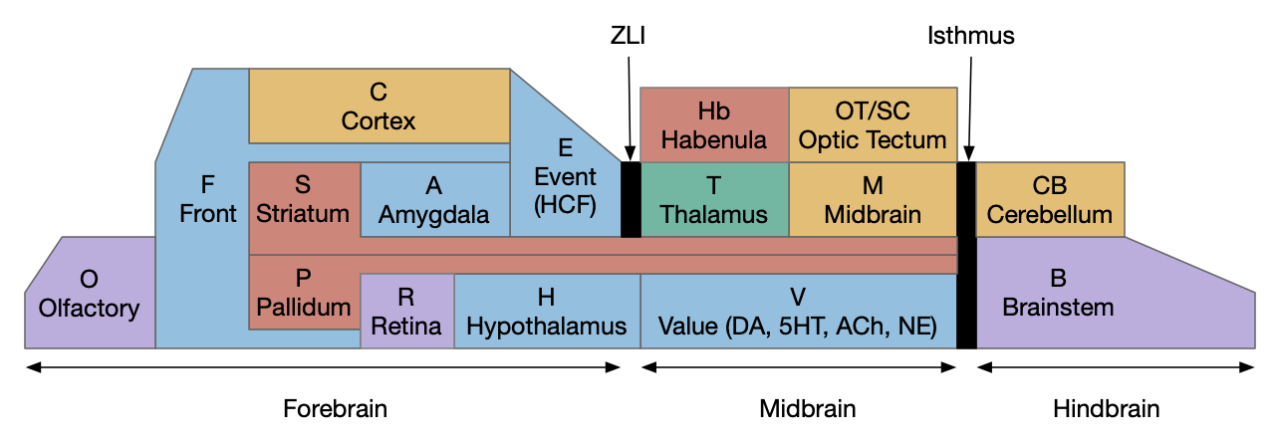
Let’s revisit the striatum timeout from essay 31: striatum LTD, where food seeking used the striatum as a timeout to avoid perseveration. Without the timeout, the animal continues to seek toward the odor source even if the food was missing. This essay adds to the timeout by adding an odor context as a cached set of locations to avoid until the timeout, as opposed to avoiding all locations until the timeout. This odor neighborhood resembles the olfactory spatial hypothesis [Jacobs 2012], which considers olfaction as primarily a navigation sense. The added specificity to failed-seek avoidance improves search for other nearby food sources.
Recap of essay 31: striatum LTD
The food seek logic from essay 31 has two search states: a general roaming search and an odor seek. If the odor seek times out, the animal avoids the current area to prevent perseveration. Essay 35 on hippocampal sequences explored using a sequence to specify the avoidance timeout.

For the timeout, the essay uses the Sv (ventral striatum aka nucleus accumbens) to suppress failed food seeking [Lafferty et al 2020]. Without the S.v timeout, the animal perseverates at the seek task and gets stuck in the center of the odor plume.

The above diagram shows the essay 31 circuit, largely based on the lamprey. V.pt (posterior tuberculum) is a locomotion hub that receives a direct signal from Ob.m (medial olfactory bulb) and drives downstream motor areas [Derjean et al 2012]. Hb.l (lateral habenula) drives place avoidance. S.v (ventral striatum) drives the timeout selection in Pv (ventral pallidum). Ad (adenosine) is the timeout variable, which increases as neural activity in S.d1 (striatum D1 projection neuron) and S.d2 (striatum D2 projection neuron) continues. Adenosine is a byproduct of ATP (adenosine triphosphate) energy production, and is also a gliotransmitter from astrocytes that monitor synapse activity. Essentially, the Sv subcircuit in red acts as a timeout for the main seek circuit.
Importantly, because the essay 31 timeout only uses the seek odor itself as a key, it can’t distinguish spatially distinct odors, such as different flowers for a honeybee.
Neighborhood odor as context
Because essay 31 only used the Ob seek odor as a signal, a timeout of that odor locks out all food search for that odor. That lockout may be long because the S.d2 LTD (long term depression) recovery time is on the order of 20 to 60 minutes. Consider an analogy to a bee searching a field of flowers for nectar. If one flower is missing nectar, the bee should give up on that flower, but it shouldn’t abandon the entire task until a 60 minute timer expires.

In the above diagram, the stars represent food locations and the clouds represent food odor plumes. Odor plumes without food are false odors. The colors of the regions represent odor neighborhoods, where non-food odors distinguish the areas. Suppose the animal first searches in the dark orange area and fails to find food. If it next reaches the green area with the star, the timeout from the failed orange search will block the search unless the timeout is specific to the orange neighborhood.
Olfactory spatial hypothesis
The olfactory spatial hypothesis argues that a primary function for olfaction is navigation, as opposed to simply proving identification [Jacobs 2012]. This navigation-centric idea is fleshed out in the parallel map theory, which argues that the hippocampus is primarily organized around two maps: a bearing map using gradients to distant odor landmarks, and a sketch map with local landmark cues [Jacobs and Schenk 2003]. The parallel map theory associates the distant bearing map with E.dg (dentate gyrus of the hippocampus) and the local sketch map with E.ca1 (CA1 region of the hippocampus).
The current essay uses the broad idea of the olfactory spatial hypothesis and the idea of a local olfactory neighborhood. The olfactory neighborhood provides a context to restrict the striatum timeout. Functionally it resembles the local sketch map, but it’s not strictly speaking a map, only a cache of failed locations.
Lamprey dual odor path
The lamprey is a useful animal model because it represents the older jawless vertebrates that preceded the development of the jaw and the majority of more complex vertebrates and because it has a simpler brain. In the lamprey, Ob.m directly drives locomotion via V.pt (posterior tuberculum), which is homologous to the mammalian midbrain dopamine areas Vta (ventral tegmental area) and Snc (substantia nigra pars compacta). Unlike the mammalian dopamine areas, the lamprey V.pt drives locomotion directly to MLR (midbrain locomotor region) and R.rs (reticulospinal motor neurons) [Beauséjour et al 2020].
The rest of the lamprey Ob drives the pallium (cortex) and subpallium (basal ganglia). Unlike the mammalian Ob which only drives specific olfactory cortical areas, the lamprey Ob broadly connects to the entire pallium [Derjean et al 2010], [Suryanarayana et al 2021]. Note that the lamprey pallium is smaller than the Ob [Pombal and Megías 2019].

The above diagram illustrates the dual olfactory projection. The main action path is Ob.m to the V.pt to the MLR locomotion [Derjean et al 2010], [Beauséjour et al 2020], [Beauséjour et al 2024]. Not shown is the Ob.m projection to the Hb.m (medial habenula) – R.ip (interpeduncular area) for chemotaxis. The previous essay included the Ob.m to S.ot path for the timeout, which suppressed chemotaxis to avoid perseveration. Ob.l is the new addition, providing distinguishing context to the S.ot circuit.
Striatal discrimination
To represent distinct timeouts, different context or olfactory neighborhoods need distinct neurons or at least different dendrite spines. The striatum architecture is well-suited for this task because of the very large number of S.pn (striatal projection neurons aka medium spiny neurons). Each S.pn can represent a distinct combination of signal and context.

The above diagram shows the context-keyed timeout architecture. Each S.pn is associated with a distinguishing context, but all of these use the same primary signal. Because S.pn stores the timeout in the LTP (long term potentiatiation) / LTD in its dendrite spines, the multiple S.pn neurons allow for distinct persistent timeout variables. Furthermore, a single S.pn can support multiple contexts because each S.pn has several dendrites, on the order of 8-12, each of which can respond to a distinct input combination.
Note the similarity of this fan-out to granule cells in the hippocampus and cerebellum, and the Kenyon cells in Drosophila fruit fly. This expansion of the coding dimensionality allows for a large space to place odors while reducing overlaps [Laurent 2002].
Striatum UP states
In mammals S.pn are only active with sustained input from multiple distributed cortical sources [Shipp 2017]. This sustain input the S.pn into an UP state, which allows a primary signal to drive the neuron, but doesn’t drive an AP (action potential) directly. Typically the context UP state inputs drive distal dendrites and spines, and the primary signal drives the proximal dendrite. S.pn are hyper polarized at rest, making it difficult for a signal to drive an AP directly. The UP state depolarizes the S.pn, allowing the signal to drive an AP. Essentially this means the context neurons are required gates for the signal.

The above diagram shows how each S.pn has an associated context made from a conjunction of several context neurons. Each S.pn has a different combination of context neurons, each differing greatly from its neighbor [Bolam and Bevan 2006]. Multiple simultaneous context neurons are necessary for an UP state.
Broad circuit
Taking an overview of this system, let’s see how addition of this context information affects the seek and timeout circuit affects the earlier circuit.

The above diagram shows the addition of Ob.l to S.ot was the only change necessary, along with the dimension expansion of the S.pn.
Cache-like model for simulation
The striatum architecture poses a scaling problem for the simulation. The striatum has a large number of neurons, each with a large number of essentially random inputs. This architecture works because the possible combinations are predefined. Each odor neighborhood is a conjunction of odor features, each corresponding to an Ob glomeruli and O.mc (olfactory mitral cells). The many predefined conjunctions are likely to match any new odor combination. However, a simulation model using this architecture would be overly large.
Because the essay model is a toy model, it can use a much simplified system. A cache-like architecture can work because only a few odor locations are active at any time. The cache only holds the recent odor locations, and the cache entry for an odor location is removed when the timeout expires. The simulation cache only needs to store the active locations, unlike the striatum, which holds the much larger number of possible distinct locations.
Simulation
The simulation adds a simplification of odor neighborhoods. Instead of simulating accurate odor plumes, each location has a place code, which then produces an odor code. In the screenshot below, the hexagonal colors represent these place codes that produce odor neighborhoods.

The above diagram shows two different odor neighborhoods (teal vs red). The animal avoids the red neighborhood after failing to find food, but seeks in the teal neighborhood to find the food. If the animal had first searched the teal neighborhood without food, it would have avoided have avoided the teal neighborhood with food.
Discussion
A major simplification in the simulation is consistency and precision in odor cues. In an actual environment, odors are not reliable. For now I’m not adding that complexity, but it might explain the need for cortical circuits in O.pir (piriform olfactory cortex) and E.hc (hippocampus). If an odor is irregular, some circuit needs to maintain a consistent odor neighborhood for the timeout circuit to work. In the simulation because the Ob perfectly represents the odor neighborhood and food plume, the downstream circuits can use the Ob signal directly. If the odor varies slightly within a neighborhood, or is lost intermittently, the S.ot timeout circuit could shift to a different S.pn timeout, breaking the logic of the circuit. A later essay might explore how cortical areas like O.pir might be necessary to create a stable neighborhood.
References
Beauséjour PA, Auclair F, Daghfous G, Ngovandan C, Veilleux D, Zielinski B, Dubuc R. Dopaminergic modulation of olfactory-evoked motor output in sea lampreys (Petromyzon marinus L.). J Comp Neurol. 2020 Jan 1;528(1):114-134.
Beauséjour PA, Veilleux JC, Condamine S, Zielinski BS, Dubuc R. Olfactory Projections to Locomotor Control Centers in the Sea Lamprey. Int J Mol Sci. 2024 Aug 29;25(17):9370.
Bolam, J. P., & Bevan, M. D. (2006). Microcircuits of the striatum. In Basal Ganglia and Thalamus in Health and Movement Disorders (pp. 29-39). Boston, MA: Springer US.
Derjean D, Moussaddy A, Atallah E, St-Pierre M, Auclair F, Chang S, Ren X, Zielinski B, Dubuc R. A novel neural substrate for the transformation of olfactory inputs into motor output. PLoS Biol. 2010 Dec 21;8(12):e1000567.
Jacobs LF, Schenk F. Unpacking the cognitive map: the parallel map theory of hippocampal function. Psychol Rev. 2003 Apr;110(2):285-315.
Jacobs L. F. (2012). From chemotaxis to the cognitive map: the function of olfaction. Proc. Natl. Acad. Sci. U.S.A. 109(Suppl. 1) 10693–10700
Lafferty CK, Yang AK, Mendoza JA, Britt JP. Nucleus Accumbens Cell Type- and Input-Specific Suppression of Unproductive Reward Seeking. Cell Rep. 2020 Mar 17;30(11):3729-3742.e3.
Laurent G. Olfactory network dynamics and the coding of multidimensional signals. Nat Rev Neurosci. 2002 Nov;3(11):884-95.
Pombal MA, Megías M. Development and Functional Organization of the Cranial Nerves in Lampreys. Anat Rec (Hoboken). 2019 Mar;302(3):512-539.
Shipp S. The functional logic of corticostriatal connections. Brain Struct Funct. 2017 Mar;222(2):669-706.
Suryanarayana SM, Pérez-Fernández J, Robertson B, Grillner S. Olfaction in Lamprey Pallium Revisited-Dual Projections of Mitral and Tufted Cells. Cell Rep. 2021 Jan 5;34(1):108596.