Essay 41: Thigmotaxis

Thigmotaxis is wall-following locomotion, as opposed to random-walk exploring open areas. Thigmotaxis is almost entirely studied as an indicator of anxiety, under the model that anxiety is driven by distant, learned fear. Under this model, wall-following is driven by trying to avoid threat. However, for this essay I’m treating thigmotaxis as a navigational strategy, an addition to the random walk, area-restricted search, and targeted seek that previous essays have simulated. Because thigmotaxis is essentially never studied in itself (or at least I haven’t found any studies yet), even the regions that implement thigmotaxis is not studied.

Simulated thigmotaxis

Because I haven’t found research into the underlying mechanisms of thigmotaxis, the following motivation and implementation is speculative, but may be useful in exploring the non-defensive value of thigmotaxis.

When navigating a maze, wall-following using the right hand rule is a highly effective technique. Although this simple rule doesn’t work on all mazes, it works on a large number. Importantly, even a simple nervous system could implement this rule, since this technique doesn’t require any memory. The following screenshot shows some of the searching value of thigmotaxis.

Simulation of thigmotaxis behavior showing an animal navigating a maze using wall-following techniques.
Screenshot of thigmotaxis where the animal follows the wall to the right to explore an island in the maze.

In the screenshot above, the animal is turning using thigmotaxis to explore the isolate island. A random walk about bound off the island and spend more time in open areas. Similar, wall-following naturally moves from section to second in the rest of the maze, such as following the corridor between the main areas to the left and right. In contrast, while random motion can also cross the passage if the trajectory happens to match, the probability is lower. Wall-following will always read the new section, but random search will only probabilistically have the proper trajectory to enter.

State and stateless thigmotaxis

For thigmotaxis, using the lateral-line sense seems to be the most direct with fewest requirements. Lateral-line is a new sense in vertebrates not present in tunicates, the closest non-vertebrates. The lateral line sense is a series of hair cells that measure water flow around the animal. This sense detects nearby objects and obstacles like a passive sonar at a distance approximately the animal’s own length. The lateral line sense has disjoint head and trunk systems and is lateralized into distinct left and right. The essay simulation approximates the lateral line by combining sense data points into these four combined areas with no finer details to approximate the information available to a simple proto-vertebrate.

A simple, stateless thigmotaxis tries to keep the head lateral-line in a middle range. If the head is too far from the wall, the animals turns toward the wall. If the head is too near the wall, the animal turns away from the wall. Because the lateral-line sense is lost beyond the animal’s own length, if the head loses the signal but the trunk still senses a wall, the animal can turn toward the trunk side to regain a head sense.

Stateless thigmotaxis is likely to lose the wall if the animal doesn’t turn quickly enough or the wall changes are too sharp, as in the post-like wall in the above screenshot. In the simulation, stateless thigmotaxis very quickly loses the wall and almost never follows sharp turns. In the animal loses the wall, thigmotaxis turns off and the animal reverts to random walk. Adding state to the system remembers the wall’s side. Even a short memory like a second or two can improve thigmotaxis performance. If the animal is following a wall to the right as above and the lateral line sense is lost, but the animal remembers that the wall is on the right, it can turn right, most likely restoring contact with the wall.

Based on running the simulation, short term memory is likely important to thigmotaxis, almost as important as the distance sense itself. In trying to understand which brain area might implement thigmotaxis, having access to simple short term memory is likely important.

Improving ascidian cement-gland search

As several essays have covered, the ascidian tunicate larva searches for a permanent adult filter-feeding settling place with a combination of phototaxis and geotaxis. When the ascidian larva finds a landing spot, it will attach with a cement gland. Geotaxis drives the ascidian larva up and phototaxis drives it away from light [Anselmi et al 2024]. This combination prefers overhanging ledges, which are both dark and upward, but the animal will settle on flat ground if it can’t find a ledge. This cement gland and phototaxis combination still exists in some fish and amphibian tadpoles. Consider a proto-vertebrate that adds thigmotaxis to this cement-gland strategy. Because the thigmotaxis animal spends more time near walls than random search would, it’s more likely to find an overhand.

As a search strategy, thigmotaxis could improve over random walk if the search target is near walls. In a reef-like ecosystem, better food sources might be near the reef and more marginal feeding in open sand. Along with potential improved defense of sticking near walls, thigmotaxis may improve search, both by preferring richer areas near walls or reefs, and improving maze-like navigation, where the maze here is the reef itself.

Arguments against thigmotaxis

There is an argument against thigmotaxis as a specific locomotor strategy, increase arguing that thigmotaxis is an epiphenomenon [Horstick et al 2016]. Circular arenas are common in scientific experiments. In a circular arena, the animal will appear to stick to the wall if the animal simply moves forward ballistically while avoiding barriers. The diagram on the left below shows this illusionary thigmotaxis. In contrast, the diagram on the right shows genuine thigmotaxis, where wall-following is needed to produce the trajectory.

Diagram comparing two maze navigation strategies: thigmotaxis (left) and a circular path (right).
Illusionary thigmotaxis on the left, where wall-following appears from a combination of ballistic motion and obstacle avoidance. In contrast, the right shows actual thigmotaxis where wall-following is necessary to produce the trajectory.

In a mouse experiment (that I can’t find the reference to), driving MLR (midbrain locomotor region), a low-level locomotor area, drives the animal forward, but obstacle avoidance keeps the animal from running into the walls. The resulting path is circular, running around and around the experimental area following the walls, which appears exactly as thigmotaxis, but in this case there is not thigmotaxis system at all. The apparent thigmotaxis is an epiphenomena from the combination of the shape of the arena, forward motion, and wall avoidance.

Note that the epiphenomenon depends on the arena shape [Horstick et al 2017]. If part of the arena is convex instead of concave, the ballistic motion will avoid the wall, bound off it, and the apparent thigmotaxis will disappear. The screenshot above shows that situation, where a distance thigmotaxis system is required to follow the wall.

Motor-driven taxis

Since I can’t find any direct thigmotaxis study, using related studies seems like the best approach. Thermotaxis is the avoidance of too-hot or too-cold areas. In fish the Hb.d (dorsal habenula; Hb.m in mammals) to R.ip (interpeduncular nucleus in the anterior hindbrain) circuit is central to thermotaxis [Paoli et al 2025]. This thermotaxis is movement-driven, as opposed to sensory-driven. Movement organizes the circuit. When the fish turns to the right, the circuit remembers the movement direction, and if heat increases, the circuit determines that heat is toward the right. The circuit needs two pieces of state. First is needs to remember that it turned to the right for a second or two. If the temperature increases, the circuit now knows the hotter area is toward the right. The second memory saves the “right is too hot” for a few seconds so the animal can avoid the right side. The important thing here is that a motor efference copy drives the hold system. The system is motor-driven with a coincidence detection of the motor turn with a sensory change.

The specific brain area for this thermotaxis circuit is the anterior hindbrain. The motor detection is in R1.a (anterior hindbrain, rhombomere 1) in the R1.dta (dorsal tegmental area). The thermal gradient signal is from the right Hb.d. The habenula is asymmetric in most vertebrates with the right and left having different functions. Taxis is primarily right Hb.d. The motor direction and sensory gradient are compared in R.ip.i (interpeduncular nucleus, intermediate part), which is in the basal R1. R.ip.i is primarily neuropil [Dragomir 2019] with axons and dendrites from R1.a and R.ip itself only has a relatively few neurons, a structure similar to Ob (olfactory bulb) glomeruli.

An interesting effect of this system is that only the signal valence matters, not the identity. A too-hot signal, or too-cold, or too-dark, or predator odor signal doesn’t need to be distinguished in the circuit. All of these result in avoiding the right if they increase after the animal turns right. This means that all kinds of threat signals can use the same circuit. In frogs the right Hb.d is organized around a single neuropil [Concha and Wilson 2001], suggesting that multiple senses lose their identity in the right Hb.d. Similarly, attraction can use the same system by switching left and right. The fish R.ip.v appears to have a gradient where more dorsal areas are attractive and more ventral areas are avoidant [Chen WY et al 2019].

Thigmotaxis and anxiety

Although thigmotaxis is not studied in itself, it is heavily studied as a marker for anxiety. Although anxiety research is aimed at understanding human anxiety, animal studies typically use “anxiety-like” to make clear that animal results may not match human anxiety. The main anxiety-like measures in mice are OFT (open field test), which directly measures thigmotaxis and EPM (elevated plus maze), which measures mice avoiding corridors above the ground.

Much of the anxiety study focuses on the forebrain, particularly sub-areas of P.bst (bed nucleus of the stria terminalis) and E.hc.v (ventral hippocampus), but there is significant anxiety research in the hindbrain, particularly research into nicotine addition and anxiety from nicotine withdrawal. The hindbrain areas most associated with anxiety-like behavior are Hb.m, R.ip and V.mr (median raphe).

Motor-driven taxis

The simulated thigmotaxis outlined earlier was sensor-driven: the animal’s movement was purely an output. But zebrafish studies about thermotaxis (avoiding too hot or too cold areas) suggest that the animal’s self movement drives the data collection and decision [Paoli et al 2025]. The thermotaxis circuit is movement-driven. The animal first moves to the right or the left, and only after the movement does the circuit measure change in temperature. If the fish turns to the right and heat increases, the circuit stores state about heat to the right. If the heat is too hot, the fish can turn to the left to avoid the heat.

This thermotaxis circuit needs to pieces of state. First it needs to remember that it turn to the right for a second or two, allowing a later temperature increase to show that the right side is hotter. Secondly once it has determined that the right side is hotter, it needs to store that information so it can avoid the right for a time. These two state variables are on the order of a second to a few seconds. The important thing here is that a motor efference copy drives the system. It’s a coincidence detection of the motor turn with changes in a sense like temperature.

The implementation area is in the anterior hindbrain. The motor direction state is in R1.a (anterior hindbrain) in R1.dta (dorsal tegmental area). The thermal gradient signal arrives from the right Hb.d (dorsal habenula in fish, medial habenula in mammals). The two data are combined in R.ip.i (interpeduncular nucleus, intermediate part), which is in the basal R1. R.ip.i is primarily neuropil [Dragomir 2019], [Wu et al 2024] with axons and dendrites from R1.a and Hb.d and only a relatively few neurons, similar to the structure of olfactory bulb glomeruli.

A second interesting effect of motor-driven behavior is that only the signal valence matters, not the identity. A too-hot signal, or too-cold, or too-dark, or a predator odor signal doesn’t need to be distinguished in the circuit, because all of these result in avoiding the dangerous right side. This means that all kinds of threat signals can use the same circuit. In frogs the right Hb.d is organized around a single neuropil [Concha and Wilson 2001], suggesting multiple senses lose their identity in the right Hb.d. Similarly attraction is a simple change in direction, so the bulk of the circuit can be the same. The first R.ip.v appears to have a gradient where more dorsal areas are attractive and more ventral areas are avoidant [Chen WY et al 2019].

Habenula and thigmotaxis

Research into anxiety and nicotine addition have consistently shown correlations with right Hb.d (Hb.mv in mammals), R.ip.d and anxiety-like behaviors, prominently including thigmotaxis. In studies anxiogenic (anxiety producing) or anxiolytic (anxiety inhibiting) is measured by changes in thigmotaxis in measurements like the OFT (open field test). Which raises the question of whether these studies are measuring anxiety as defined in human psychology or something else that merely resembles anxiety, but may have a different underlying purpose. Studies generally use “anxiety-like” instead of “anxiety” to make it clear that “anxiety-like” might not be the same as the normal use of anxiety. For example exploration-based task can’t distinguish anxiolytic from novelty seeking, exploration, or impulsive approach [Calhoon and Tye 2015]. Some anxiety researchers criticize using thigmotaxis tests like OFT and EPM for anxiety [Headley et al 2019]. The majority of anxiety studies are definitely measuring thigmotaxis (OFT) but may not be measuring anxiety.

For these studies, I’m treating Hb.m (Hb.d in fish), R.ip, and V.mr (median raphe) as part of a single interconnected system, with V.dr (dorsal raphe) as a possibly interconnected region.

Left Hb.d does not appear to be anxiety related [Agetsuma et al 2010], but several studies suggest right Hb.d in fish, Hb.mv in mammals as anxiety related. Hb.mv / right Hb.d are associated with ACh and in particular the nACh (nicotinic receptor) which is named after nicotine’s stimulatory effect in this region, and Hb.m and R.ip are in a center in nicotine addition and anxiety-like withdrawal symptoms [Jonkman et al 2017], [Molas et al 2017], [Pang et al 2016], [Klenowski et al 2023], [Matos-Ocasio et al 2021], [Wills et al 2022], [Zhao-Shea et al 2015]. Disabling Hb.d increases anxiety baseline [Bühler et al 2021]. Disabling of Grp151 (a genetic transcription factor) in Hb and impairs habituation to novelty [Broms et al 2017]. Disruption of Hb asymmetry in development is anxiogenic [Corradi and Filosa 2021]. Hb.m is associated with nicotine, novelty, anxiety and fear in mammals [Hashikawa et al 2020]. Disabling Hb can be anxiolytic, particularly when stressed [Jacinto et al 2017], but disabling the Hb.mv to R.ip connection can be anxiolytic, and disabling the P.ts to Hb.mv input can be anxiolytic [Okamoto and Aizawa 2013], [McLaughlin et al 2017], [Yamaguchi et al 2013]. Disabling Hb.m reduces ACh in R.ip, producing many side effects including increase in anxiety [Mathuru and Jesuthasan 2013] and failure to habituate to novel area [Kobayashi et al 2013]. Hb.mv nACh activation can be anxiogenic in nicotine mice, although with a lesser effect in naive mice [Pang et al 2016]. A reminder here that anxiogenic and anxiolytic here is always measured by thigmotaxis, in combination with non-thigmotaxis anxiety-like tests.

R.ip is highly connected with Hb.m and it is essentially defined as the target of Hb.m axons, but R.ip has an independent identity comprised of a strong connection with the anterior hindbrain is modulated by Vta. Importantly here, Vta is heterogeneous. One DA from section from Vta.pn-if (paranigral area, interfascicular) to R.ipc is anxiolytic [DeGroot et al 2020], another projection from Vta.p associated with CRF (corticotropin releasing factor peptide), associated with stress, is anxiogenic [Grieder et al 2014], [Calpari et al 2020], [Wills et al 2022]. CRF in R.ip potentiates Hb.mv to R.ip [Zhao-Shea et al 2015]. R.ip receives anxiety-modulating input from both Hb.mv and from Vta and is strong associated with anxiety produced by nicotine withdrawal [Matos-Ocasio et al 2021], [Zhao-Shea et al 2015].

V.mr (median raphe) is a major 5HT (serotonin) region, tightly connected with R.ip and with E.hc (hippocampus). Physically V.mr is adjacent to R.ip, immediately posterior and dorsal to R.ip. V.mr 5HT is anxiogenic with projections to E.hc.d [Abela et al 2020], [Andrade et al 2013]. Since many studies are highly focused on the forebrain, ascending connections are often overemphasized. More studies focus on the V.mr connections to the forebrain and few study connections to the more local hindbrain. V.mr 5HT is anxiogenic [Dos Santos et al 2015], [Ohmura et al 2014] 5HT anxiety is only R1-derived 5HT but not R2, R3/R5 [Kim et al 2009].

Although more studies report Hb.m ACh areas as anxiogenic, some studies also report Hb.l affecting anxiety. Because Hb.l does project to both V.mr and V.dr, this circuit may feed into the same circuit mentioned above, but more directed to V.mr and not to R.ip. Disabling Hb.l is anxiolytic [Cui et al 2020]. Interestingly V.lc (locus coeruleus) to Hb.l is anxiogenic [Pereira et al 2023], and anxiety is correlated with Hb.l astrocyte activation [Tan et al 2022], and V.lc and R.my (medulla) norepinephrine are strongly related to astrocyte activation.

Habenula, R.ip, and anterior hindbrain

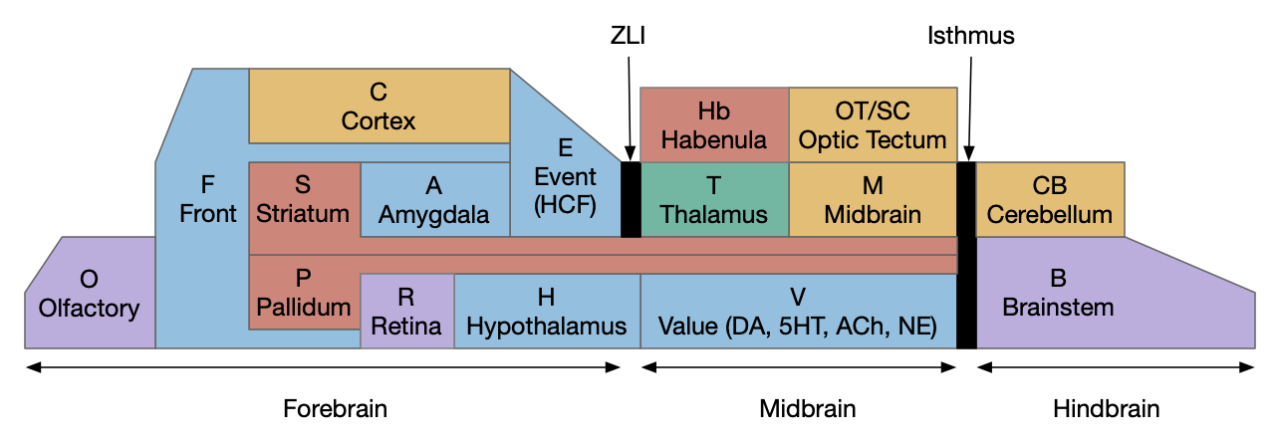
This essay assumes that thigmotaxis is somewhere in the anterior hindbrain and strongly connected to Hb.m, R.ip.v, and V.mr. The following diagram shows current studies of relevant hindbrain connections and emphasizes an ambiguity relevant to the essay, namely the relation of R.ip.v to anterior hindbrain motor areas, particularly R2.artr.

A diagram illustrating neural connections involving the habenula (Hb.m), interpeduncular nucleus (R.ip), and median raphe (V.mr), indicating potential links in anxiety and navigation-related circuits.
The medial habenula to interpeduncular nucleus circuit, which this essay uses as a possible location for thigmotaxis. Hb.m (medial habenula), R1.a (anterior hindbrain), R2.artr (anterior hindbrain turning region), R.ip.d (interpeduncular nucleus, dorsal), R.ip.v (R.ip, ventral), V.mr (median raphe).

R.ipd and R1.a are connected to form a head direction circuit [Petrucco et al 2023], [Petrucco 2024] and landmark navigation [Lavian et al 2024]. This sub circuit does not appear to be anxiety or thigmotaxis because R.ip.d and Hb.md (left Hb.d) are not associated with anxiety, in contrast to Hb.mv (right Hb.d) and R.ipv, which are strongly associated with anxiety and thigmotaxis.

R.ip.v is strongly correlated with chemotaxis [Chen WY et al 2019], thermotaxis [Palieri et al 2024], [Paoli et al 2025], and OMR [Dragomir et al 2020] and necessarily needs to connect with motor regions [Wu et al 2024].

R2-R3 ARTR (anterior hindbrain turning region) is strongly associated with turning direction [Chen X et al 2018], [Dunn et al 2016], and phototaxis [Karpenko et al 2020], [Wolf et al 2017], and OMR [Chen X et al 2018], [Naumann et al 2016].

However, none of the R2.artr studies mention any connection with R.ip.v or V.mr, and none of the R.ip.v studies mention R2.artr. While is seems plausible that R2.artr and the unnamed R1.a motor area are the same area, but the science doesn’t say anything at all, neither confirming the identity as R2.artr with the unnamed R.ip pair or establishing a separate anterior hindbrain area. For the sake of the essay and simulation, I’m treating R2.artr as being the partner of R.ip.v, because that option is simpler, with fewer moving parts.

Discussion

Here I’ve approached thigmotaxis primarily as a navigation strategy, adding to earlier essays that used random walk and target seek and avoid (taxis) that previous essays have used. Here the wall-following is a strategy that reduces search from a two dimensional problem to a one dimensional problem. In addition it increases the time spent searching near wall-like areas as like a reef in coastal water, which may have been important to proton-vertebrates as they searched for filter-feeding locations.

However scientific studies don’t currently study thigmotaxis as a separate behavior, which makes this essay particularly speculative. Essentially all of the information about thigmotaxis is from studies that use thigmotaxis as a measure of anxiety. Because anxiety is a major research topic, thigmotaxis has a large amount of indirect research. In a sense it’s a well-studied topic, but that research doesn’t cover how the motor circuit for thigmotaxis works.

From the other direction, there is significant research for locomotion for seeking and other taxis [Palieri et al 2024], random walks [Dunn et al 2016], klinotaxis [Karpenko et al 2020], optic-flow locomotion [Chen X et al 2020], and details on swimming primitives like enumerating several swimming types and turn types [Marques et al 2018]. But I haven’t found a study that treats thigmotaxis as a locomotion primitive that needs explaining.

Because thigmotaxis can be implemented fairly simply using the lateral line with some short-term memory, both of which are available in the hindbrain, and because the anterior hindbrain Hb.m / R.ip / V.mr system is an anxiety (thigmotaxis) center, placing thigmotaxis in the anterior hindbrain seems reasonable. Recent research has started to explain anterior hindbrain locomotion [Paoli et al 2025], [Dragomir et al 2020], [Naumann et al 2016]. However there appears to be two lines of research, one centered on the Hb / R.ip circuit and another studying the R2.artr circuit, but I haven’t yet found a study that connects the two lines of research, which makes it unknown whether the Rb – R.ip and R2.artr are two separate circuits or part of a single circuit. If they’re two adjacent circuits, then presumably they communicate, but this is also unknown. Again the essay simulation needs to make a decision in the absence of scientific data. Because treating the two circuits as one larger circuit is simpler, the essay uses that model.

If thigmotaxis is part of a search strategy: reducing search dimensionality from two to one, then some of the ascending connections from this circuit, including from V.mr, R.dtg, and R.nin (nucleus incepts, a target of R.ip) to E.hc (hippocampus) could be spatial and navigational, not just anxiogenic. Lesions to those connections produce spatial navigational deficits in tests like the Morris water maze.

Although this essay has focused on anxiety studies that target the hindbrain, there are many studies that show forebrain anxiety circuits. In particularly P.bst.ov (bed nucleus of the stria terminals, oval nucleus), part of the extended amygdala and E.hc (ventral hippocampus) are strong anxiety-like centers [Han et al 2024]. Furthermore the combination of E.hc.v, A.bl (basolateral amygdala), and F.m (medial prefrontal cortex) [Padilla-Coreano et al 2016] is also a strong anxiety-like center. Again where “anxiety-like” is measured as modulating thigmotaxis. R.ip – V.mr are anxiety-related, but not directly implementing the thigmotaxis motor action.

References

Abela AR, Browne CJ, Sargin D, Prevot TD, Ji XD, Li Z, Lambe EK, Fletcher PJ. Median raphe serotonin neurons promote anxiety-like behavior via inputs to the dorsal hippocampus. Neuropharmacology. 2020 May 15;168:107985. 

Agetsuma M., Aizawa H., Aoki T., Nakayama R., M. Takahoko, M. Goto, T. Sassa, R. Amo, T. Shiraki, K. Kawakami, et al. The habenula is crucial for experience-dependent modification of fear responses in zebrafish Nat. Neurosci., 13 (2010), pp. 1354-1356

Andrade TG, Zangrossi H Jr, Graeff FG. The median raphe nucleus in anxiety revisited. J Psychopharmacol. 2013 Dec;27(12):1107-15. 

Anselmi, C., Fuller, G.K., Stolfi, A., Groves, A.K. and Manni, L., 2024. Sensory cells in tunicates: insights into mechanoreceptor evolution. Frontiers in Cell and Developmental Biology, 12, p.1359207.

Broms J, Grahm M, Haugegaard L, Blom T, Meletis K, Tingström A. Monosynaptic retrograde tracing of neurons expressing the G-protein coupled receptor Gpr151 in the mouse brain. J Comp Neurol. 2017 Oct 15;525(15):3227-3250. 

Bühler A, Carl M. Zebrafish Tools for Deciphering Habenular Network-Linked Mental Disorders. Biomolecules. 2021 Feb 20;11(2):324.

Calhoon GG, Tye KM. Resolving the neural circuits of anxiety. Nat Neurosci. 2015 Oct;18(10):1394-404.

Calipari ES. Dopamine Release in the Midbrain Promotes Anxiety. Biol Psychiatry. 2020 Dec 1;88(11):815-817. 

Chen WY, Peng XL, Deng QS, Chen MJ, Du JL, Zhang BB. Role of Olfactorily Responsive Neurons in the Right Dorsal Habenula-Ventral Interpeduncular Nucleus Pathway in Food-Seeking Behaviors of Larval Zebrafish. Neuroscience. 2019 Apr 15;404:259-267. 

Chen X, Mu Y, Hu Y, Kuan AT, Nikitchenko M, Randlett O, Chen AB, Gavornik JP, Sompolinsky H, Engert F, Ahrens MB. Brain-wide Organization of Neuronal Activity and Convergent Sensorimotor Transformations in Larval Zebrafish. Neuron. 2018 Nov 21;100(4):876-890.e5.

Concha ML, Wilson SW. Asymmetry in the epithalamus of vertebrates. J Anat. 2001 Jul-Aug;199(Pt 1-2):63-84. 

Corradi L, Filosa A. Neuromodulation and Behavioral Flexibility in Larval Zebrafish: From Neurotransmitters to Circuits. Front Mol Neurosci. 2021 Jul 15;14:718951. 

Cui WQ, Zhang WW, Chen T, Li Q, Xu F, Mao-Ying QL, Mi WL, Wang YQ, Chu YX. Tacr3 in the lateral habenula differentially regulates orofacial allodynia and anxiety-like behaviors in a mouse model of trigeminal neuralgia. Acta Neuropathol Commun. 2020 Apr 7;8(1):44. 

DeGroot SR, Zhao-Shea R, Chung L, Klenowski PM, Sun F, Molas S, Gardner PD, Li Y, Tapper AR. Midbrain Dopamine Controls Anxiety-like Behavior by Engaging Unique Interpeduncular Nucleus Microcircuitry. Biol Psychiatry. 2020 Dec 1;88(11):855-866.

Dos Santos, L., de Andrade, T. G., & Zangrossi, H. (2005). Serotonergic neurons in the median raphe nucleus regulate inhibitory avoidance but not escape behavior in the rat elevated T-maze test of anxiety. Psychopharmacology, 179, 733-74

Dragomir EI. Perceptual decision making in larval zebrafish revealed by whole-brain imaging. PhD thesis 2019.

Dragomir EI, Štih V, Portugues R. Evidence accumulation during a sensorimotor decision task revealed by whole-brain imaging. Nat Neurosci. 2020 Jan;23(1):85-93. 

Dunn TW, Mu Y, Narayan S, Randlett O, Naumann EA, Yang CT, Schier AF, Freeman J, Engert F, Ahrens MB. Brain-wide mapping of neural activity controlling zebrafish exploratory locomotion. Elife. 2016 Mar 22;5:e12741. 

Grieder TE, Herman MA, Contet C, Tan LA, Vargas-Perez H, Cohen A, Chwalek M, Maal-Bared G, Freiling J, Schlosburg JE, Clarke L, Crawford E, Koebel P, Repunte-Canonigo V, Sanna PP, Tapper AR, Roberto M, Kieffer BL, Sawchenko PE, Koob GF, van der Kooy D, George O. VTA CRF neurons mediate the aversive effects of nicotine withdrawal and promote intake escalation. Nat Neurosci. 2014 Dec;17(12):1751-8. 

Han RW, Zhang ZY, Jiao C, Hu ZY, Pan BX. Synergism between two BLA-to-BNST pathways for appropriate expression of anxiety-like behaviors in male mice. Nat Commun. 2024 Apr 24;15(1):3455. 

Hashikawa Y, Hashikawa K, Rossi MA, Basiri ML, Liu Y, Johnston NL, Ahmad OR, Stuber GD. Transcriptional and Spatial Resolution of Cell Types in the Mammalian Habenula. Neuron. 2020 Jun 3;106(5):743-758.e5.

Headley DB, Kanta V, Kyriazi P, Paré D. Embracing Complexity in Defensive Networks. Neuron. 2019 Jul 17;103(2):189-201.

Horstick EJ, Mueller T, Burgess HA. Motivated state control in larval zebrafish: behavioral paradigms and anatomical substrates. J Neurogenet. 2016 Jun;30(2):122-32. 

Horstick EJ, Bayleyen Y, Sinclair JL, Burgess HA. Search strategy is regulated by somatostatin signaling and deep brain photoreceptors in zebrafish. BMC Biol. 2017 Jan 26;15(1):4. 

Jacinto LR, Mata R, Novais A, Marques F, Sousa N. The habenula as a critical node in chronic stress-related anxiety. Exp Neurol. 2017 Mar;289:46-54. 

Johnson, A. and Hamilton, T.J., 2017. Modafinil decreases anxiety-like behaviour in zebrafish. PeerJ 5, e2994 

Jonkman S, Risbrough VB, Geyer MA, Markou A. Spontaneous nicotine withdrawal potentiates the effects of stress in rats. Neuropsychopharmacology. 2008 Aug;33(9):2131-8. doi: 10.1038/sj.npp.1301607. Epub 2007 Nov 21. 

Karpenko S, Wolf S, Lafaye J, Le Goc G, Panier T, Bormuth V, Candelier R, Debrégeas G. From behavior to circuit modeling of light-seeking navigation in zebrafish larvae. Elife. 2020 Jan 2;9:e52882. 

Kim JC, Cook MN, Carey MR, Shen C, Regehr WG, Dymecki SM. Linking genetically defined neurons to behavior through a broadly applicable silencing allele. Neuron. 2009 Aug 13;63(3):305-15.

Klenowski PM, Zhao-Shea R, Freels TG, Molas S, Zinter M, M’Angale P, Xiao C, Martinez-Núñez L, Thomson T, Tapper AR. A neuronal coping mechanism linking stress-induced anxiety to motivation for reward. Sci Adv. 2023 Dec 8;9(49):eadh9620. 

Kobayashi Y, Sano Y, Vannoni E, Goto H, Suzuki H, Oba A, Kawasaki H, Kanba S, Lipp HP, Murphy NP, Wolfer DP, Itohara S. Genetic dissection of medial habenula-interpeduncular nucleus pathway function in mice. Front Behav Neurosci. 2013 Mar 12;7:17. 

Lavian, H., Prat, O., Petrucco, L., Stih, V. and Portugues, R., 2024. The representation of visual motion and landmark position aligns with heading direction in the zebrafish interpeduncular nucleus. BioRxiv, pp.2024-09.

Marques JC, Lackner S, Félix R, Orger MB. Structure of the Zebrafish Locomotor Repertoire Revealed with Unsupervised Behavioral Clustering. Curr Biol. 2018 Jan 22;28(2):181-195.e5.

Matos-Ocasio F, Espinoza VE, Correa-Alfonzo P, Khan AM, O’Dell LE. Female rats display greater nicotine withdrawal-induced cellular activation of a central portion of the interpeduncular nucleus versus males: A study of Fos immunoreactivity within provisionally assigned interpeduncular subnuclei. Drug Alcohol Depend. 2021 Apr 1;221:108640. 

Mathuru AS, Jesuthasan S. The medial habenula as a regulator of anxiety in adult zebrafish. Front Neural Circuits. 2013 May 27;7:99. 

McLaughlin, I., Dani, J.A. and De Biasi, M., 2017. The medial habenula and interpeduncular nucleus circuitry is critical in addiction, anxiety, and mood regulation. Journal of neurochemistry, 142, pp.130-143.

Molas S, Zhao-Shea R, Liu L, DeGroot SR, Gardner PD, Tapper AR. A circuit-based mechanism underlying familiarity signaling and the preference for novelty. Nat Neurosci. 2017 Sep;20(9):1260-1268.

Naumann EA, Fitzgerald JE, Dunn TW, Rihel J, Sompolinsky H, Engert F. From Whole-Brain Data to Functional Circuit Models: The Zebrafish Optomotor Response. Cell. 2016 Nov 3;167(4):947-960.e20. 

Ohmura Y, Tanaka KF, Tsunematsu T, Yamanaka A, Yoshioka M. Optogenetic activation of serotonergic neurons enhances anxiety-like behaviour in mice. Int J Neuropsychopharmacol. 2014 Nov;17(11):1777-83. 

 Okamoto H, Aizawa H. Fear and anxiety regulation by conserved affective circuits. Neuron. 2013 May 8;78(3):411-3. 

Padilla-Coreano N, Bolkan SS, Pierce GM, Blackman DR, Hardin WD, Garcia-Garcia AL, Spellman TJ, Gordon JA. Direct Ventral Hippocampal-Prefrontal Input Is Required for Anxiety-Related Neural Activity and Behavior. Neuron. 2016 Feb 17;89(4):857-66. 

Palieri V, Paoli E, Wu YK, Haesemeyer M, Grunwald Kadow IC, Portugues R. The preoptic area and dorsal habenula jointly support homeostatic navigation in larval zebrafish. Curr Biol. 2024 Feb 5;34(3):489-504.e7.

Pang X, Liu L, Ngolab J, Zhao-Shea R, McIntosh JM, Gardner PD, Tapper AR. Habenula cholinergic neurons regulate anxiety during nicotine withdrawal via nicotinic acetylcholine receptors. Neuropharmacology. 2016 Aug;107:294-304. 

Paoli, E., Palieri, V., Shenoy, A. and Portugues, R., 2025. A zebrafish circuit for behavioral credit assignment. bioRxiv, pp.2025-02.

Pereira AR, Alemi M, Cerqueira-Nunes M, Monteiro C, Galhardo V, Cardoso-Cruz H. Dynamics of Lateral Habenula-Ventral Tegmental Area Microcircuit on Pain-Related Cognitive Dysfunctions. Neurol Int. 2023 Oct 27;15(4):1303-1319.

Petrucco L, Lavian H, Wu YK, Svara F, Štih V, Portugues R. Neural dynamics and architecture of the heading direction circuit in zebrafish. Nat Neurosci. 2023 May;26(5):765-773. 

Petrucco, L., 2024. Investigating heading representation in the zebrafish interpeduncular nucleus (2024 FENS‐Kavli network of excellence PhD thesis prize). European Journal of Neuroscience, 60(11), pp.6911-6914.

Tan W, Ikoma Y, Takahashi Y, Konno A, Hirai H, Hirase H, Matsui K. Anxiety control by astrocytes in the lateral habenula. Neurosci Res. 2024 Aug;205:1-15. 

Wills L, Ables JL, Braunscheidel KM, Caligiuri SPB, Elayouby KS, Fillinger C, Ishikawa M, Moen JK, Kenny PJ. Neurobiological Mechanisms of Nicotine Reward and Aversion. Pharmacol Rev. 2022 Jan;74(1):271-310. 

Wolf S, Le Goc G, Debrégeas G, Cocco S, Monasson R. Emergence of time persistence in a data-driven neural network model. Elife. 2023 Mar 14;12:e79541.

Wu, Y.K., Petrucco, L. and Portugues, R., 2024. Anatomical and functional organization of the interpeduncular nucleus in larval zebrafish. bioRxiv, pp.2024-10.

Yamaguchi T, Danjo T, Pastan I, Hikida T, Nakanishi S. Distinct roles of segregated transmission of the septo-habenular pathway in anxiety and fear. Neuron. 2013 May 8;78(3):537-44. 

Zhao-Shea R, DeGroot SR, Liu L, Vallaster M, Pang X, Su Q, Gao G, Rando OJ, Martin GE, George O, Gardner PD, Tapper AR. Increased CRF signalling in a ventral tegmental area-interpeduncular nucleus-medial habenula circuit induces anxiety during nicotine withdrawal. Nat Commun. 2015 Apr 21;6:6770.

Essay 39: Food Zone

H.l (lateral hypothalamus) is a key node in the foraging system and has an interesting capability of distinguishing a food zone from a non-food zone [Jennings et al 2015]. In a sense foraging is searching for a food zone and then eating.

Foraging as a state machine.

The above diagram shows the foraging phases that I’ve already covered in earlier essays. Importantly, each phase is an independent action path as part of a distributed system, not merely a state in a state machine. To force the separate action paths to act like a state machine, each transition needs to suppress the preceding and following state. In particular the eating phase needs to inhibit the seeking system. This lateral inhibition is important because circuitry is required to force activation of only a single system at a time.

The food zone is particularly interesting for filter feeding, which is naturally area based and long term, as opposed to snapping up a morsel of food. Non-vertebrate chordates are filter feeders, lamprey larvae are filter feeders, and early jawless vertebrates were also likely filter feeders [D’Aniello et al 2023]. Tunicate ascidians, the closest non-vertebrate chordates, have an extreme version of this foraging loop, where the tadpoles find a feeding place after swimming for 12 hours and then settling in place for their adult life [Anselmi et al 2024]. The ascidian foraging state marine is a straight line that ends in the eating phase in the food zone, not continuing in a loop. The ascidian search and settle might give a hint how the vertebrate foraging circuitry is organized.

Ascidians

As covered in essay 30, the ascidian larva nervous system has several seeking (taxis) systems: geotaxis (gravity avoidance – moving up), phototaxis (light avoidance), and dimming for predator and obstacle avoidance. Ascidian navigation disperses the larva from its parent and prefers to settle on the underside of ledges by avoiding gravity while avoiding light. Its settling sensors also avoid toxic or irritating areas and may try to find food-friendly areas, although the specific sensor capabilities aren’t well known. When the larva finds an appropriate place, around 14 hours after hatching, it settles for life [Hoyer et al 2024].

Functional organization of the ascidian larva navigation and settling circuit.

The above diagram is a functional representation of the ascidian larva navigation brain. For this essay the important part is the palp and food-zone sensor and the settling neurons that inhibit motor neurons. The palms are three tentacle-like protrusions from the larva head, which attach the ascidian to a rock with cement glands [Johnson et al 2024]. They contain chemosensory and mechanosensors that distinguish the settling zone from non-settling zones [Hoyer et al 2024]. Interestingly, the genetic markers for the palp neurons are similar to markers for the vertebrate forebrain.

Head cement glands still exist in some fish larvae [Pottin et al 2010] and most frog tadpoles [Nokhbatolfoghahai and Downie 2005], [Rétaux and Pottin 2011], [Sive and Bradley 1996]. Frog tadpoles will swim up and attach to the underside of leaves or to the water surface. This cement gland and settling system may have existed in the pre-vertebrate ancestor and shared for tunicates and vertebrates. Unlike the ascidians the pre-vertebrates likely did not permanently settle. For the sake of this essay, let’s assume they temporarily settled to filter feed in a location and only moved on if filter feeding was unsuccessful or if forced to move by predators, competitors, or environmental hazards.

Ascidian larva navigation and palp settling circuit with the settling circuit highlighted. Each of the boxes represents a single neuron or a small (5-10) group of neurons. Labels are neuron names.

The above diagram shows specific neurons in the ascidian larva brain. The importance here is the glutamate pnIN (palp interneuron) to GABA pnRN (palp relay neuron), which inhibits all motor neurons and interneurons. Comparing vertebrate and ascidian neural systems is sketchy and probably should be avoided because both have diverged [Holland 2016]. For this essay, I’ll ignore that sound advice to try to motivate part of the vertebrate nervous system.

H.stn as an analogous node to the settling neurons. H.stn (subthalamic nucleus), MLR (midbrain locomotor region), Ob (olfactory bulb), OT (optic tectum), P.v (ventral pallidum), R.rs (reticulospinal motor command), S.v (ventral striatum), S.nr (substantia nigra pars reticulata), V.pt (posterior tubuculum)

The above diagram shows the H.stn (subthalamic nucleus) as fulfilling a similar role as the pnIN from ascidian Ciona, suppressing seek in preparation for eating. Part of P.v (ventral pallidum) suppresses S.v (ventral striatum) during eating [Vachez et al 2021]. This P.v “arkypallidal” subset is named after similar neurons in P.ge (globus pallidus) that suppresses S.d (dorsal striatum). Although the driver of this eating suppression isn’t known, the timing of the arkypallidal activation closely matches V.dr serotonin food activation [Spring and Nautiyal 2024], ramping at the end of seek and peaking after eating. Also, H.stn and P.ge form an oscillating pair, evident in Parkinson’s disease. So, it’s plausible that H.stn drives persistent suppression of the seek path in S.v through its projection to P.v, possibly influenced or driven by V.dr (dorsal raphe, serotonin). This specific path is speculation but seems compatible with experiments. The second suppression path is the well-known H.stn to S.nr (substantia nigra pars reticulata) that suppresses motor activity. Snr has a widespread suppression or MLR (midbrain locomotor region), R.rs (reticulospinal motor command), and Snr suppresses Snc (substantia nigra parsa compacta dopamine). Note that the medial H.stn, the area connected with P.v, merges with H.l with minimal boundary [Haynes and Haber 2013].

Food zone

Let’s return to the H.l food zone in [Jennings et al 2015] and consider where the food zone information might come from. Following [Jacobs 2012], let’s treat olfaction as the central sense for navigation, which is particularly compelling for food zones.

The diagram below shows the H.l main connectivity. Not displayed is the H.l internal sensing of nutrient information peptides like glucose sensing and leptin fat sensing. H.l doesn’t receive direct sensory input with the exception of R.pb (parabrachial nucleus), which sends nociceptive information like itch or pain. Because an itchy or painful place is a poor choice for filter feeding, this R.pb input is negative place information for a filter-feeding zone, but R.pb doesn’t give positive reasons to stay like food odors.

H.l connectivity encompasses much of the limbic system, driven by olfactory information. A.bl (basolateral amygdala), E.hc (hippocampus), F.pfc (prefrontal cortex), H.arc (hypothalamus arcuate), H.l (lateral hypothalamus), H.pv (paraventricular hypothalamus), H.stn (subthalamic nucleus), Hb.l (lateral habenula), M.pag (periaqueductal gray), Ob (olfactory bulb), O.pir (piriform cortex), P.bst (bed nucleus of the stria terminalis), P.v (ventral pallidum), R.pb (parabrachial), S.a (central amygdala), S.ls (lateral striatum), S.v (ventral striatum), V.dr (dorsal raphe – serotonin), Vta (ventral tegmental area – dopamine)

As the diagram suggests, the information H.l receives about food sources is very abstract. It receives cue information from A.bl (basolateral amygdala), place information from E.hc (hippocampal complex), value-like information from F.ofc (orbitofrontal cortex) and task-like information from F.vm (ventromedial prefrontal cortex). All of those areas are strongly connected with the olfactory system. While H.l doesn’t receive odor place information directly from sensors, it receives multiple organizational perspectives on odor information. P.bst (bed nucleus of the stria terminalis) receives very similar olfactory input as H.l, and it also receives negative information from R.pb. However, R.pb sends different nociceptive information to the S.a (central amygdala)/P.bst extended amygdala than it sends to H.l [Arthurs et al 2023]. The R.pb projections to H.l compared to S.a/P.bst are not redundant.

Not only are the H.l inputs abstract, but the outputs are also abstract, in contrast to direct action paths. This abstraction might be a later evolutionary development, similar to V.pt (posterior tuberculum) in zebrafish. V.pt is roughly homologous to Vta (ventral tegmental area) in mammals, but V.pt has more direct locomotor output to MLR (midbrain locomotor region), while most of Vta’s output is generally abstract.

As a note, the diagram does not include H.l ox (orexin) or H.l mch (melanin-concentrating hormone), partially for simplicity and partially because the zebrafish H.l is distinct from the ox and mch populations, suggesting that the mammalian ox and mch areas of H.l can be separated from the rest of H.l function. The diagram also omits some other connections like Ppt (pedunculopontine nucleus).

Food and serotonin

Returning to the foraging state diagram, it’s important that each “state” is a large, distributed, complex system, not a state in a state machine. The seek state includes areas like S.v, Vta, H.l, E.hc, F.pfc, and the motor regions MLR and R.rs (reticulospinal motor command) with the help of cortical areas and can include OT (optic tectum). Although the eating state is small, it is still comprised of many areas, including V.dr (dorsal raphe), OT.d, R.my.irt (medulla eating), H.l, H.pstn (parasubthalamic nucleus), R.pb and possibly some Vta and S.v subareas. Although the system is not a state machine, each “state” needs to laterally suppress the other systems to prevent multiple action paths from colliding.

Foraging state machine with dopamine and serotonin modulation. DA (dopamine), V.dr (dorsal raphe), Vta ventral tegmental area, 5HT (serotonin).

The split between eat and seek is important, because many studies merge the behavior into a general category “feeding.” Because some experiments only measure total feeding, it can be difficult to distinguish whether the experiment is measuring a seek effect or an eating effect. For example, eating needs to suppress seek to keep the animal from wandering away from the food. If an experiment stimulates eat but inhibits seek, the animal might not search for food even if it’s ready to eat. If it doesn’t seek food, it doesn’t find food.

This distinction between eating and seeking is exhibited by the question of serotonin, which is a heterogeneous system that has a role in feeding. The serotonin from V.dr is a heterogenous system with V.dr having at least 14 different genetic clusters [Okaty et al 2020] with at least 11 different projection patterns [Ren et al 2014]. Earlier studies noted that 30% of V.dr were active during eating [Fornal et al 1996], and many others have noted V.dr being active for “reward” (eating).

Suppose one component of V.dr serotonin encourages eating while discouraging seeking. If an experiment floods the brain with serotonin, it might see total feeding drop because serotonin suppresses seeking food, even if it encourages long meals when it finds food. The confusion becomes greater for studies looking for the even more abstract “reward” as opposed to concrete eating. The point being that serotonin in particular is a complicated system, not reducible to a single value or function.

Eating related effects of serotonin. DA (dopamine), H.arc (hypothalamus arcuate), H.stn (subthalamic nucleus), P.v (ventral pallidum), S.nr (substantia nigra pars reticulata), V.dr (dorsal raphe), Vta (ventral tegmental area), Vta.g (GABA neurons of Vta), 5HT (serotonin)

The above diagram shows some of the eating-related projections. Only a few of the 14 V.dr subtypes are know. The V.dr to Vta connection is one of the known projections and drives the seek system [Courtiol et al 2021], [Wang HL et al 2019]. Unfortunately, the other projections are not known, in particular the 30% of V.dr that is active while eating [Bromberg-Martin et al 2010].

V.dr enhances satiety with 5HT2c.q (serotonin G-q stimulating receptor) in H.arc POME satiety neurons, which suppresses the AgRP hunger peptide. Note that AgRP drops just before eating, suggesting that it’s a seek-promoting system, but an eating-promoting system [Bhave and Nettow 2021]. The prediction suppression only occurs after training and V.dr serotonin shows inverse behavior, possibly suggesting V.dr as suppressing H.arc. Untrained V.dr serotonin only responds after tasting [Li et al 2016], but trained V.dr serotonin responds about 2 seconds before eating [Zhong et al 2016].

Filter feeding and foraging theory

Let’s the consider filter feeding using foraging theory. Foraging theory studies how animals browse patches of food, such as a cluster of flowers for a bee or worms in pine cones for birds [Krebs et al 1974] or a hunting spot for a predator. In particular, foraging theory considers how long the animal should stay at a particular patch before deciding to move on: measuring the give up time. A filter-feeding proto-vertebrate needs to decide if the current food rate is good enough to stay at the current food zone.

The MVT (marginal value theorem) suggests that an animal should move on if the current patch has less food than the environment average [Charnov 1976]. MVT has simplifying assumptions that are challenged by the complexity in the world [Pyke 1984], [Wajnberg et al 2006]. MVT assumptions include omniscience, immortality, determinism, no competition, no predation, and no hunger. Some of those complexities are important to the essay, particularly the omniscience. In MVT the animal knows the average environment food value, but this omniscience isn’t plausible for simple animals [Tenhumberg et al 2001], and the essay animal has almost no learning at all. Realistic search is stochastic and can fail, such as a predator hunting, which is particularly important if the animal is starving. Starvation and satiation are also not covered by the MVT. If the animal is starving, it might stick with a non-optimal, low quality food source below the environment average because not finding a better patch is too risky. Simple organisms use rules of thumb instead of complex strategy, and even birds seem to use a constant give up time [Krebs et al 1974].

As a side note, the foraging terms for eating (“exploiting”) and searching for a new patch (“exploring”) have been appropriated by RL (reinforcement learning) [Sutton and Barto 2018] with some differences in meaning. Reinforcement learning use an n-armed bandit (gambling slot machine) model, where exploring means finding the reward rates of the other arms before deciding on the best arm to exploit. The RL focus is on gather information, generally in a finite and persistent system. In contrast, this essay uses the original foraging terminology.

Covered in essay 36, vertebrate food motivation divides into hunger-driven (“homeostatic”) and opportunistic (“hedonic”) foraging. These form two levels of search and involve different circuits with some overlap. When no longer hungry, mice will not eat plain food but will still eat rich food. In terms of foraging theory, hungry mice will stay longer at poor patches, while sated mice will leave more quickly.

Simulation complexity

After starting to implement the simulation, the issue of complication became overwhelming. Specifically, adding the striatum is too complicated. Consider the issue of distinguishing the eating function of dopamine vs serotonin, when both are responsive to eating food. That similarity makes it difficult to find the system function. The system must have developed from a simpler system because the ascidian feeding or amphioxus feeding is not overly complicated. For the sake of the simulation, I’m backing off and considering only the hindbrain and hypothalamus systems, treating the striatum as a later enhancement.

Hypothalamus and raphe nuclei

The core of the simulation is the pair of H.l and V.dr. As mentioned above, H.l is driven by food zone indicators and can drive both seeking and eating. V.dr is responsive to eating and as part of the hindbrain (it derives from r1) it is a good candidate for primitive, tunicate-like filter feeding circuitry.

Simulation eating model. Ob and H.l form the forebrain food zone system, while V.dr and R.nts form the hindbrain eating system. H.l (lateral hypothalamus), Ob (olfactory bulb), R.nts (nucleus of the solitary tract), V.dr (dorsal raphe).

The diagram above is a simplification, where the Ob to H.l connection represents an ancient version of the food zone system. The V.dr to R.nts (nucleus of the solitary tract) connection includes more hindbrain structures such as medulla eating circuits. The simplification has H.l as a food zone controller and V.dr as an eating sustaining manager.

Although V.dr is a serotonin system, not V.dr neurons are non-serotonin, both glutamate and GABA. As mentioned above the V.dr and V.mr (median raphe) serotonin neurons have at least 11-14 distinct neuron types and projection types. For the essay I’m assuming at least one serotonin neuron type is a measure of eating food. In the simulation successful filter feeding increases the serotonin for eating.

Start and sustain

Let’s return to foraging, where the central decision is when to stop exploiting a patch if it’s not effective. Consider a simple where the animal gives up on a patch if the feeding rate drops below a fixed threshold. Filter feeding naturally has delays between starting filter feeding, trapping some prey, and later receiving nutrients in the gut. This raises a problem: the feeding rate is zero until some food is digested, which implies the animal should give up immediately.

Foraging give-up occurs when the combination of a start signal and sustain signal drop below a threshold.

One solution is to prime the system with a start signal. While the start signal exists, the animal won’t leave even if it hasn’t digested any nutrients. In the simulation H.l is responsible for the start signal and V.dr is responsible for both the sustain and for integrating the two systems. The H.l start signal comes from the food zone detection.

However, the start signal raises a new issue because the start signal must stop to allow sustain to act as the primary decision variable. If H.l always sends the food zone signal to V.dr, it will remain active as long as the animal is in the food zone, preventing the animal from leaving the zone. So, H.l itself needs a timeout. The simulation uses a striatum timeout to disable the H.l food zone signal. The striatum connection can either represent the striatum layer between the olfactory and cortical layers and H.l, or it can represent H.l reciprocal input to the striatum.

The start timeout has the same issues as other striatum systems. Specifically, it needs to remain timed out until the animal leaves the food zone.

Simulation

The screenshot below shows the animal feeding from a low-quality food zone. The grey star is a food zone (grey represents poor food). The nearby purple checkerboard is an avoidance zone, representing an aversive area such as itch or high carbon dioxide.

Simulation of the animal filter feeding at a poor food zone just before giving up.

In the screenshot the startup signal from H.l is temporarily sustaining feeding. It will soon timeout and the animal will abandon the food zone.

Avoidance response and search

The simulation adds two other serotonin-based systems: one for avoiding toxic areas and one for search. Avoidance is one of the V.mr functions. The search serotonin represents the V.dr to Vta connection, despite the current essay disabling the seek function. These two functions may not be serotonin functions because V.mr avoidance is largely non-serotonin, and the V.dr to Vta connection is primarily glutamate. Because the avoidance and search are not the primary focus of the essay, I’m putting off the question of accuracy to a later essay.

Discussion

The essay’s big questionable decision is the omission of the striatum, particularly because I’ve already used the striatum for give-up timing. For eating as opposed to seeking, one possible area appears to be S.dl.vl, which is the orobranchial, mouth area [Foster et al 2021]. Because S.dl receives late dopamine from food in the gut, it might be a good candidate for filter feeding sustain.

Map of the striatum. dl (dorsal lateral striatum), dm (dorsal medial striatum), lsh (lateral shell), msh.d (dorsal medial shell), msh.v (ventral medial shell), ot (olfactory tubercle)

A second area is S.msh.d (dorsal medial shell) which responds to hedonic “liking” and drives strong eating [Castro et al 2016], [Richard and Berridge 2011], [Richard et al 2013]. S.msh.d drives H.l, which is central to the essay. In addition S.msh has longer, sustained dopamine (5-10s) contrasted with shorter dopamine in S.dl (100ms) [de Jong et al 2022].

From a motivational perspective, S.dl.vm and S.msh.d are strong candidates, but they lack the lateral inhibition of seek that’s necessary for the state machine to work. S.dl.vl also works through OT.d.l (optic tectum deep motor areas), which would add more complexity to this essay. In contrast the V.dr serotonin is already part of the hindbrain motor areas, and serotonin is already inhibitory toward seek. V.dr requires fewer additional systems to work. For future work, the two striatum areas are strong areas to research.

References

Anselmi C, Fuller GK, Stolfi A, Groves AK, Manni L. Sensory cells in tunicates: insights into mechanoreceptor evolution. Front Cell Dev Biol. 2024 Mar 14;12:1359207. 

Arthurs JW, Pauli JL, Palmiter RD. Activation of Parabrachial Tachykinin 1 Neurons Counteracts Some Behaviors Mediated by Parabrachial Calcitonin Gene-related Peptide Neurons. Neuroscience. 2023 May 1;517:105-116. 

Bhave VM, Nectow AR. The dorsal raphe nucleus in the control of energy balance. Trends Neurosci. 2021 Dec;44(12):946-960.

Bromberg-Martin ES, Hikosaka O, Nakamura K. Coding of task reward value in the dorsal raphe nucleus. J Neurosci. 2010 May 5;30(18):6262-72.

Castro DC, Cole SL, Berridge KC. Lateral hypothalamus, nucleus accumbens, and ventral pallidum roles in eating and hunger: interactions between homeostatic and reward circuitry. Front Syst Neurosci. 2015 Jun 15;9:90.

Charnov, E. L. (1976b). Optimal foraging: The marginal value theorem. Theoretical Popula- tion Biology, 9, 129–136.

Courtiol E, Menezes EC, Teixeira CM. Serotonergic regulation of the dopaminergic system: Implications for reward-related functions. Neurosci Biobehav Rev. 2021 Sep;128:282-293.

D’Aniello S, Bertrand S, Escriva H. Amphioxus as a model to study the evolution of development in chordates. Elife. 2023 Sep 18;12:e87028. 

de Jong JW, Fraser KM, Lammel S. Mesoaccumbal Dopamine Heterogeneity: What Do Dopamine Firing and Release Have to Do with It? Annu Rev Neurosci. 2022 Jul 8;45:109-129. 

Fornal CA, Metzler CW, Marrosu F, Ribiero-do-Valle LE, Jacobs BL. A subgroup of dorsal raphe serotonergic neurons in the cat is strongly activated during oral-buccal movements. Brain Res. 1996 Apr 15;716(1-2):123-33.

Foster NN, Barry J, Korobkova L, Garcia L, Gao L, Becerra M, Sherafat Y, Peng B, Li X, Choi JH, Gou L, Zingg B, Azam S, Lo D, Khanjani N, Zhang B, Stanis J, Bowman I, Cotter K, Cao C, Yamashita S, Tugangui A, Li A, Jiang T, Jia X, Feng Z, Aquino S, Mun HS, Zhu M, Santarelli A, Benavidez NL, Song M, Dan G, Fayzullina M, Ustrell S, Boesen T, Johnson DL, Xu H, Bienkowski MS, Yang XW, Gong H, Levine MS, Wickersham I, Luo Q, Hahn JD, Lim BK, Zhang LI, Cepeda C, Hintiryan H, Dong HW. The mouse cortico-basal ganglia-thalamic network. Nature. 2021 Oct;598(7879):188-194. 

Haynes WI, Haber SN. The organization of prefrontal-subthalamic inputs in primates provides an anatomical substrate for both functional specificity and integration: implications for Basal Ganglia models and deep brain stimulation. J Neurosci. 2013 Mar 13;33(11):4804-14. 

Holland, L. Z. (2016). Tunicates. Current Biology, 26(4), R146-R152.

Hoyer J, Kolar K, Athira A, van den Burgh M, Dondorp D, Liang Z, Chatzigeorgiou M. Polymodal sensory perception drives settlement and metamorphosis of Ciona larvae. Curr Biol. 2024 Mar 25;34(6):1168-1182.e7. 

Jacobs L. F. (2012). From chemotaxis to the cognitive map: the function of olfaction. Proc. Natl. Acad. Sci. U.S.A. 109(Suppl. 1) 10693–10700 10.1073/pnas.1201880109 

Jennings JH, Ung RL, Resendez SL, Stamatakis AM, Taylor JG, Huang J, Veleta K, Kantak PA, Aita M, Shilling-Scrivo K, Ramakrishnan C, Deisseroth K, Otte S, Stuber GD. Visualizing hypothalamic network dynamics for appetitive and consummatory behaviors. Cell. 2015 Jan 29;160(3):516-27. 

Johnson CJ, Razy-Krajka F, Zeng F, Piekarz KM, Biliya S, Rothbächer U, Stolfi A. Specification of distinct cell types in a sensory-adhesive organ important for metamorphosis in tunicate larvae. PLoS Biol. 2024 Mar 13;22(3):e3002555.

Krebs JR, Kacelnik TP (1978) Tests of optimal sampling by foraging great tits. Nature 275:27–31

Li Y, Zhong W, Wang D, Feng Q, Liu Z, Zhou J, Jia C, Hu F, Zeng J, Guo Q, Fu L, Luo M. Serotonin neurons in the dorsal raphe nucleus encode reward signals. Nat Commun. 2016 Jan 28;7:10503. 

Nokhbatolfoghahai M, Downie JR. Larval cement gland of frogs: comparative development and morphology. J Morphol. 2005 Mar;263(3):270-83. doi: 10.1002/jmor.10305. 

Okaty BW, Sturrock N, Escobedo Lozoya Y, Chang Y, Senft RA, Lyon KA, Alekseyenko OV, Dymecki SM. A single-cell transcriptomic and anatomic atlas of mouse dorsal raphe Pet1 neurons. Elife. 2020 Jun 22;9:e55523. 

Pottin K, Hyacinthe C, Rétaux S. Conservation, development, and function of a cement gland-like structure in the fish Astyanax mexicanus. Proc Natl Acad Sci U S A. 2010 Oct 5;107(40):17256-61. 

Pyke, G.H., 1984. Optimal foraging theory: a critical review. Annual review of ecology and systematics, 15, pp.523-575.

Ren J, Isakova A, Friedmann D, Zeng J, Grutzner SM, Pun A, Zhao GQ, Kolluru SS, Wang R, Lin R, Li P, Li A, Raymond JL, Luo Q, Luo M, Quake SR, Luo L. Single-cell transcriptomes and whole-brain projections of serotonin neurons in the mouse dorsal and median raphe nuclei. Elife. 2019 Oct 24;8:e49424.

Rétaux S, Pottin K. A question of homology for chordate adhesive organs. Commun Integr Biol. 2011 Jan;4(1):75-7.

Richard JM, Plawecki AM, Berridge KC. Nucleus accumbens GABAergic inhibition generates intense eating and fear that resists environmental retuning and needs no local dopamine. Eur J Neurosci. 2013 Jun;37(11):1789-802. 

Richard JM, Berridge KC. Nucleus accumbens dopamine/glutamate interaction switches modes to generate desire versus dread: D(1) alone for appetitive eating but D(1) and D(2) together for fear. J Neurosci. 2011 Sep 7;31(36):12866-79.

Sive H, Bradley L. A sticky problem: the Xenopus cement gland as a paradigm for anteroposterior patterning. Dev Dyn. 1996 Mar;205(3):265-80. 

Spring MG, Nautiyal KM. Striatal Serotonin Release Signals Reward Value. J Neurosci. 2024 Oct 9;44(41):e0602242024. 

Sutton, R. S., & Barto, A. G. (2018). Reinforcement learning: An introduction (2nd ed.). The MIT Press.

Tenhumberg, B., Keller, M. A. & Possingham, H. P. Using Cox’ s proportional hazard models to implement optimal strategies: an example from behavioural ecology 2. Wasp behaviour model. Behaviour 33, 597–607 (2001).

Vachez YM, Tooley JR, Abiraman K, Matikainen-Ankney B, Casey E, Earnest T, Ramos LM, Silberberg H, Godynyuk E, Uddin O, Marconi L, Le Pichon CE, Creed MC. Ventral arkypallidal neurons inhibit accumbal firing to promote reward consumption. Nat Neurosci. 2021 Mar;24(3):379-390. 

Wajnberg, E., Bernhard, P., Hamelin, F. & Boivin, G. Optimal patch time allocation for time-limited foragers. Behav. Ecol. Sociobiol. 60, 1–10 (2006).

Wang HL, Zhang S, Qi J, Wang H, Cachope R, Mejias-Aponte CA, Gomez JA, Mateo-Semidey GE, Beaudoin GMJ, Paladini CA, Cheer JF, Morales M. Dorsal Raphe Dual Serotonin-Glutamate Neurons Drive Reward by Establishing Excitatory Synapses on VTA Mesoaccumbens Dopamine Neurons. Cell Rep. 2019 Jan 29;26(5):1128-1142.e7. 

Zhong W, Li Y, Feng Q, Luo M. Learning and Stress Shape the Reward Response Patterns of Serotonin Neurons. J Neurosci. 2017 Sep 13;37(37):8863-8875. 

Essay 25: head direction gradients

Essay 24, which investigated temporal gradient navigation, raised the question of head direction and navigation. The essay 24 model followed a zebrafish phototaxis experiment by [Chen and Engert 2014] which created a virtual light spot surrounded by darkness. The phototaxis behavior used Hb.m (medial habenula) and B.ip (interpeduncular nucleus) path using 5HT (serotonin) from V.mr (median raphe) as an average integrator [Cheng et al 2016] to generate the gradient without using head direction. Since B.ip receives head direction input [Petrucco et al 2023], essay 25 explores using head direction with the phototaxis gradient.

In the fruit fly drosophila, head direction and goal direction combine in the fan-shaped body to produce motor commands toward the goal [Matheson et al 2022]. Since the vertebrate B.ip connectivity with head direction resembles the fan-shaped body, this essay will use it as a model.

B.ip connectivity

Head direction from B.dtg (dorsal tegmental nucleus of Gudden) and the photo-gradient input from Hb.m would combine in tabular rows and columns in B.ip, if it resembles the fan-shaped body.

B.ip connectivity following a fan-shaped body model. B.dtg dorsal tegmental nucleus of Gudden, B.ip interpeduncular nucleus, B.rs reticulospinal motor command, Hb.m medial habenula.

Head direction encoding

Head direction is necessarily encoded by neurons. Each neuron in the head direction population has a specific direction, and fires when the animal is heading toward the neuron’s preferred direction.

Head direction encoding. Each neuron (colored box) corresponds to a direction. The neuron in the current direction is active, while other directions are silent.

In general, the heading is encoded is an ensemble of neurons, where several neurons around the actual direction fire at different rates (or possibly delayed phases). In the diagram above, the central direction (blue) has a higher activity while neighboring neurons have smaller values [Petrucco et al 2023].

Drosophila uses a coding for its head direction, where the amplitude of the actual direction neuron is close to one and the neurons at orthogonal directions are zero [Westeinde et al 2022]. This sinusoidal encoding enables neuron-friendly transformations and combinations [Touretzky et al 1993] with advantages over neural rate-encoding or phase encoding, particularly in response speed.

Fan-shaped body: allocentric to egocentric

Fruit fly navigation uses its fly-shaped body to combine an allocentric goal direction with the head direction to create motor commands to turn left or right. Egocentric is self-focused and allocentric is other-focused. Allocentric coordinates are animal-independent like North or toward a distant landmark, which egocentric coordinates are relative to the animal, like forward, right or left.

The fan-shaped body has a tabular shape where each column is a head direction and each row is a goal input [Hulse et al 2021]. The fan-shaped body combines the goal vector and the head direction to create motor commands [Westeinde et al 2022].

The fan-shaped body combines head direction with goal vectors to produce motor commands.

By shifting the head direction and combining the sinusoidal encodings of the goal vector, the motor output is a turn toward left or right. In drosophila, there’s a third motor command for a U-turn when the goal is behind the fly. Each motor command is carried by a specific neuron: PFL2.L (left), PFL2.R (right), and PFL3 (U-turn).

In drosophila, there are 18 distinct head direction columns and up to 9 goal rows. The fan-shaped body is also used for motivation calculations like sleep, despite sleep not fitting into the strict tabular model shown above. To create the strict organization, the fan-shaped body has 400 distinct neuron types [Hulse et al 2021].

Constructing goal vectors

In the phototaxis situation as in essay 24 or [Chen and Engert 2014] the goal vector is constructed from the gradient as the animal enters darkness from light and the head direction at that moment.

Captured goal vector (red) when the animal crosses into darkness.

As the diagram above suggests, the stored vector isn’t the true direction from light to dark, but only the sample along the animal’s path. The gradient value is then stored in the goal direction cells.

Storing the goal vector requires gating based on head direction. In zebrafish, serotonin accumulators can be gated by actions and used as a short term memory (5s – 20s) [Kawashima et al 2016]. For the essay, head dir gates serotonin accumulation as a replacement for the action gating.

Storing gradient into the goal vector based on the current goal. The red direction (south-east) gates its associated serotonin accumulator.

Since V.mr (median raphe) neurons produce consistent tonic oscillations, they are ideal for reading the accumulated value. No additional circuitry for the read is necessary.

Essay simulation

Because the essay model is a functional level, not a circuit level, it can use a directional vector encoding: a pair of floating-point numbers for direction and gradient for strength.

The simulation also calculated two averages: a short-term average for the goal vector gradient and a long-term average for phototaxis gradient motivation. The goal vector average needs to be shorter to avoid bleed-over from a previous direction.

Screenshot of animal crossing into darkness.

The above screenshot shows the animal’s state when it crosses into darkness. The long-timescale motivational gradient (“gr/grad”) is negative, driving the animal to avoid darkness. The short directional gradient (“sa”) is near zero, avoiding update of the stored goal vector. (Note: gradients are 0.5-centered for graphing consistency.)

The homunculus diamond in the upper right shows the current head direction (black semicircle pointing north-east) and the avoidance goal vector (orange semi-circle pointing east). Since the animal is heading toward the avoidance direction, it has a U-turn motor command (orange triangle at top). In addition, since the goal vector and head direction are near a right angle, right turns are inhibited (red at lower right). Because locomotion remains exploratory and stochastic, inhibits reduce turn probability but don’t force turns.

Discussion

This essay’s model is more speculative even compared to other essays, because I haven’t found any papers reporting in B.ip head direction behavior other than the base existence of head direction afferents [Petrucco et al 2023]. In particular, the drosophila fan-shaped body is not homologous to B.ip because the pre-vertebrate animal amphioxus lacks either structure. Nevertheless, it’s interesting that a goal gradient vector circuit is at least possible and relatively simple.

Specifically, the goal vector provides an evolutionary step toward hippocampal (E.hc) object vector cells and grid cells, because those are relatively small enhancements over the goal vector. Without a Bi.ip goal vector system as an intermediary step, hippocampal navigation is too big of an evolutionary step with too many concurrent requirements to be likely.

Note that the hippocampal system is strongly connected with the Hb, B.ip, V.mr, B.dtg system from this essay. E.hc (hippocampus), P.ms (medial septum), Hb (habenula), B.ip (interpeuncular nucleus), V.mr (median raphe), B.dtg (head direction) form a strong connected system together with H.sum (supramammilary/ retromammilary nucleus).

References

Chen X, Engert F. Navigational strategies underlying phototaxis in larval zebrafish. Front Syst Neurosci. 2014 Mar 25;8:39.

Cheng RK, Krishnan S, Jesuthasan S. Activation and inhibition of tph2 serotonergic neurons operate in tandem to influence larval zebrafish preference for light over darkness. Sci Rep. 2016 Feb 12;6:20788.

Hulse, B. K., Haberkern, H., Franconville, R., Turner-Evans, D., Takemura, S. Y., Wolff, T., … & Jayaraman, V. (2021). A connectome of the Drosophila central complex reveals network motifs suitable for flexible navigation and context-dependent action selection. Elife, 10.

Kawashima T, Zwart MF, Yang CT, Mensh BD, Ahrens MB. The Serotonergic System Tracks the Outcomes of Actions to Mediate Short-Term Motor Learning. Cell. 2016 Nov 3;167(4):933-946.e20. 

Matheson, A. M., Lanz, A. J., Medina, A. M., Licata, A. M., Currier, T. A., Syed, M. H., & Nagel, K. I. (2022). A neural circuit for wind-guided olfactory navigation. Nature Communications, 13(1), 4613.

Petrucco L, Lavian H, Wu YK, Svara F, Štih V, Portugues R. Neural dynamics and architecture of the heading direction circuit in zebrafish. Nat Neurosci. 2023 May;26(5):765-773. 

Touretzky, D. S., Redish, A. D., & Wan, H. S. (1993). Neural representation of space using sinusoidal arrays. Neural Computation, 5(6), 869-884.

Westeinde Elena A., Emily Kellogg, Paul M. Dawson, Jenny Lu, Lydia Hamburg, Benjamin Midler, Shaul Druckmann, Rachel I. Wilson (2022). Transforming a head direction signal into a goal-oriented steering command. bioRxiv 2022.11.10.516039; 

17: Issues on vertebrate seek

While implementing the basic model, some issues came up, including issues already solved in earlier essays.

What controls “give-up”?

The foraging task needs to give-up on a non-promising odor, ignore it, leave from the current place, and explore for a new odor. In an earlier essay, odor habituation implemented give-up. If the seek didn’t find the food within the habituation time, the sense would disappear, disabling the seek action.

Animal circling food with no ability to break free.

The perseveration problem can be solved in many ways, including the goal give-up circuit in essay 17 and the odor habituation in an earlier essay. One approach cuts the sensor; the other disables the action. But two solutions raises the question of more possible solutions, any or all of which might affect the animal.

  • Sense habituation (cutting sensor)
  • Habenula give-up (inhibit action)
  • Motivational state – hypothalamus hunger/satiety
  • Circadian rhythm – foraging at twilight
  • Global periodic reset – rest / sleep

Give-up or leave?

The distinction between giving-up and leaving is between abandoning the current action and switching to a new, overriding action. Although the effect is similar, the implementing circuit differs. In a leave circuit, after the give-up time, the animal would actively leave the current area (place avoidance). Assuming the leave action has a higher priority than seeking, then lateral inhibition would disable the seek action. In foraging vocabulary, does failure inhibit exploitation or does it encourage exploration?

Distinct circuits for give-up and leave to curtail a failed odor approach.

As the diagram above shows, this distinction isn’t a semantic quibble, but represents different circuits. In the give-up circuit, the quit decision either inhibits the olfactory seek input and/or inhibits the seek action. With seek disable, the default action moves the animal away from the failed odor. In the leave circuit, the quit decision activates a leave action, which moves the animal away from the failed place, inhibiting the seek action laterally.

Leave or avoid?

Leaving an area is a primitive action and is a requirement for foraging. However, neuroscience papers don’t generally study foraging, they study place avoidance from aversive stimuli, which raises a question. Since the physical action of leaving and aversive place avoidance is identical, do the two actions share circuits or are they distinct?

Distinct leave and avoid actions compared to shared locomotion.

In the avoid circuit, danger avoidance is distinct from food-seeking, only sharing at the lowest motor layers. In the leave circuit, exploration leaving and place avoidance share the same mid-locomotor action.

Slow and fast twitch swimming

[Lacalli 2012] explores the evolution of chordate swimming, inspired by a discovery of mid-Cambrian fossils, which suggest that fast-twitch muscles are a later addition to a more basal chordate swimming, possibly to escape from new Cambrian predators. The paper explores the non-vertebrate Amphioxus motor circuitry in like of the fossil, suggesting two distinct motor circuits: normal swimming and escape.

Slow and fast paths for normal swimming and fast predator escape.

In this model, higher layers are independent paths that only resolve at the lowest motor command neuron level (such as B.rs). For the foraging tasks, this model that leaving an explored area would use a different system from leaving a noxious area (place aversion), despite being the same underlying motion.

Serotonin as muscle gain-control

In the zebrafish, [Wei et al. 2014] studied serotonin in V.dr (dorsal raphe) as gain-control for muscle output, amplifying the effect of glutamate signals. When they inhibited 5HT (serotonin), the muscle only produced 40% of its maximal strength. Serotonin acted as a gain-control, a multiplicative signal that amplified glutamate signals, allowing for a broader dynamic range.

[Kawashima et al. 2016] investigated 5HT in the context of task-learning for muscle effort, where 5HT caches the real-time adjustment by the cerebellum and pretectal areas. When 5HT is disabled, the real-time system still adjusts the muscle effort, but it doesn’t remember the adjustment for future bouts. That study considers the 5HT neurons as leaky integrators of motor-gated visual feedback, where zebrafish gauge the success of swimming effort by visual motion. Notably, the neurons only store visual information when the fish is actively swimming, as an action-outcome integrator.

The two studies focused on opposite muscle effects, both increasing effort and decreasing effort. 5HT can either inhibit or excite depending on the receptor type, suggesting that 5HT shouldn’t be interpreted as representing a specific value, either positive or negative, but instead possibly carrying either value.

Taking these studies as analogies, it seem reasonable to consider V.dr as an action-outcome accumulator for future effort in the 10-30 seconds range, not specific to either positive or negative amplification. Of course, because serotonin has diverse effects in multiple circuits, reality is likely more complicated.

Serotonin zooplankton dispersal and learning

Many aquatic animals have a larval zooplankton stage, where the larva disperses from its spawn point for several days or weeks, then descends to the sea floor for its adult life. A small number of serotonin neurons signal the switch to descend. Essentially, this is a single explore/exploit pair.

Larva exploring in a dispersal stage, switching to descend to the sea floor for adult life.

Habenula function circuit

Essay 17 is running with the model of the habenula as central to the give-up/move-on circuit. The following is a straw man model of the habenula based on the above discussion of quitting, leaving and avoiding circuits. Because essay 17 has no learning or higher areas like the striatum, the diagram ignores any learning functionality. This diagram is for a hypothetical pre-stratal habenular function.

Odor-based locomotion using the habenula.

Note, this locomotion only includes odor-based navigation. The audio-visual-touch locomotion uses a different system based on the optic tectum. This dual-locomotive system may be the result of a bilaterian chimaera brain [Tosches and Arendt 2013].

The habenula connectivity and avoidance path is loosely based on [Stephenson-Jones et al. 2012] on the lamprey habenula connectivity. The seek path is loosely based on [Derjean et al. 2010] for the zebrafish.

In this model, Hb.m (medial habenula) is primarily a danger-avoidance circuit, and M.ipn (interpeduncular nucleus) is a place avoidance locomotive region. Hb.l (lateral habenula) is a give-up circuit that both inhibits the seek function (giving up) and excites the shared leave locomotor region, implementing the foraging exploit to explore decision. Here, place avoidance and exploratory leaving are treated as equivalent. As mentioned above, this diagram is mean to be a straw man or a thought experiment, because it’s easier to work with a concrete model.

References

Derjean D, Moussaddy A, Atallah E, St-Pierre M, Auclair F, Chang S, Ren X, Zielinski B, Dubuc R. A novel neural substrate for the transformation of olfactory inputs into motor output. PLoS Biol. 2010 Dec 21

Kawashima T, Zwart MF, Yang CT, Mensh BD, Ahrens MB. The Serotonergic System Tracks the Outcomes of Actions to Mediate Short-Term Motor Learning. Cell. 2016 Nov 3

Lacalli, T. (2012). The Middle Cambrian fossil Pikaia and the evolution of chordate swimming. EvoDevo, 3(1), 1-6.

Stephenson-Jones M, Floros O, Robertson B, Grillner S. Evolutionary conservation of the habenular nuclei and their circuitry controlling the dopamine and 5-hydroxytryptophan (5-HT) systems. Proc Natl Acad Sci U S A. 2012 Jan 17

Tosches, Maria Antonietta, and Detlev Arendt. The bilaterian forebrain: an evolutionary chimaera. Current opinion in neurobiology 23.6 (2013): 1080-1089.

Wei, K., Glaser, J.I., Deng, L., Thompson, C.K., Stevenson, I.H., Wang, Q., Hornby, T.G., Heckman, C.J., and Kording, K.P. (2014). Serotonin affects movement gain control in the spinal cord. J. Neurosci. 34