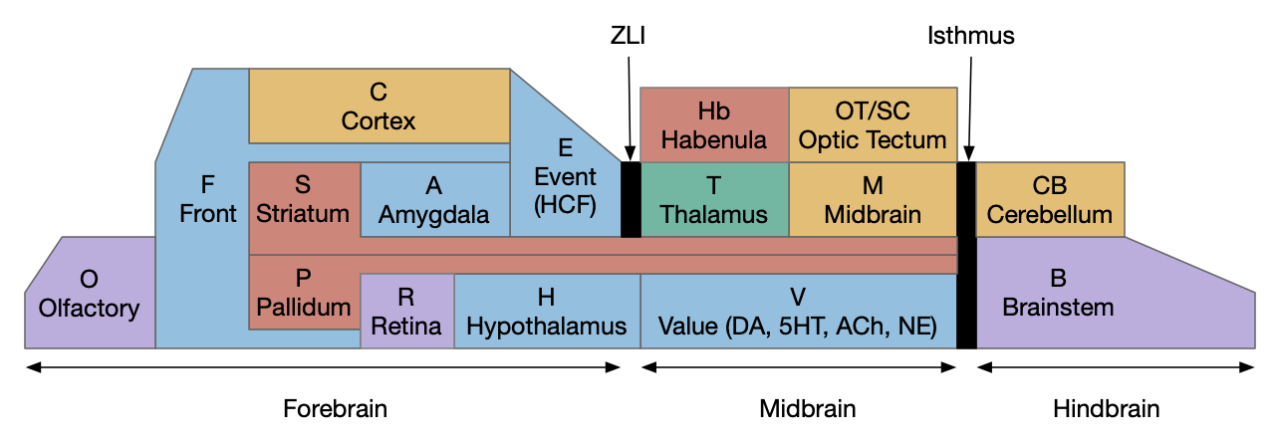
I’m revisiting feeding, because it’s central to the vertebrate brain’s organization, redoing essay 23: feeding, essay 27: feeding state machine, essay 36: R.pb as tunicate brain, and essay 38: food zone. For this essay, I’m leaning harder into the proto-vertebrate as a filter feeder [Mallat 2021], similar to the chordate amphioxus [Chung J et al 2023]. Proto-vertebrate filter feeding is essentially breathing, and vertebrate breathing itself developed from filter feeding [Li S and Wang F 2021]. This filter feeding circuitry is distinct from the jawed vertebrate searching for small morsels of food and quickly eating them, which is a more action-oriented process.
I’m focusing again on the transition between locomotion and feeding, but this time using the DLR (diencephalic locomotor region) and introducing opioids as a feeding signal. To keep the system manageable, I’m disabling the seek system, such as chemotaxis, and only using a simple random walk roaming search. The whole system can then be reduced to switching between a roaming search phase and a resting, filter-feeding stage.
Filter-feeding state machine
Consider a simple proto-vertebrate filter-feeder, similar to amphioxus [Chung J et al 2023] or an ascidian that continued locomotion through adulthood. Unlike ascidians that lose locomotion [Osugi et al 2017], the proto-vertebrate would alternate filter feeding in a location with moving to a new location. The animal might move because the filter feeding didn’t produce any nutrients or because of a noxious environment or to avoid a predator.
Because the proto-vertebrate is no simple, it might use the same system as ascidians to choose a filter feeding place: either finding odor, taste, and touch that indicates a good place to stop, or timing out and settling for the current place if it hasn’t found an ideal place.

The above state diagram shows a minimal behavior for a simple filter feeder. The search for food can time out with A2a.s (adenosine receptor), or it can halt earlier if a food zone is found with DOR.i (δ-opioid Gi inhibiting receptor for enkephalin). Filter feeding ends continues as long as the feeding produces food, signaled by MOR.i (μ-opioid Gi receptor). The animal leaves the feeding place and filter feeding ends if the environment is hazardous with tac1.q (tachykinin 1 Gq receptor for substance P) or when filter feeding doesn’t produce food, and the animal remains hungry, signaled by NPY (neuropeptide Y). Similarly, if the search state has a promising seek target, DA (dopamine) extends the search.
Expanding the filter feeding state machine
The filter feeding state can be the main state, such as tunicate ascidians committing to sessile filter feeding as adults. Since adult ascidians are sessile, filter feeding is the only state. The proto-vertebrate may have similarly spent almost all of its time filter feeding or resting, only moving when necessary to avoid environment hazards, or predators, or if the filter feeding is unsuccessful.

I’ve distinguished the avoiding path from the give-up path because they have very different internal logic. Avoidance is driven by external senses, but giving up is internal, comparing expected food intake with the actual eating results. Because an initial sampling phase does not yet generate nutrients, the system must sustain the sampling phase even without feeding back, but it must also timeout eventually if the feeding place is unsuccessful.
Opioids as suppressing search
The opioid peptides and receptors are a vertebrate novelty. Neither amphioxus nor tunicates show either the opioids or their receptors, and invertebrates also lack these [Dreborg et al 2008], [Huang et al 2022]. The four opioid peptides and receptors (pomc with MOR, penk with DOR, pdyn with KOR, pnoc with NOR) exist in all vertebrates and likely divided from a single opioid paired with a single receptor [Larhammar et al 2015], [Stevens 2009] during the two whole genome duplication events between tunicates and vertebrates [Dreborg et al 2008].
In mammals the MOR.i receptor exists across the entire brain [Le Merrer et al 2009] and is broadcast in ventricle CSF (cortical spinal fluid) [Veening et al 2012] and the bloodstream through the pituitary [Veening et al 2012]. However, the matching opioid β-endorphin is only produced in three places, H.arc (hypothalamus arcuate nucleus), H.pit (pituitary gland), R.nst (nucleus of the solitary tract in hindbrain). Before the genome duplication events, the proto-vertebrate likely had only a single opioid and paired receptor. The timing for β-endorphin is seconds to minutes in CSF and 30 minutes or more for peripheral [Veening et al 2012].
For the purposes of filter feeding, I think it’s reasonable to treat proto-vertebrate MOR as mainly through CSF with a relatively long time of minutes to an hour. Because the proto-vertebrate brain would have been smaller, many or most of brain areas would be adjacent to the CSF [Vígh et al 2004] and might use MOR as a broadcast peptide.
Many locomotor regions are inhibited by eating and often have MOR.i receptors. H.sum (supramammillary nucleus) is associated with movement, exploration, and avoidance and is suppressed while eating. Subsets of H.l.g (lateral hypothalamus gaba neurons) sensitive to leptin (a fat-sensing satiation peptide) is suppressed while eating [Petzold et al 2023]. H.l.ox (lateral hypothalamus orexin area) is associated with arousal and seeking and is suppressed while eating. H.arc AgRP (arcuate with AgRP peptide) is active before feeding, associated with hunter, and suppressed at contact with food [Altafi et al 2024]. V.lc (locus coerulus – noradrenaline source) is suppressed during mammal licking [Fan W et al 2024]. S.v (ventral striatum) is inhibited while eating and inhibiting S.v increases eating. H.l may be a central node in the transition between seeking and eating [Kongstorp et al 2025]. Food presentation suppresses R.pb CGRP (parabrachial nucleus CGRP alarm peptide) [Carter et al 2013].
Roaming drive from H.arc AgRP/NPY
A voluntary search for food needs to be driven by some specific process. While hunger is a driving force, the circadian rhythm seems to be the primary driver, modulated by hunger [Sayar-Atasoy et al 2023]. In the mammal hypothalamus, H.scn (suprachiasmatic nucleus) is the main circadian driver, with H.dm (dorsomedial hypothalamic nucleus) and H.l orexin as other important nodes. For the hunger circuit, circadian drives the hunger circuits in H.arc and H.pv (paraventricular hypothalamus). These circadian and hunger systems drive roaming circuits in H.l and eating circuits in R.pb.

The above diagram shows major nodes in the circadian, hunger, roaming food search, and eating circuits. The H.l subarea corresponds to the DLR, driving R1.a (anterior hindbrain) roaming. R.pb.l (lateral parabrachial nucleus) is a key hindbrain nucleus for managing feeding and alarm. R1.a essentially implements the roaming random walk search for food. R.nst is a key hindbrain eating nucleus.
Roaming and DLR
Roaming needs locomotor circuitry because it’s a locomotor action. The DLR (diencephalon motor region) and MLR (midbrain locomotor region) are locomotor areas above the hindbrain that exist in all vertebrates, including the lamprey [Ménard and Grillner 2008], [Robertson et al 2014]. Although the MLR is well-studied, less is known about the DLR. MLR is strongly driven by OT (optic tectum) [Kim LH et al 2017], and basal ganglia, and may be part of an olfactory seek path in lamprey that does not use DLR [Derjean et al 2018]. In mammals, DLR appears be be in H.l.p (posterior H.l), directly driving R1.a (anterior hindbrain, pontine oralis area) [Ji C et al 2024] with a possible corresponding locomotor region for zebrafish in H.v (ventral hypothalamus) [Farrell et al 2021]. The following diagram shows potential related areas and connectivity with H.l.p as DLR.

Exploration is associated with several highly interconnected regions, including H.sum (supramammillary nucleus) [Farrell et al 2021], P.ms (median septum) [Köhler and Srebro 1980], [Kuhn et al 2024], [Mocellin and Mikulovic 2021], Po.l (lateral preoptic area) [Subramanian et al 2018], and H.l [Altafi et al 2024]. I’m interpreting exploration as roaming food search, but “exploration” is often used in distinct and specialized contexts, such as information gathering. These exploration areas are also associated with RTPA (real-time place avoidance), such as the H.sum projections to Po.l [Escobedo et al 2023]. P.ms projections to Hb.l are RTPA, but P.ms projections to Po.l are locomotive without avoidance [Zhang GW et al 2018]. Although it’s possible that Po.l is strictly an avoidance node, which would not help this essay’s need for roaming, it’s also possible that sub-circuits within Po.l, P.ms, and H.sum are dedicated to avoidance, while others are used for roaming. For example, one study shows H.sum to Po.l as strictly avoidance [Escobedo et al 2023], while another shows H.sum tac1 (substance P) as correlated with all voluntary locomotion, not only avoidance [Farrell et al 2021].
P.ms may be particularly important for roaming as an integrator of spatial information and food drive [Tsanov 2022]. For the DLR, H.sum, H.pv and Poa stimulation all produce locomotion, but these areas require P.ms [Fuhrman et al 2015]. Some of these studies suggest that P.msdb.glu to Vta produces locomotion, which would be more to the seek circuit than for roaming. P.ms.glu activity sustains for several seconds after the stimulation ends, likely from intrinsic neuron mechanisms, because blocking internal neurotransmission does not curtail the sustained activity [Korvasová et al 2021].
Timing issues with giving up
As discussed in essay 38, a circuit for giving up on a feeding place conflicts with the circuit for starting feeding, because both have a shared threshold for giving up. The animal gives up on a feeding place if it isn’t receiving nutrients, but when it starts eating, it also doesn’t receive any nutrients. In particularly, filter feeding has a long delay between starting to feed and nutrients in the gut, as opposed to relatively quick feeding for mammals. The MOR.i receptor might manage successful feeding, but β-endorphin might be released only after minutes. To solve this dilemma, some mechanisms is necessary to spend enough time sampling the new place before giving up one it.

The above graph shows the difficulty. The horizontal dotted line represents the threshold for giving up. When feeding starts, the received nutrients are below the threshold at zero. A naive implementation would immediately give up. Successful feeding has a delay (1 minute here) before its signal for MOR.i is available. To give the potential feeding place a chance, the animal either needs to be actively stopped with a starting enthusiasm period, or stopped for resting. Because filter-feeding and resting are essentially identical for the proto-vertebrate, a resting stop could be sufficient without needing a starting enthusiasm system.
Taste and dopamine is a possible intermediate to give time for MOR to kick in. If the animal tastes food in the filter-feeding branchial arches before the food is digested, that early signal could trigger dopamine to extend a food-zone waiting period and allow filter feeding to continue. This temporary dopamine signal might habituate relatively quickly to avoid perseveration. In mammals, Vta dopamine extends eating rich food [Zhu Z et al 2025].
Food-zone stopping
Essay 38 covered the H.l support for food zone from [Jennings et al 2015]. The core of the food zone is food odor. The ascidian larva has a simple odor and tactile circuit in the ascidian palps that help decide where the larva should settle. The genetic transcription factors for ascidian palps are similar to the vertebrate forebrain, specifically foxg1, which marks the vertebrate forebrain [Cao C et al 2019]. Looking at the vertebrate circuit, the path from Ob (olfactory bulb) to S.ot (olfactory tubercle) to Pv (ventral pallidum) to H.l can serve the food zone function.

From [Bernat et al 2024], the S.ot to P.v to H.l path is the main S.ot path through P.v. Let’s consider this as the food-zone stop circuit. When the animal senses a food odor, the S.ot to H.l circuit will activate, detecting a food zone, which drives the animal to stop roaming and settle for feeding.
Importantly, S.o has the same adenosine timeout capability as the rest of the striatum, with A2a. (adenosine Gs receptor) and penk (enkephalin) marking the timeout indirect path. Enkephaline is the opioid ligand for DOR.i, but it also activates MOR.i, which is expressed in Pv [Neuhofer and Kalivas 2023], [Le Merrer et al 2009] and increases eating. This A2a.i and DOR.i circuit is the transition marker for the state machine above.
A dopamine taste signal might extend the food zone timeout [Zhu Z et al 2025]. The S.ot adenosine timeout neuron has a D2.i (dopamine Gi inhibitory) receptor, which inhibits the timeout without suppressing it entirely, essentially extending it.
Roaming timeout as filter-feeding sample
Anther possibly simpler sampling strategy is to use resting as a sampling phase. The roaming action itself could time out after a few minutes, resting for another few minutes before starting roaming again. In rodents the locomotion bouts are fairly short. Obviously, rodents are not filter feeders, but a proto-vertebrate filter-feeder could use a similar roaming-resting rhythm to periodically sample potential feeding zones without needing any odor place-detection circuit.

The above circuit shows roaming driven by H.l with a timeout circuit suing S.sh (ventral striatum shell) and Pv. As in the odor timeout, roaming uses an A2a.s circuit as a timeout, with a time of a few minutes. Because filter feeding and resting are essentially equivalent, this resting phase can find a feeding spot without explicitly detecting a food zone.
Simulation
The simulation roughly follows the circuits outlines above, centered on H.l as a roaming driver. The main change from previous essays is in HypMove which represents H.l. This essay simplifies H.l, because H.l has almost no internal connections [Burdakov et al 2020], mantling that HypMove needs to essentially implement a single neural layer. It can combine the main circadian driver with hunger and suppressive elements like FoodZone or a morphine suppressor from HypEat, where the animal shouldn’t move if it’s successfully filter feeding. H.l has strong MOR.i, which can inhibit the driving hunger signal. H.l uses a timeout with a S.msh model in RoamTimeout to timeout the roaming. This timeout produces a periodic rest time while the timeout recovers, which then defaults to filter feeding.

The above diagram shows the roaming sub circuit, focused on HypMove. FoodZone is equivalent to S.ot in this simulation, while in mammals the food zone likely includes S.ls (lateral septum), S.v (ventral striatum), and P.bst (bed nucleus of the stria terminalis). HypEat is equivalent to the morphine and satiation circuits, which includes H.arc and H.pv, but also includes broadcast feeding receptors like leptin and glucose receptors that are on H.l neurons directly without needing separate interoception neurons.
HypMove roaming drives HindMove, the R1.a model. As in the DLR H.l to R1.a connection, this connection is slow (~1s) and weak in HindMove and can be overridden by essentially anything else in the hindbrain.
Filter feeding is likewise weak and not driven by upstream modules outside of the hindbrain. This passive eating without higher control is unlike mammal eating. HindEat is not driven by hypothalamus or forebrain inputs. If the animal has stopped moving, the hindbrain will start filter feeding after a short time (~1s). If the filter feeding is successful, gut nutrients will trigger MOR release in HypEat, which will continue to suppress roaming.

The above screenshot shows the animal stopped in a food zone (the teal stars), eating and receiving gut nutrient feedback, which drives MOR to suppress roaming.
References
Altafi, M., Chen, C., Korotkova, T. and Ponomarenko, A., 2024. Sequential activation of lateral hypothalamic neuronal populations during feeding and their assembly by gamma oscillations. Journal of Neuroscience, 44(43).
Bernat, N., Campbell, R.R., Nam, H., Basu, M., Odesser, T., Elyasaf, G., Engeln, M., Chandra, R., Golden, S., Ament, S. and Lobo, M.K., 2024. Multimodal interrogation of ventral pallidum projections reveals projection-specific signatures and effects on cocaine reward. Journal of Neuroscience, 44(18).
Cao C, Lemaire LA, Wang W, Yoon PH, Choi YA, Parsons LR, Matese JC, Wang W, Levine M, Chen K. Comprehensive single-cell transcriptome lineages of a proto-vertebrate. Nature. 2019 Jul;571(7765):349-354.
Carter ME, Soden ME, Zweifel LS, Palmiter RD. Genetic identification of a neural circuit that suppresses appetite. Nature. 2013 Nov 7;503(7474):111-4.
Chung J, Newman-Smith E, Kourakis MJ, Miao Y, Borba C, Medina J, Laurent T, Gallean B, Faure E, Smith WC. A single oscillating proto-hypothalamic neuron gates taxis behavior in the primitive chordate Ciona. Curr Biol. 2023 Aug 21;33(16):3360-3370.e4.
Derjean D, Moussaddy A, Atallah E, St-Pierre M, Auclair F, Chang S, Ren X, Zielinski B, Dubuc R. A novel neural substrate for the transformation of olfactory inputs into motor output. PLoS Biol. 2010 Dec 21;8(12):e1000567.
Dreborg, S., Sundström, G., Larsson, T.A. and Larhammar, D., 2008. Evolution of vertebrate opioid receptors. Proceedings of the National Academy of Sciences, 105(40), pp.15487-15492.
Escobedo Abraham, Holloway Salli-Ann, Votoupal Megan, Cone Aaron L, Skelton Hannah E, Legaria Alex A., Ndiokho Imeh, Floyd Tasheia, Kravitz Alexxai V., Bruchas Michael R., Norris Aaron J. (2023) Glutamatergic Supramammillary Nucleus Neurons Respond to Threatening Stressors and Promote Active Coping eLife 12:RP90972
Fan, W., Engborg, C.B. and Sciolino, N.R., 2024. Locus Ceruleus Dynamics Are Suppressed during Licking and Enhanced Postlicking Independent of Taste Novelty. Eneuro, 11(4).
Farrell JS, Lovett-Barron M, Klein PM, Sparks FT, Gschwind T, Ortiz AL, Ahanonu B, Bradbury S, Terada S, Oijala M, Hwaun E, Dudok B, Szabo G, Schnitzer MJ, Deisseroth K, Losonczy A, Soltesz I. Supramammillary regulation of locomotion and hippocampal activity. Science. 2021 Dec 17;374(6574):1492-1496.
Fuhrmann, F., Justus, D., Sosulina, L., Kaneko, H., Beutel, T., Friedrichs, D., Schoch, S., Schwarz, M.K., Fuhrmann, M. and Remy, S., 2015. Locomotion, theta oscillations, and the speed-correlated firing of hippocampal neurons are controlled by a medial septal glutamatergic circuit. Neuron, 86(5), pp.1253-1264.
Huang, A.Y., Taylor, A.M., Ghogha, A., Pribadi, M., Wang, Q., Kim, T.S., Cahill, C.M., Coppola, G. and Evans, C.J., 2022. Genetic and functional analysis of a Pacific hagfish opioid system. Journal of neuroscience research, 100(1), pp.19-34.
Jennings JH, Ung RL, Resendez SL, Stamatakis AM, Taylor JG, Huang J, Veleta K, Kantak PA, Aita M, Shilling-Scrivo K, Ramakrishnan C, Deisseroth K, Otte S, Stuber GD. Visualizing hypothalamic network dynamics for appetitive and consummatory behaviors. Cell. 2015 Jan 29;160(3):516-27.
Ji, C., Zhang, Y., Lin, Z., Zhao, Z., Jiao, Z., Zheng, Z., Shi, X., Wang, X., Li, Z., Yu, S. and Qu, Y., 2024. Activation of hypothalamic-pontine-spinal pathway promotes locomotor initiation and functional recovery after spinal cord injury in mice. bioRxiv, pp.2024-11.
Kim LH, Sharma S, Sharples SA, Mayr KA, Kwok CHT, Whelan PJ. Integration of Descending Command Systems for the Generation of Context-Specific Locomotor Behaviors. Front Neurosci. 2017 Oct 18;11:581.
Kongstorp, M., Karnani, M.M. and McCutcheon, J.E., 2025. Does the lateral hypothalamus govern the transition between appetitive and consummatory feeding?. Neuropharmacology, p.110438.
Korvasová, K., Ludwig, F., Kaneko, H., Sosulina, L., Tetzlaff, T., Remy, S. and Mikulovic, S., 2021. Locomotion induced by medial septal glutamatergic neurons is linked to intrinsically generated persistent firing. bioRxiv, pp.2021-04.
Köhler, C. and Srebro, B., 1980. Effects of lateral and medial septal lesions on exploratory behavior in the albino rat. Brain Research, 182(2), pp.423-440.
Kuhn, F., Mocellin, P., Pupe, S., Wang, L., Lemire, A.L., Sosulina, L., Barnstedt, O., Spruston, N., Cembrowski, M.S. and Remy, S., 2024. Neuronal heterogeneity in the medial septum and diagonal band of Broca: classes and continua. bioRxiv, pp.2024-08.
Larhammar, D., Bergqvist, C. and Sundström, G., 2015. Ancestral vertebrate complexity of the opioid system. Vitamins & Hormones, 97, pp.95-122.
Le Merrer J, Becker JA, Befort K, Kieffer BL. Reward processing by the opioid system in the brain. Physiol Rev. 2009 Oct;89(4):1379-412.
Li S, Wang F. Vertebrate Evolution Conserves Hindbrain Circuits despite Diverse Feeding and Breathing Modes. eNeuro. 2021 Apr 28;8(2):ENEURO.0435-20.2021.
Mallatt, J., 2008. The origin of the vertebrate jaw: neoclassical ideas versus newer, development-based ideas. Zoological science, 25(10), pp.990-998.
Ménard A, Grillner S. Diencephalic locomotor region in the lamprey–afferents and efferent control. J Neurophysiol. 2008 Sep;100(3):1343-53.
Mocellin P, Mikulovic S. The Role of the Medial Septum-Associated Networks in Controlling Locomotion and Motivation to Move. Front Neural Circuits. 2021 Jul 22;15:699798.
Neuhofer, D. and Kalivas, P., 2023. Differential modulation of GABAergic and glutamatergic neurons in the ventral pallidum by GABA and neuropeptides. Eneuro, 10(7).
Petzold A, van den Munkhof HE, Figge-Schlensok R, Korotkova T. Complementary lateral hypothalamic populations resist hunger pressure to balance nutritional and social needs. Cell Metab. 2023 Mar 7;35(3):456-471.e6.
Robertson B, Kardamakis A, Capantini L, Pérez-Fernández J, Suryanarayana SM, Wallén P, Stephenson-Jones M, Grillner S. The lamprey blueprint of the mammalian nervous system. Prog Brain Res. 2014;212:337-49.
Stevens, C.W., 2009. The evolution of vertebrate opioid receptors. Frontiers in bioscience: a journal and virtual library, 14, p.1247.
Subramanian, S., Reichard, R.A., Stevenson, H.S., Schwartz, Z.M., Parsley, K.P. and Zahm, D.S., 2018. Lateral preoptic and ventral pallidal roles in locomotion and other movements. Brain Structure and Function, 223, pp.2907-2924.
Tsanov, M., 2022. Basal forebrain impairment: understanding the mnemonic function of the septal region translates in therapeutic advances. Frontiers in Neural Circuits, 16, p.916499.
Veening JG, Gerrits PO, Barendregt HP. Volume transmission of beta-endorphin via the cerebrospinal fluid; a review. Fluids Barriers CNS. 2012 Aug 10;9(1):16.
Vígh B, Manzano e Silva MJ, Frank CL, Vincze C, Czirok SJ, Szabó A, Lukáts A, Szél A. The system of cerebrospinal fluid-contacting neurons. Its supposed role in the nonsynaptic signal transmission of the brain. Histol Histopathol. 2004 Apr;19(2):607-28.
Zhang GW, Shen L, Zhong W, Xiong Y, Zhang LI, Tao HW. Transforming Sensory Cues into Aversive Emotion via Septal-Habenular Pathway. Neuron. 2018 Sep 5;99(5):1016-1028.e5.
Zhu Z, Gong R, Rodriguez V, Quach KT, Chen X, Sternson SM. Hedonic eating is controlled by dopamine neurons that oppose GLP-1R satiety. Science. 2025 Mar 28;387(6741):eadt0773.


