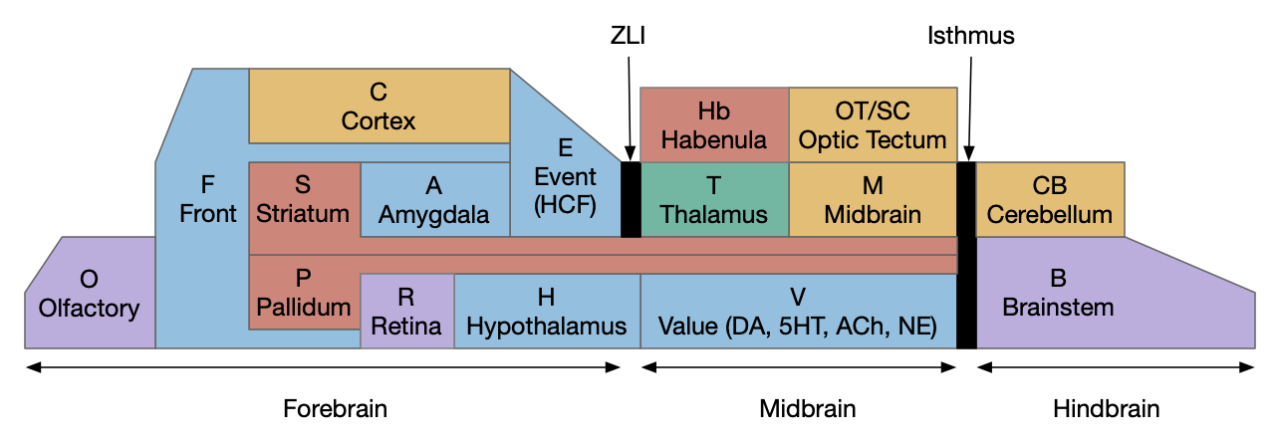
I’m returning to decision making from essay 42, because I think it can be simplified by restricting it further to concentrate on the hindbrain parts of BG (basal ganglia) without needing the forebrain S.d (striatum) or P.ge (external globus pallidus). [Kamali Sarvestani et al 2011] suggest a BG functional split between a brainstem arbitration system with Snr (substantia nigra pars reticulata), H.stn (subthalamus), and P.ge; and an extension system focused on S.d. Because I’m still focused on left vs right turning decisions, which is part of the bilaterian physical structure [Braitenberg 1984], P.ge can also be dropped. Snr and H.stn form short subcortical BG loops such as Snr, H.stn, and OT (optic tectum); or Snr, H.stn, and R.pb (parabrachial nucleus); or Snr, H.stn, and M.pag (midbrain periaqueductal gray) [Coizet et al 2024]. For the essay simulation, these short BG loops can connect brainstem action paths into a consensus circuit.
Decision, coordination, and consensus
The simulation represents has several independent brainstem locomotion action paths that currently combine in the spinal cord: temporal chemotaxis and phototaxis in the Hb.mv (habenula, medial ventral) to R.ip (interpeduncular nucleus) to R1.a (anterior hindbrain motor area) path, spatial chemical seek in the V.pt (posterior tuberculum) to MLR (midbrain locomotor region) path, and obstacle avoidance in the M.pt (pretectum) to M.nmlf (nucleus of the median lateral fasciculus – midbrain motor area). If the simulation implemented ASR (acoustic startle reflex), it would implement the N8 (acoustic nerve) to R4.rs.mc (Mauthner cell) to N.sp (spinal cord) 3-neuron reflex action path. If the simulation implemented looming defense, it would need the OT to R5.rs (mid-hindbrain turning reticulospinal) path. With the exception of MLR and OT, which both use the hindbrain R5.rs, these each use different reticulospinal driving neurons, resolved only in the spinal cord.

The above diagram shows two of the chemotaxis (odor seeking) paths in the current simulation. In the lamprey, Ob.m (medial olfactory bulb) projects to Hb.mv in the midbrain roof [Stephenson-Jones et al 2012], and to V.pt in the midbrain tegmentum (floor) [Derjean et al 2010]. The Hb.mv to R.ip system is used for chemotaxis [Chen WY et al 2019], phototaxis [Chen X and Engert 2014], and thermotaxis [Palieri et al 2024], using self-motion and temporal gradient measurement to determine direction [Chen X and Engert 2014], [Palieri et al 2024]. The V.pt path drives MLR locomotion [Derjean et al 2010], and I’m using this path as a tropotaxis seek, but without a study backing it up, other than V.pt being involved with turning [Barrios et al 2020], [Horstick et al 2020]. Both paths are chemotaxis paths, but they are entirely separate except for their Ob input and N.sp final output. Currently, any differences are resolved by a strict priority where R5.rs from the MLR/OT path strictly overrides R1.a (aka R.pn.o pontine oxalis) from the Hb.mv – R.ip.m path. A better solution would combine the two chemotaxis estimates, improving the accuracy and avoiding conflicts. This combination would be part of a consensus decision system, which essay 30 introduced as a place holder in the context of RTPA (real-time place avoidance).

This consensus loop could be implemented by the short brainstem BG loops described by [Kamali Sarvestani et al 2011] and [Coizet et al 2024]. A key node in MLR, Ppt (pedunculopontine tegmentum), is tightly connected with the entire BG. R1.a (aka R.pn.o) is both an input to BG using T.pf (parafascicular thalamus) [Gonzalo-Martín et al 2024] and driven by Snr [McElvain et al 2021].
MLR seek
To introduce the BG, consider a simplified role as lateral inhibition between a left vs right decision for the MLR seek circuit. Essay 40 discussed the Sprague effect, which uncovered contralateral inhibition between OT involving Snr and Ppt [Durmer and Rosenquist 2001], [Jiang H et al 2003], [Krauzlis et al 2013], [Valero-Cabré et al 2020]. GABA neurons in Ppt.a (anterior Ppt) are essentially a continuation of the adjacent Snr.p [Mena-Segovia and Bolam 2017], [Hormigo et al 2018]. Glutamate neurons in Ppt.p are part of the MLR and produce locomotion, extending into the adjacent M.cnf (uniform nucleus) part of MLR [Mena-Segovia and Bolam 2017]. Both Ppt and Snr.p derive from R1 (hindbrain rhombomere 1) [Waite 2012], [Lahti et al 2016], [Morello et al 2020].

A possible early proto-vertebrate could use Snr simply for lateral inhibition when deciding to turn left or right in the MLR seek circuit. In the above circuit based on the Sprague effect circuit, Snr acts both as a feedforward inhibition from V.pt to Ppt and feedback inhibition from Ppt to the contralateral Ppt.
For simplicity, I’ve used Ppt for both forward motion [Brocard et al 2010] and turning [Assous et al 2019], [Dautan 2023], [Huang Y et al 2024] omitting the highly related OT turning. Although Ppt does have directional neurons [Huang Y et al 2024], turning is more closely associated with OT, which both Ppt and Snr are reciprocally connected to [Comoli et al 2012], [Valero-Cabré et al 2020]. It’s possible that a proto-vertebrate seek circuit always used OT as its primary turning node with Ppt as modulatory for attention and persistence.
T.pf parafascicular thalamus
The Hb.mv → R.ip → R1.a chemotaxis circuit connects to BG with T.pf (parafascicular thalamus) [Gonzalo-Martín et al 2024], which directly connects to Snr and H.stn [Hanini-Daoud et al 2022]. T.pf is a unique thalamus nucleus both morphologically and electrophysically [Phelan et al 2005]. T.pf receives input from several brainstem motor regions, including R1.a (R.pn.o) [Gonzalo-Martín et al 2024], and it outputs to most of the cortex, strongly to S.d, and also directly to H.stn and S.nr [Gonzalo-Martín et al 2024], [Hanini-Daoud et al 2022]. This path from R1.a → T.pf → Snr lets the Hb.mv – R.ip.m chemotaxis path influence the V.pt → MLR chemotaxis seek path. Stimulating T.pf produces ipsiversive head turning, prolonged stimulation produces full body turns, and stimulation and restore movement during DA depletion such as in Parkinson’s disease [Fallon et al 2023].

The above diagrams shows the R1.a temporal chemotaxis path influencing the MLR spatial chemotaxis path via T.pf, where Snr is already a left vs right decision for MLR, now modulated by R1.a → T.pf input. T.pf itself can provide an integrative role, but for not it has only a single input. This T.pf connection could either serve as an efferent copy: preventing MLR from interfering with an R1.a decision, or a consensus planning input before the turning decision commits.
The thalamus is a new system in vertebrates, not present in other chordates. It developed in the same prosomere (brainstem segment) as Hb and the pineal gland. If the thalamus defining tcf7l2 genetic transcription factor is changed, the thalamus acquires Hb properties [Roberson and Halperin 2018]. Tcf7l2 is also a regulator for nACh function [Srivastava et al 2023], with other effects including the GLP-1 metabolic pathway. The thalamus is modulated by ACh (acetylcholine), which transforms most of the thalamus from a sleep-mode bursting pattern to an attentive tonic bursting pattern [Ye M et al 2009], but many T.pf neurons respond differently to ACh without the more typical bursting vs tonic thalamus pattern. Thalamus ACh comes from Ppt and P.ldt (laterodorsal tegmentum) [Ye M et al 2009]. One possibly motivation for a proto-vertebrate adding the thalamus as a relay is its reaction to ACh as a sleep and attention gating mechanism.

As a speculation, Hb.mv is interesting in this context because T.pf is called “parafasciclar” because it encircles the Hb projection Hb.fr (fasciculus retroflex) and because Hb.mv is a major ACh source that appears to be driven by local ACh release [Chung L et al 2016]. As far as I know, there is no evidence that ACh from Hb.mv affects T.pf in modern vertebrates. To motivate a proto-vertebrate creating a T.pf relay instead of directly contacting Snr, note that both ACh and the Hb-pineal complex are associated with the sleep-wake cycle. The pineal gland and habenula serve as a circadian clock [Vatine et al 2011], [Baño-Otálora et al 2017], and pineal producing melatonin [Aranda-Martínez et al 2023], and Hb providing a role in sleep [Hikosaka 2010], [Aizawa et al 2013]. However, this is entirely speculative, because the initial reason for the thalamus is known. In some vertebrates like fish, parts of the thalamus have an entirely different origin and organization with a similar function [Butler 2008], [Mueller 2012]. Speculative origin aside, adding T.pf as a gated relay to the decision commitment circuit adds value by making the circuit responsive to sleep and attention modulation.
Ppt as attention center like R.is
While the R1.a temporal chemotaxis modulation of the MLR spatial chemotaxis is relatively straightforward, the opposite direction is complicated by the complexity of Ppt, which is not purely motor but integrative [Gut and Winn 2016], [Noga and Whelan 2022], with some arguing that Ppt should not be considered as MLR [Gut and Winn 1016], [Opris et al 2019]. Ppt has a role in attention and as a central BG node. Connectivity from MLR/Ppt to R1.a may not be a locomotive consensus circuit, but an independent attention/modulatory function. To illustrate a possible attention/modulatory role for Ppt independent of MLR, consider the analogy with a sibling nucleus R.is (nucleus isthmi, aka parabigeminal in mammals).
R.is is a developmental sibling to Ppt, produced from the same progenitors in R1, but at a different development time [Volkmann et al 2010], [Wullimann et al 2011]. It is well-studied for visual attention in the OT [Henriques et al 2019], and unlike Ppt it has a clear and straightforward function. Like Ppt, R.is contains ACh and GABA neurons, but these are separated into distinct nuclei in R.is. The ACh neurons sustain visual attention in zebrafish to maintain focus on a hunting target [Henriques et al 2019], [Krauzlis et al 2013], [Marín et al 2007]. The GABA neurons form a long-distance lateral inhibition network to suppress distractors [Marín et al 2007]. R.is is visually topographic: each R.is area corresponds to a visual area in OT. If OT receives a visual stimulus near the horizon, it excites a corresponding R.is area, which in turn sustains attention to the reciprocal OT area with ACh and suppresses other visual areas with GABA.

The above diagram shows the R.is visual attention circuit for OT.s (superficial OT – visual), simplified to two regions, such as the upper or lower visual field. Importantly, this is a unilateral circuit: it does not have contralateral inhibition of the opposite side, unlike the focus of this essay. However, note that the circuit structure is similar to the Ppt, Snr and OT.d (deep OT – motor) circuit, where Ppt provides ACh and Snr provides GABA to select OT.d motor actions. So, consider Ppt as if it played a similar role as R.is, but selected attention to left and right motor decisions instead of visual attention, and where ACh sustains attention to the current selected motor action and Snr inhibition suppresses distractors.

In the above diagram, the left and right OT are weighing a decision to turn left or right for seeking. The mammalian OT.l (lateral OT) has crossed seek output to mid-hindbrain R5.rs turning neurons [Melleu and Canteras 2024]. Ppt.a (anterior Ppt) and Snr provide lateral inhibition for the OT decision, while Ppt.p (posterior Ppt) provides ACh to sustain attention to the currently selected side.

To complete the consensus loop, Snr also projects to R1.a (R.pn.o) [Delgado-Zabalza et al 2023], and Ppt projects to T.pf, including ACh and non-ACh projections [Ye M et al 2009], [Gonzalo-Martín et al 2024]. To simplify the diagram, I’ve merged the OT and Ppt. OT projects heavily to T.pf [Fallon et al 2023], [Gonzalo-Martín et al 2024].
As a caveat, the Snr projections to OT and R1.a are largely disjoint, although both collateralize to Ppt [McElvain et al 2021]. So, Snr may not provide a single shared left vs right decision between OT and R1.a but may instead facilitate reciprocal consensus with each making its final decision.
H.stn inheritance from chordate ancestor
The preceding discussion uses systems derived from R1 or from the midbrain for OT, which are on opposite sides of the MHB (midbrain-hindbrain boundary). H.stn (subthalamic nucleus) is a hypothalamus-derived region [Barbier and Risold 2021] of BG, adjacent to H.pstn (para-subthalamic nucleus) and H.l (lateral hypothalamus), which are all interconnected with R.pb. Unlike the all-GABA Snr, H.stn is almost entirely glutamate, and is part of the indirect BG path from S.d and the hyperdirect path from the cortex [Cavanagh et al 2011], but also from R.pb and Ppt [Jia T et al 2022], [Pautrat et al 2018]. H.stn enables stopping from the cortex hyperdirect path [Fischer et al 2017], [Ricci et al 2024] and also for delaying decision making in difficult situations [Frank 2006]. H.stn can also produce movement [Watson et al 2021], [Ricci et al 2024] with projections to Ppt and Snc (substantia nigra pars compacta).
The question here is why would the midbrain-hindbrain BG circuits above add a hypothalamus node to an existing consensus circuit in the hindbrain? One natural possibility is to gate food-seek by hunger, which is a major hypothalamus function. R.pb, H.l and R.nst (nucleus of the solitary tract) are all hunger and eating related nuclei. Alternatively, action paths through the hypothalamus may have been original chordate circuits, preceding the Ppt-Snr circuits described above.
The chordate tunicate ascidian Ciona has a larval stage that swims for about 12 hours before setting on a feeding spot, dissolving its tail and locomotor brain, and transforming into a sessile filter feeder [Anselmi et al 2024]. The larval brain is highly asymmetrical with a single gravity sensor, and two one-sided photoreceptor regions for separate phototaxis and dimming avoidance paths [Borba et al 2024], with functional similarities to the Hb.m-R.ip phototaxis and M.pt (pretectum)-OT dimming circuits. The transformation to sessile filter-feeding adult is triggered by chemical and mechanical neurons in three papillae at the front of the animal, which trigger a shutdown of locomotion [Hoyer et al 2024].

The above diagram shows the Ciona phototaxis path [Borba et al 2024], the papillae stop and metamorphosis path [Hoyer et al 2024], and some of the hindbrain [Ryan et al 2016], [Ryan and Meinertzhagen 2019]. I’ve added vertebrate areas as analogies, but these are not homologous. Genetic studies have suggested that aBV (anterior brain vesicle), pBV (posterior BV), and MG (motor ganglia) are homologous to the vertebrate forebrain, midbrain and hindbrain [Negrón-Piñeiro et al 2020]. Coronet cells in Ciona forebrain have been associated with hypothalamic DA cells [Lemaire et al 2021] or retina DA amacrine cells [Negrón-Piñeiro et al 2020], and relay cells of the coronet as genetically related to H.mb (hypothalamic mammillary body) [Lemaire et al 2021]. AMG (ascending motor ganglia) is genetically related to CB (cerebellum) [Kourakis et al 2024]. However, there is no evidence for homology in the functional analogies I’ve added for H.stn, Snr and MLR.
The additional vertebrate analogies in the diagram, including H.stn, Snr, MLR, Hb are for illustration only and are not homologous. However, the Ciona circuit does show that chordate action paths through the hypothalamus to the midbrain and hindbrain predate vertebrates. So, a proto-vertebrate could have built the proto-BG starting from a hypothalamus action path, instead of H.stn being added later to a hindbrain circuit. In this explanation, a single, asymmetrical H.stn and Snr could be primitive with a single, asymmetrical Ppt/MLR and only later adding bilateral inhibition and consensus with the phototaxis/chemotaxis path in Hb-R.ip.
The H.stn hyperdirect path
In keeping with H.stn is a primitive component of the BG circuit, consider the hyperdirect BG path, which is named following the conventions of the direct and indirect paths in the striatum. In mammals the hyperdirect path is often studies from C.mo (motor cortex) and F.pfc (prefrontal cortex) as a stop signal [Cavanagh et al 2011]. A path from OT.l (lateral OT) to H.stn is a stop signal for surprising visual events [Coizet et al 2009]. A path involving R.pb is involved with pain responses [Pautrat et al 2018], [Luan et al 2020], [Ricci et al 2024]. H.stn is also associated with prolonged decision-making under uncertainty [Frank 2006], slowing the decision process itself.

H.stn is heterogenous both topographically and mixed salt-and-pepper for connectivity and genetically [Haynes and Haber 2013], [Prasad and Wallén-Mackenzie 2024]. Functionally, it is highly involved with decision making, particularly premature and impulsive responses, perseveration, and motivation [Baunez and Lardeax 2011]. Along with its Snr projection, H.stn projects to MLR/Ppt [Smith et al 1990], [Watson et al 2021] and to Snc [Lobb et al 2010], [Ledonne et al 2012], and can initiate movement and turns, not only stopping movement. Importantly for this essay, unilateral H.stn stimulation produces ipsilateral turning [Freestone et al 2015], [Zhou J et al 2025], and stimulation of T.pf → H.stn connection produces locomotion or ipsilateral turning [Watson et al 2021].

The above diagram incorporates H.stn into the consensus circuit between the Hb → R.ip temporal chemotaxis and the V.pt → MLR spatial odor seek circuit. H.stn signals stop when the filter-feeding animal reaches an appropriate feeding spot. For simplicity, the diagram only shows the influence Hb→R.ip on the MLR/Ppt circuit, but the opposite direction includes Ppt to T.pf modulation of the R1.a output of the Hb→R.ip path. Because H.stn also receives input from the entire R.pb [Williams 2024], [Jia T et al 2022] and from OT.l [Al Tanner et al 2024], it can incorporate visual, somatosensory, and lateral-line stop signals from OT, and incorporate R.pb pain and irritation signals into the left vs right decision loop [Al Tanner et al 2023].
Asymmetry
So far, the essay has assumed a Braitenberg-like bilateral circuit [Braitenberg 1986] for the left vs right decision, but the ascidian Ciona forebrain and midbrain are asymmetrical, with single asymmetrical ganglia as opposed to bilateral paired ganglia. This asymmetry may help explain some of the circuitry in Snr and in OT.l, where each side contains decision variables for both ipsilateral and contralateral turning.
Although the Ciona hindbrain is primarily symmetrical in general connectivity, its AMPA (glutamate receptor) pattern is asymmetrically biased toward the left, driven by the left-bias pitx2 transcription factor [Kourakis et al 2021]. The nodal/pitx transcription factor chain produces left-based asymmetry, affecting Hb [Lagadec et al 2015] and non-neural systems including the heart [Waite 2012]. This pitx2 path is also important for forming the pituitary and stomeodeum (mouth opening) [Waite 2012]. H.stn and OT.i orientation neurons are both marked by a symmetrical pitx2 isoform in mammals, despite being symmetrical, but zebrafish only have an asymmetrical form of pitx2 [Waite 2012].
So, let’s consider an asymmetrical implementation of this left vs right decision. A reason to examine asymmetry is the internal structure of both Snr and OT.l, where each side has both ipsilateral and contralateral turning information [Brown et al 2014], [Báez-Cordero et al 2020], [Hanini-Daoud et al 2022], [Duan et al 2021], [Doykos et al 2025], [Essig et al 2020], which means each side is capable of a turning decision without needing a contralateral decision.

The above diagram shows an asymmetrical left vs right decision using Snr. When T.pf→Snr is stimulated, of the 28% of Snr that respond, ~50% are excited and ~50% are biphasic inhibited followed by excited [Hanini-Daoud et al 2022]. Similarly, when T.pf→H.stn is stimulated, 50% of Snr are excited and 50% inhibited. Similarly, the OT turning system has both ipsilateral and contralateral neurons for decision-making [Essig et al 2020], [Duan et al 2021].

In vertebrates, H.stn, Snr and OT.l as symmetrical, despite H.stn and OT.l having asymmetrical pitx2 markers, and despite these ganglia having the capability of deciding using only a single side. It’s possible that an original single-sided system later became duplicated, similar to the single eye of Amphioxus and Ciona developing into the paired vertebrate eye.
Snr internal lateral disinhibition
The above asymmetry discussion is largely a motivation for the Snr internal circuitry and behavior, which contains both ipsilateral and contralateral turning responses [Báez-Cordero et al 2020]. Snr neurons are essentially all projection neurons with no interneurons, but the projection neurons contain weak collaterals to other Snr neurons [Brown et al 2014]. Because Snr is tonically active, the collaterals are also tonically active, but the net tonic effect is minimal or nonexistent, because Snr neuron neuron firing is desynchronized [Brown et al 2014], [Higgs and Wilson 2016], suggesting that Snr collaterals may primarily enforce desynchronization [Higgs and Wilson 2016]. Alternatively, the weak Snr collaterals may require a synchronous input to significantly disinhibit other Snr, similar to lateral inhibition for contrast [Brown et al 2014] or serve as divisive gain control as feedback inhibition not lateral inhibition [Yttri and Dudman 2018].

T.pf and H.stn stimulation can drive both inhibition and excitation in S.nr [Hanini-Daoud et al 2022], possibly using this disinhibition circuit. An inhibition of one option disinhibits other options. The above diagram shows how this lateral disinhibition could scale beyond two options. Inhibiting option B disinhibits both open A and C. Inhibition both options B and C more strongly disinhibits option A. In this context, H.stn could encode “move-away,” leaving contralateral space, not encoding a direct motor action [Zhou J et al 2025].
This need for synchronous input resembles the looming circuit between OT.m and M.pag [Evans 2017] and amphibian hindbrain decision circuits [Buhl et 2012]. An advantage of this kind of weak, consensus input circuit is resistance to noise or other spurious input, because the animal will only react to a strong stimulus that drives many inputs simultaneously. In Parkinson’s disease, one of the causes of movement impairment is a synchronous H.stn↔P.ge (globus pallidus, external) oscillation at beta frequencies [Deffains et al 2016]. A treatment for Parkinson’s disease is DBS (deep brain stimulation) of H.stn, which breaks up abnormal beta [Pelloux et al 2014], although the exact mechanism of DBS stimulation is still unclear.
Simulation: comparison with previous conflict resolution
The previous essay 44 also had to resolve conflicts between the Hb→R.ip path and the Seek-MLR path. In that essay, I used a sibling of Ppt, P.ldt (laterodorsal tegmentum), to inhibit midbrain DA (dopamine) to inhibit the seek path. However, that DA control assumes an already existing BG circuit, and in a sense I’m going backwards to rebuild foundational control.

The plan for the current essay is functionally similar: R1.a chemical avoidance inhibits MLR odor seek, but the implementation now uses BG H.stn→S.nr inhibition instead of inhibition DA as a way of disabling seek. The previous implementation was a bit hand-wavy because it assumed a fully-functioning DA and BG system already existed. In this essay, I’m starting to assemble the core of a BG system itself.

For the sake of the simulation, I’m splitting turning from forward drive, where Tectum handles turning and MidMove handles forward. This functional division has vertebrate correlates because unilateral MLR stimulation produces bilateral forward movement without turns [Brocard et al 2010]. However, as discussed above, Ppt does have turning information. For simplicity, however, I’m combining that function into OT as the main turning system. In reality MLR/Ppt likely has turning functionality, but for the simulation it’s difficult to distinguish the Ppt turning role from the OT turning role. Instead, I’m treating Ppt as modulatory/attention for OT-based turning, similar to R.is attention circuit for vision.
Issues with M.pt
There is an issue with how M.pt (pretectum) obstacle avoidance fits into this H.stn-Snr model. In non-mammals, particularly in amphibians, M.pt is the main visual obstacle avoidance [Krauzlis et al 2018], while OT is for orientation, such as hunting prey, and M.pt inhibits OT.co (crossed-output OT) directly [Krauzlis et al 2018]. However, this direct M.pt inhibition of OT.co is counter to this essay’s model of H.stn-Snr as the central node in a consensus circuit. In fact, in non-mammals a major striatum output is both directly from S.d and through P.epn.a (entopeduncular nucleus) to M.pt and from P.epn.a and M.pt to OT [Marin et al 1997]. While P.epn.a has similar functionality to Snr, it is derived from the forebrain, not from R1 like part of Snr.

With this system, which exists in reptiles, birds, and frogs but not mammals [Krauzlis et al 2018], Ppt/MLR cannot be the final left vs right integration center. M.pt and OT.d do project to Snr [Liu D et al 2020], specifically the gad2 subpopulation. Lamprey M.pt is directly connected with OT [Capantini et al 2017], and it receives P.gi inhibition [Capantini et al 2017], where P.gi is functionally similar to Snr but derives from forebrain progenitors. The amphibian S.d to S.nr to M.pt to OT path inhibits obstacle avoidance to disinhibit hunting [Krauzlis et al 2018]. In amphibians, the striatum has two major pathways, the above S.d to M.pt to OT, and a tegmental S.d to M.tg (midbrain tegmentum) as a possible Snr homolog [Krauzlis et al 2018].
In itself, M.pt inhibition of OT isn’t a major issue, because I can treat it as an exception, but it does illustrate a problem with envisioning a general system for locomotion consensus. Although a general system may be a cleaner model, it doesn’t necessarily match evolution’s actual implementation. The striatum is explicitly outside of the scope of this essay, but the direct S.d to M.pt connectivity does show the benefit of splitting the BG into parts, because that S.d to M.pt function can presumably function without the rest of BG.
Issues with Ppt
Ppt is proving difficult to model because it’s not performing a single coherent function (or that I’m not seeing it.) Instead, it’s performing a set of semi-related functions. Partly, Ppt is performing MLR functions with glutamate neurons that extend to M.cnf [Mena-Segovia and Bolam 2017], which is more purely MLR. Some researchers consider Ppt as entirely separate from MLR [Gut and Winn 2016], which would simplify the model. Partly, Ppt is performing Snr-like functionality with the Ppt.a GABA population that extends from Snr.p [Mena-Segovia and Bolam 2017]. Partly, it seems to have R.is-like functionality with its ACh population, providing attention for OT, thalamus, P.bf (basal forebrain), S.d, and several hypothalamic, midbrain and hindbrain areas. But Ppt also has independent decision functions, including triggering a final decision with Snc bursting [Redila et al 2015] and C.m2 (premotor cortex) transition from planning to execution [Inagaki et al 2022].

Although Ppt can be studied in terms of its ACh, glutamate, and GABA neurotransmitters, even the neurotransmitter types oversimplifies the problem. For example, Ppt.p contains a distinct GABA cluster unrelated to the Snr extension in Ppt.a [Mena-Sevogia et al 2009]. Ppt contains non-MLR glu that signals decision threshold to Snc [Nishimaru et al 2023], [Ryczko 2024] and to C.mo via the thalamus [Inagaki et al 2022]. The Ppt decision functionality is related to neighboring M.rn (midbrain reticular nucleus). Ppt heavily influences T and S.d, particular S.cin (acetylcholine interneurons of S.d) with ACh and glutamate projections [Morgenstern and Esposito 2024]. Contrariwise, Ppt ACh signals deviation from exception [Zhang S et al 2024]. Because Ppt is highly internal connected with all ACh, glutamate, and GABA [Hormigo et al 2018], these sub-functions don’t appear to be independent modules.
Simulation
The simulation update itself turned out to be fairly minor, without any externally visible effects. Essentially, it ended up refactoring updates from the Hb-R.ip avoidance path through T.pf and the H.stn-Snr complex. Although it’s a significant architectural change, at least currently with the simple left vs right decisions, there’s no real functional change.
One question is whether the simulated H.stn-Snr circuit is for commitment or for choice. The actual H.stn-Snr is used for both, but the sub-functions may use different circuits. As I explored in essay 42, commitment is more primitive because commitment without a sophisticated choice system is useful, but choice without the ability to commit is useless.
It’s tempting to use Ppt as a central critical node, because it’s at the intersection of multiple functionality, but Ppt can be lesioned without eliminating decision. So it may be important in a modulatory sense, but it is not essential for functionality.
In the current simulation, H.stn and Snr are functionally indistinguishable. There’s currently no reason to have separate modules that distinguish between them. This may be because the current decision is simply right vs left, and later complexity will show the need for distinct areas. Alternatively, it may be that at the level of abstraction for the simulation, there is no need to separate the two into separate modules.
Discussion
The essay has two main aims: see if BG could be broken apart into simpler, but still useful subregions, preferably with more local developmental origins instead of the sprawling multi-region mammal BG; and see if BG could form the foundation of a consensus circuit linking disjoint action paths. This basic idea seems solid, but there are many interesting open questions about the details, because there are almost too many potential kernels of a proto-vertebrate BG, and it’s unclear how to select which ones are more likely.
The [Kamali Sarvestani et al 2011] model splits the BG into a striatum domain and a H.stn, Snr, and Pge arbitration domain centered on H.stn. That paper considered evidence from the mammalian BG, and I think the anamniote (amphibian, lamprey, and fish) BG adds supporting evidence to their model. Although missing in mammals, a major S.d output in anamniotes modulates M.pt obstacle avoidance and OT visual hunting without involving H.stn, Snr, or Ppt [Marin et al 1997]. This second striatum output path raises the possibility of the S.d to M.pt to OT being primitive, and the S.d to H.stn, Snr as a secondary improvement.
The [Coizet et al 2024] model examines even smaller subcortical BG loops with Snr and H.stn as joining with OT, R.pb, and M.pag as independent loops. In this essay, I focused more on the Hb-R.ip and R1.a temporal chemotaxis path and V.pt to MLR spatial chemotaxis paths, because the simulation uses those action paths more prominently. The general idea seems solid, despite the change in focus nodes. Simpler brainstem loops with a subset of BG.
The consensus aspect of the essay has fewer studies that I’ve found so far. [Jeon H et al 2022] studied cortical BG loops, focusing on H.stn as a central integrating hub, describing the system as “everyone talks and everyone listens.” I think the same description could apply to subcortical loops. For the essay simulation, the consensus circuit is the more driving need. As I mentioned in the previous essay 44, the integration of multiple action paths, including hypothalamic food-zone drivers, seek action paths, distinct avoidance-of-return paths, and obstacle avoidance was becoming increasingly ad hoc, even for a relatively simple animal. A consensus system allows better integration and likely more extensibility.
Snr complications
Although the essay uses Snr as part of the consensus system, the Snr output is mostly disjoint, not collateralized. [McElvain et al 2021] find disjoint output pools, including distinct OT.m (medial OT), OT.c (central OT), OT, R.pn.o (aka R1.a), R.my (medulla reticulum), V.dr (dorsal raphe), M.ic (inferior colliculus – auditory and lateral line). They find that all these pools do collateralize with Ppt, T.il (including T.pf), and T.mo (motor thalamus), but not across pools. For the essay, this result argues against a general “turn left” (or “avoid right”) consensus Snr, and more for individual “turn left” for R1.a and OT.
Additionally, the mammalian Snr is itself a chimera formed from both R1 hindbrain progenitors and midbrain progenitors [Partanen and Achim 2022], [Mendelsohn et al 2024]. These multiple Snr types have different origins and distinct genetic transcription factor development, and each type has multiple subtypes.
Somewhat independently, Snr can be divided into gad2 and PV subtypes. The Snr gad2 subpopulation drives more connected to midbrain and hindbrain motor areas and receives more input from non-BG sources (only 38% of inputs from BG) [Liu D et al 2020]. Gad2 is also associated with sleep and rest [Liu D et al 2020]. So an additional potential Snr origin story could be sleep neurons appropriated by decision systems. The Snr PV subpopulation is more specifically driven by BG (75% of inputs) and its output is more focused on midbrain and thalamus [Liu D et al 2020]. OT.l (crossed) has more Snr PV input and OT→H.stn connection is only from OT.l, not OT.m.
Presumably, the proto-vertebrate had only a single Snr system. The hindbrain R1 and gad2 seems more likely, with midbrain and PV as enhancing decision-making. Unfortunately, there’s no data to support that speculation. Because the majority of studies are mammalian, some of these Snr systems may be mammalian innovations, obscuring a simpler proto-vertebrate system.
Mammalian bias for H.stn, Snr, and Ppt
Almost all of the studies for the essay are mammalian studies of H.stn, Snr, and Ppt. When the aim of the essay is exploring proto-vertebrate origins of BG, excluding data from anamniotes: amphibian tadpoles, fish, or lampreys is a major flaw. Homologues for H.stn, Snr, and Ppt exist for those animals, but they are either poorly studied, or I just haven’t found the studies. This absence is important for both Snr and Ppt.
As mentioned above, the mammal Ppt is playing too many roles to understand what its core, original function might have been. An attention system like R.is, or a MLR function, a lateral inhibition like Snr, or even a decision threshold system connected to DA are all plausible. Ppt studies from lampreys, amphibian tadpoles, and fish might show a single, simpler function or at least a smaller system like an MLR with an associated ACh attention system.
The mammalian Snr is also highly heterogenous both in development and function. Studies from lampreys, tadpoles, or fish might distinguish conserved Snr areas from mammalian innovations. The distinct M.pt to OT path in anamniotes might mean that the Snr-like path is simpler than mammals and possibly more functionally focused.
References
Aizawa H, Cui W, Tanaka K, Okamoto H. Hyperactivation of the habenula as a link between depression and sleep disturbance. Front Hum Neurosci. 2013 Dec 10;7:826.
Al Tannir, R., Pautrat, A., Baufreton, J., Overton, P.G. and Coizet, V., 2023. The subthalamic nucleus: a hub for sensory control via short three-lateral loop connections with the brainstem?. Current Neuropharmacology, 21(1), pp.22-30.
Anselmi, C., Fuller, G.K., Stolfi, A., Groves, A.K. and Manni, L., 2024. Sensory cells in tunicates: insights into mechanoreceptor evolution. Frontiers in Cell and Developmental Biology, 12, p.1359207.
Aranda-Martínez P, Fernández-Martínez J, Ramírez-Casas Y, Rodríguez-Santana C, Rusanova I, Escames G, Acuña-Castroviejo D. Chronodisruption and Loss of Melatonin Rhythm, Associated with Alterations in Daily Motor Activity and Mitochondrial Dynamics in Parkinsonian Zebrafish, Are Corrected by Melatonin Treatment. Antioxidants (Basel). 2023 Apr 18;12(4):954.
Assous M, Dautan D, Tepper JM, Mena-Segovia J. Pedunculopontine Glutamatergic Neurons Provide a Novel Source of Feedforward Inhibition in the Striatum by Selectively Targeting Interneurons. J Neurosci. 2019 Jun 12;39(24):4727-4737.
Báez-Cordero, A.S., Pimentel-Farfan, A.K., Peña-Rangel, T. and Rueda-Orozco, P.E., 2020. Unbalanced inhibitory/excitatory responses in the substantia nigra pars reticulata underlie cannabinoid-related slowness of movements. Journal of Neuroscience, 40(30), pp.5769-5784.
Baño-Otálora B, Piggins HD. Contributions of the lateral habenula to circadian timekeeping. Pharmacol Biochem Behav. 2017 Nov;162:46-54.
Barbier M, Risold PY. Understanding the Significance of the Hypothalamic Nature of the Subthalamic Nucleus. eNeuro. 2021 Oct 4;8(5):ENEURO.0116-21.2021.
Barrios JP, Wang WC, England R, Reifenberg E, Douglass AD. Hypothalamic Dopamine Neurons Control Sensorimotor Behavior by Modulating Brainstem Premotor Nuclei in Zebrafish. Curr Biol. 2020 Dec 7;30(23):4606-4618.e4.
Baunez C, Lardeux S. Frontal cortex-like functions of the subthalamic nucleus. Front Syst Neurosci. 2011 Oct 11;5:83.
Borba, C., Kourakis, M.J., Miao, Y., Guduri, B., Deng, J. and Smith, W.C., 2024. Whole nervous system expression of glutamate receptors reveals distinct receptor roles in sensorimotor circuits. Eneuro, 11(9).
Braitenberg V. Vehicles: Experiments in synthetic psychology. MIT press; 1986 Feb 7.
Brocard F, Ryczko D, Fénelon K, Hatem R, Gonzales D, Auclair F, Dubuc R. The transformation of a unilateral locomotor command into a symmetrical bilateral activation in the brainstem. J Neurosci. 2010 Jan 13;30(2):523-33.
Brown J, Pan WX, Dudman JT. The inhibitory microcircuit of the substantia nigra provides feedback gain control of the basal ganglia output. Elife. 2014 May 21;3:e02397.
Buhl E, Roberts A, Soffe SR. The role of a trigeminal sensory nucleus in the initiation of locomotion. J Physiol. 2012 May 15;590(10):2453-69.
Butler, Ann. (2008). Evolution of the thalamus: A morphological and functional review. Thalamus & Related Systems. 4. 35 – 58.
Capantini L, von Twickel A, Robertson B, Grillner S. The pretectal connectome in lamprey. J Comp Neurol. 2017 Mar 1;525(4):753-772.
Cavanagh, J.F., Wiecki, T.V., Cohen, M.X., Figueroa, C.M., Samanta, J., Sherman, S.J. and Frank, M.J., 2011. Subthalamic nucleus stimulation reverses mediofrontal influence over decision threshold. Nature neuroscience, 14(11), pp.1462-1467.
Chen WY, Peng XL, Deng QS, Chen MJ, Du JL, Zhang BB. Role of Olfactorily Responsive Neurons in the Right Dorsal Habenula-Ventral Interpeduncular Nucleus Pathway in Food-Seeking Behaviors of Larval Zebrafish. Neuroscience. 2019 Apr 15;404:259-267.
Chen X, Engert F. Navigational strategies underlying phototaxis in larval zebrafish. Front Syst Neurosci. 2014 Mar 25;8:39.
Chung L, Jing M, Li Y, Tapper AR. Feed-forward Activation of Habenula Cholinergic Neurons by Local Acetylcholine. Neuroscience. 2023 Oct 1;529:172-182.
Coizet V, Graham JH, Moss J, Bolam JP, Savasta M, McHaffie JG, Redgrave P, Overton PG. Short-latency visual input to the subthalamic nucleus is provided by the midbrain superior colliculus. J Neurosci. 2009 Apr 29;29(17):5701-9.
Coizet, V., Tannir, R.A., Pautrat, A. and Overton, P.G., 2024. Separation of channels subserving approach and avoidance/escape at the level of the basal ganglia and related brainstem structures. Current Neuropharmacology, 22(9), pp.1473-1490.
Comoli, E., Das Neves Favaro, P., Vautrelle, N., Leriche, M., Overton, P. G., & Redgrave, P. (2012). Segregated anatomical input to sub-regions of the rodent superior colliculus associated with approach and defense. Frontiers in neuroanatomy, 6, 9.
Dautan, D., 2023. Cortical projection to the pedunculopontine nucleus subpopulation for the Go/STOP signal modulation of muscle tone and locomotion. bioRxiv, pp.2023-01.
Deffains M, Iskhakova L, Katabi S, Haber SN, Israel Z, Bergman H. Subthalamic, not striatal, activity correlates with basal ganglia downstream activity in normal and parkinsonian monkeys. Elife. 2016 Aug 23;5:e16443.
Delgado-Zabalza, L., Mallet, N.P., Glangetas, C., Dabee, G., Garret, M., Miguelez, C. and Baufreton, J., 2023. Targeting parvalbumin-expressing neurons in the substantia nigra pars reticulata restores motor function in parkinsonian mice. Cell reports, 42(10).
Derjean D, Moussaddy A, Atallah E, St-Pierre M, Auclair F, Chang S, Ren X, Zielinski B, Dubuc R. A novel neural substrate for the transformation of olfactory inputs into motor output. PLoS Biol. 2010 Dec 21;8(12):e1000567.
Doykos, T.K., Yamauchi, T., Buteau, A., Hanson, S., Dudman, J.T., Felsen, G. and Stubblefield, E.A., 2025. Correlates of head-fixed orienting movements in mouse superior colliculus and substantia nigra pars reticulata. bioRxiv, pp.2025-05.
Duan CA, Pagan M, Piet AT, Kopec CD, Akrami A, Riordan AJ, Erlich JC, Brody CD. Collicular circuits for flexible sensorimotor routing. Nat Neurosci. 2021 Aug;24(8):1110-1120.
Durmer JS, Rosenquist AC. Ibotenic acid lesions in the pedunculopontine region result in recovery of visual orienting in the hemianopic cat. Neuroscience. 2001;106(4):765-81.
Essig, J., Hunt, J.B. and Felsen, G., 2020. Inhibitory midbrain neurons mediate decision making. BioRxiv.
Evans DA, A midbrain mechanism for computing escape decisions in the mouse. PhD thesis 2017
Fallon, I. P., Hughes, R. N., Severino, F. P. U., Kim, N., Lawry, C. M., Watson, G. D., … & Yin, H. H. (2023). The role of the parafascicular thalamic nucleus in action initiation and steering. Current Biology, 33(14), 2941-2951.
Fischer P, Pogosyan A, Herz DM, Cheeran B, Green AL, Fitzgerald J, Aziz TZ, Hyam J, Little S, Foltynie T, Limousin P, Zrinzo L, Brown P, Tan H. Subthalamic nucleus gamma activity increases not only during movement but also during movement inhibition. Elife. 2017 Jul 25;6:e23947.
Frank, Michael J. Hold your horses: a dynamic computational role for the subthalamic nucleus in decision making. Neural networks 19.8 (2006): 1120-1136.
Freestone, P.S., Wu, X.H., de Guzman, G. and Lipski, J., 2015. Excitatory drive from the subthalamic nucleus attenuates GABAergic transmission in the substantia nigra pars compacta via endocannabinoids. European Journal of Pharmacology, 767, pp.144-151.
Gonzalo-Martín E, Alonso-Martínez C, Sepúlveda LP, Clasca F. Micropopulation mapping of the mouse parafascicular nucleus connections reveals diverse input-output motifs. Front Neuroanat. 2024 Jan 8;17:1305500.
Gut NK, Winn P. The pedunculopontine tegmental nucleus-A functional hypothesis from the comparative literature. Mov Disord. 2016 May;31(5):615-24.
Hanini‐Daoud, M., Jaouen, F., Salin, P., Kerkerian‐Le Goff, L. and Maurice, N., 2022. Processing of information from the parafascicular nucleus of the thalamus through the basal ganglia. Journal of Neuroscience Research, 100(6), pp.1370-1385.
Haynes WI, Haber SN. The organization of prefrontal-subthalamic inputs in primates provides an anatomical substrate for both functional specificity and integration: implications for Basal Ganglia models and deep brain stimulation. J Neurosci. 2013 Mar 13;33(11):4804-14.
Henriques, P.M., Rahman, N., Jackson, S.E. and Bianco, I.H., 2019. Nucleus isthmi is required to sustain target pursuit during visually guided prey-catching. Current Biology, 29(11), pp.1771-1786.
Higgs MH, Wilson CJ. Unitary synaptic connections among substantia nigra pars reticulata neurons. J Neurophysiol. 2016 Jun 1;115(6):2814-29.
Hikosaka, O., 2010. The habenula: from stress evasion to value-based decision-making. Nature reviews neuroscience, 11(7), pp.503-513.
Hormigo, S., López, D.E., Cardoso, A., Zapata, G., Sepúlveda, J. and Castellano, O., 2018. Direct and indirect nigrofugal projections to the nucleus reticularis pontis caudalis mediate in the motor execution of the acoustic startle reflex. Brain Structure and Function, 223(6), pp.2733-2751.
Horstick EJ, Bayleyen Y, Burgess HA. Molecular and cellular determinants of motor asymmetry in zebrafish. Nat Commun. 2020 Mar 3;11(1):1170.
Hoyer J, Kolar K, Athira A, van den Burgh M, Dondorp D, Liang Z, Chatzigeorgiou M. Polymodal sensory perception drives settlement and metamorphosis of Ciona larvae. Curr Biol. 2024 Mar 25;34(6):1168-1182.e7.
Huang, Y., Wang, S., Wang, Q., Zheng, C., Yang, F., Wei, L., Zhou, X. and Wang, Z., 2024. Glutamatergic circuits in the pedunculopontine nucleus modulate multiple motor functions. Neuroscience Bulletin, pp.1-20.
Inagaki HK, Chen S, Ridder MC, Sah P, Li N, Yang Z, Hasanbegovic H, Gao Z, Gerfen CR, Svoboda K. A midbrain-thalamus-cortex circuit reorganizes cortical dynamics to initiate movement. Cell. 2022 Mar 17;185(6):1065-1081.e23.
Jiang H, Stein BE, McHaffie JG. Opposing basal ganglia processes shape midbrain visuomotor activity bilaterally. Nature. 2003 Jun 26;423(6943):982-6.
Jia T, Wang YD, Chen J, Zhang X, Cao JL, Xiao C, Zhou C. A nigro-subthalamo-parabrachial pathway modulates pain-like behaviors. Nat Commun. 2022 Dec 15;13(1):7756.
Jeon, H., Lee, H., Kwon, D.H., Kim, J., Tanaka-Yamamoto, K., Yook, J.S., Feng, L., Park, H.R., Lim, Y.H., Cho, Z.H. and Paek, S.H., 2022. Topographic connectivity and cellular profiling reveal detailed input pathways and functionally distinct cell types in the subthalamic nucleus. Cell Reports, 38(9).
Kamali Sarvestani I K, Lindahl M, Hellgren-Kotaleski J, Ekeberg O. The arbitration-extension hypothesis: a hierarchical interpretation of the functional organization of the Basal Ganglia. Front Syst Neurosci. 2011 Mar 11;5:13.
Kourakis MJ, Bostwick M, Zabriskie A, Smith WC. Disruption of left-right axis specification in Ciona induces molecular, cellular, and functional defects in asymmetric brain structures. BMC Biol. 2021 Jul 13;19(1):141.
Kourakis MJ, Ryan K, Newman-Smith ED, Meinertzhagen IA, Smith WC. Deep homologies in chordate caudal central nervous systems. bioRxiv [Preprint]. 2024 Jun 4:2024.06.03.597227.
Krauzlis RJ, Lovejoy LP, Zénon A. Superior colliculus and visual spatial attention. Annu Rev Neurosci. 2013 Jul 8;36:165-82.
Krauzlis RJ, Bogadhi AR, Herman JP, Bollimunta A. Selective attention without a neocortex. Cortex. 2018 May;102:161-175. doi: 10.1016/j.cortex.2017.08.026.
Lagadec, R., Laguerre, L., Menuet, A., Amara, A., Rocancourt, C., Péricard, P., Godard, B.G., Celina Rodicio, M., Rodriguez-Moldes, I., Mayeur, H. and Rougemont, Q., 2015. The ancestral role of nodal signalling in breaking L/R symmetry in the vertebrate forebrain. Nature communications, 6(1), p.6686.
Lahti L, Haugas M, Tikker L, Airavaara M, Voutilainen MH, Anttila J, Kumar S, Inkinen C, Salminen M, Partanen J. Differentiation and molecular heterogeneity of inhibitory and excitatory neurons associated with midbrain dopaminergic nuclei. Development. 2016 Feb 1;143(3):516-29.
Ledonne, A., Mango, D., Bernardi, G., Berretta, N. and Mercuri, N.B., 2012. A continuous high frequency stimulation of the subthalamic nucleus determines a suppression of excitatory synaptic transmission in nigral dopaminergic neurons recorded in vitro. Experimental neurology, 233(1), pp.292-302.
Lemaire LA, Cao C, Yoon PH, Long J, Levine M. The hypothalamus predates the origin of vertebrates. Sci Adv. 2021 Apr 28;7(18):eabf7452.
Liu, D., Li, W., Ma, C., Zheng, W., Yao, Y., Tso, C. F., … & Dan, Y. (2020). A common hub for sleep and motor control in the substantia nigra. Science, 367(6476), 440-445.
Lobb CJ, Wilson CJ, Paladini CA. A dynamic role for GABA receptors on the firing pattern of midbrain dopaminergic neurons. J Neurophysiol. 2010 Jul;104(1):403-13.
Luan Y, Tang D, Wu H, Gu W, Wu Y, Cao JL, Xiao C, Zhou C. Reversal of hyperactive subthalamic circuits differentially mitigates pain hypersensitivity phenotypes in parkinsonian mice. Proc Natl Acad Sci U S A. 2020 May 5;117(18):10045-10054.
Marin, O., González, A. and Smeets, W.J., 1997. Anatomical substrate of amphibian basal ganglia involvement in visuomotor behaviour. European Journal of Neuroscience, 9(10), pp.2100-2109.
Marín, G., Salas, C., Sentis, E., Rojas, X., Letelier, J.C. and Mpodozis, J., 2007. A cholinergic gating mechanism controlled by competitive interactions in the optic tectum of the pigeon. Journal of Neuroscience, 27(30), pp.8112-8121.
McElvain LE, Chen Y, Moore JD, Brigidi GS, Bloodgood BL, Lim BK, Costa RM, Kleinfeld D. Specific populations of basal ganglia output neurons target distinct brain stem areas while collateralizing throughout the diencephalon. Neuron. 2021 May 19;109(10):1721-1738.e4.
Melleu FF, Canteras NS. Pathways from the Superior Colliculus to the Basal Ganglia. Curr Neuropharmacol. 2024;22(9):1431-1453.
Mena-Segovia, Juan, and J. Paul Bolam. Rethinking the pedunculopontine nucleus: from cellular organization to function. Neuron 94.1 (2017): 7-18.
Mendelsohn AI, Nikoobakht L, Bikoff JB, Costa RM. Segregated basal ganglia output pathways correspond to genetically divergent neuronal subclasses. bioRxiv [Preprint]. 2024 Sep 18:2024.08.28.610136.
Morgenstern NA, Esposito MS. The Basal Ganglia and Mesencephalic Locomotor Region Connectivity Matrix. Curr Neuropharmacol. 2024;22(9):1454-1472.
Morello F, Borshagovski D, Survila M, Tikker L, Sadik-Ogli S, Kirjavainen A, Estartús N, Knaapi L, Lahti L, Törönen P, Mazutis L, Delogu A, Salminen M, Achim K, Partanen J. Molecular Fingerprint and Developmental Regulation of the Tegmental GABAergic and Glutamatergic Neurons Derived from the Anterior Hindbrain. Cell Rep. 2020 Oct 13;33(2):108268.
Mueller T. (2012). What is the thalamus in zebrafish? Front. Neurosci. 6:64
Negrón-Piñeiro, L.J., Wu, Y. and Di Gregorio, A., 2020. Transcription factors of the bHLH family delineate vertebrate landmarks in the nervous system of a simple chordate. Genes, 11(11), p.1262.
Nishimaru, H., Matsumoto, J., Setogawa, T. and Nishijo, H., 2023. Neuronal structures controlling locomotor behavior during active and inactive motor states. Neuroscience Research, 189, pp.83-93.
Noga BR, Whelan PJ. The Mesencephalic Locomotor Region: Beyond Locomotor Control. Front Neural Circuits. 2022 May 9;16:884785.
Opris I, Dai X, Johnson DMG, Sanchez FJ, Villamil LM, Xie S, Lee-Hauser CR, Chang S, Jordan LM, Noga BR. Activation of Brainstem Neurons During Mesencephalic Locomotor Region-Evoked Locomotion in the Cat. Front Syst Neurosci. 2019 Nov 14;13:69.
Palieri V, Paoli E, Wu YK, Haesemeyer M, Grunwald Kadow IC, Portugues R. The preoptic area and dorsal habenula jointly support homeostatic navigation in larval zebrafish. Curr Biol. 2024 Feb 5;34(3):489-504.e7.
Partanen J, Achim K. Neurons gating behavior-developmental, molecular and functional features of neurons in the Substantia Nigra pars reticulata. Front Neurosci. 2022 Sep 6;16:976209. doi: 10.3389/fnins.2022.976209.
Pautrat A, Rolland M, Barthelemy M, Baunez C, Sinniger V, Piallat B, Savasta M, Overton PG, David O, Coizet V. Revealing a novel nociceptive network that links the subthalamic nucleus to pain processing. Elife. 2018 Aug 28;7:e36607.
Pelloux, Y., Meffre, J., Giorla, E. and Baunez, C., 2014. The subthalamic nucleus keeps you high on emotion: behavioral consequences of its inactivation. Frontiers in behavioral neuroscience, 8, p.414.
Phelan, K.D., Mahler, H.R., Deere, T., Cross, C.B., Good, C. and Garcia-Rill, E., 2005. Postnatal maturational properties of rat parafascicular thalamic neurons recorded in vitro. Thalamus & related systems, 3(2), pp.89-113.
Prasad AA, Wallén-Mackenzie Å. Architecture of the subthalamic nucleus. Commun Biol. 2024 Jan 10;7(1):78. doi: 10.1038/s42003-023-05691-4.
Redila V, Kinzel C, Jo YS, Puryear CB, Mizumori SJ. A role for the lateral dorsal tegmentum in memory and decision neural circuitry. Neurobiol Learn Mem. 2015 Jan;117:93-108.
Ricci, A., Rubino, E., Serra, G.P. and Wallén-Mackenzie, Å., 2024. Concerning neuromodulation as treatment of neurological and neuropsychiatric disorder: Insights gained from selective targeting of the subthalamic nucleus, para-subthalamic nucleus and zona incerta in rodents. Neuropharmacology, 256, p.110003.
Ryan K, Lu Z, Meinertzhagen IA. The CNS connectome of a tadpole larva of Ciona intestinalis (L.) highlights sidedness in the brain of a chordate sibling. Elife. 2016 Dec 6;5:e16962.
Ryan K, Meinertzhagen IA. Neuronal identity: the neuron types of a simple chordate sibling, the tadpole larva of Ciona intestinalis. Curr Opin Neurobiol. 2019 Jun;56:47-60.
Ryczko D. The Mesencephalic Locomotor Region: Multiple Cell Types, Multiple Behavioral Roles, and Multiple Implications for Disease. Neuroscientist. 2024 Jun;30(3):347-366.
Smith Y, Hazrati LN, Parent A. Efferent projections of the subthalamic nucleus in the squirrel monkey as studied by the PHA-L anterograde tracing method. J Comp Neurol. 1990 Apr 8;294(2):306-23.
Stephenson-Jones M, Floros O, Robertson B, Grillner S. Evolutionary conservation of the habenular nuclei and their circuitry controlling the dopamine and 5-hydroxytryptophan (5-HT) systems. Proc Natl Acad Sci U S A. 2012 Jan 17;109(3):E164-73.
Valero-Cabré A, Toba MN, Hilgetag CC, Rushmore RJ. Perturbation-driven paradoxical facilitation of visuo-spatial function: Revisiting the ‘Sprague effect’. Cortex. 2020 Jan;122:10-39.
Vatine G, Vallone D, Gothilf Y, Foulkes NS. It’s time to swim! Zebrafish and the circadian clock. FEBS Lett. 2011 May 20;585(10):1485-94.
Volkmann, K., Chen, Y.Y., Harris, M.P., Wullimann, M.F. and Köster, R.W., 2010. The zebrafish cerebellar upper rhombic lip generates tegmental hindbrain nuclei by long‐distance migration in an evolutionary conserved manner. Journal of Comparative Neurology, 518(14), pp.2794-2817.
Waite, M.R., 2012. Pleiotropic and isoform-specific functions of PITX2 in brain development (Doctoral dissertation, University of Michigan).
Watson GDR, Hughes RN, Petter EA, Fallon IP, Kim N, Severino FPU, Yin HH. Thalamic projections to the subthalamic nucleus contribute to movement initiation and rescue of parkinsonian symptoms. Sci Adv. 2021 Feb 5;7(6):eabe9192.
Williams, M., 2024. Study of the network involving the subthalamic nucleus in various measures of motivation in rats (Doctoral dissertation, Aix-marseille université).
Wullimann, M.F., Mueller, T., Distel, M., Babaryka, A., Grothe, B. and Köster, R.W., 2011. The long adventurous journey of rhombic lip cells in jawed vertebrates: a comparative developmental analysis. Front. Neuroanat., 5, p.27.
Ye, M., Hayar, A., Strotman, B. and Garcia-Rill, E., 2010. Cholinergic modulation of fast inhibitory and excitatory transmission to pedunculopontine thalamic projecting neurons. Journal of neurophysiology, 103(5), pp.2417-2432.
Yttri, E.A. and Dudman, J.T., 2018. A proposed circuit computation in basal ganglia: History‐dependent gain. Movement Disorders, 33(5), pp.704-716.
Zhang S, Mena-Segovia J, Gut NK. Inhibitory Pedunculopontine Neurons Gate Dopamine-Mediated Motor Actions of Unsigned Valence. Curr Neuropharmacol. 2024;22(9):1540-1550.
Zhou, J., Sajid, M.S., Hormigo, S. and Castro-Alamancos, M.A., 2025. A Forebrain Hub for Cautious Actions via the Midbrain. bioRxiv, pp.2025-05.


